The Iran War: What Happened and Why It Changes Everything
On February 28, 2026, Israel and the United States launched a coordinated joint attack on Iran, codenamed Roaring Lion by Israel and Operation Epic Fury by the US Department of Defense, targeting key military commanders, officials, and facilities across the country. The scale was historic. Israel struck over 500 targets in Iran using approximately 200 fighter jets, in what the Israeli newspaper Haaretz described as the biggest military flyover operation in Israeli Air Force history.
The most consequential outcome was the killing of Iran’s Supreme Leader. Iranian state media confirmed that Supreme Leader Ayatollah Ali Khamenei, 86, was killed in air strikes targeting his office in Tehran. His death sets in motion a formal succession process that could have significant implications for the country’s political stability, sanctions outlook, and already strained economy.
Iran struck back hard. Iran’s Islamic Revolutionary Guard Corps launched attacks on 27 bases in the Middle East where US troops are deployed, as well as Israeli military facilities, while Israel’s air force dropped more than 1,200 munitions across 24 of Iran’s 31 provinces. The Pentagon confirmed that three US service members were killed and at least five seriously wounded, with Trump saying there will “likely be more” Americans killed.
The regional spillover is severe and spreading across multiple geographies. Blasts were reported in the United Arab Emirates, Jordan, Qatar, Bahrain, and Saudi Arabia, with footage showing people fleeing a smoke-filled passageway at Dubai International Airport. The UAE ordered all schools and universities to switch to remote learning through Wednesday. Iran’s top security official, Ali Larijani, warned that any secessionist groups attempting to take action would face a harsh response, as Tehran moves to shore up control following Khamenei’s killing.
For markets, the scale of the strikes, along with the apparent goal of regime change in Iran, suggests the conflict could escalate rapidly and unpredictably, with substantial immediate risk for regional and potentially global escalation. A deep understanding of this backdrop is the foundation of every trade idea and every risk management decision this week. Leading analysts and dedicated research teams across the globe are still working to fully analyze the situation, and this is the lens through which every position must be filtered.
Quick Summary Box
G10 FX has violently repriced over the weekend as geopolitical shock from the joint US-Israel military assault on Iran dominates every asset class, overriding macro data as the primary market driver and forcing a complete reset of risk positioning heading into this week; and these market insights break down exactly what it means.
Safe-haven flows are surging into JPY, CHF, and Gold, with XAUUSD spiking toward $5,300 as the assassination of Iranian Supreme Leader Ayatollah Ali Khamenei, widening Gulf strikes, and Strait of Hormuz supply fears redefine risk premia across the globe. Oil is gapping sharply higher, equities are bracing for a volatile open, and the US Dollar Index faces a two-speed dynamic: initial risk-off weakness followed by potential energy price-driven support as the world’s largest oil exporter.
This is not a normal week. Geopolitics has replaced macro data as the primary driver of price action, and this G10 market research is designed to give traders, investors, and businesses a deep understanding of exactly where the opportunities and the dangers sit. The insights, data, and forecasts contained in this report are intended to inform clients, guide businesses, and help traders stay ahead of future trends in what may be the most consequential trading week of 2026.
G10 Currency Breakdown: Market Research on Global Markets
EUR/USD: Caught Between Risk Off and Dollar Ambiguity
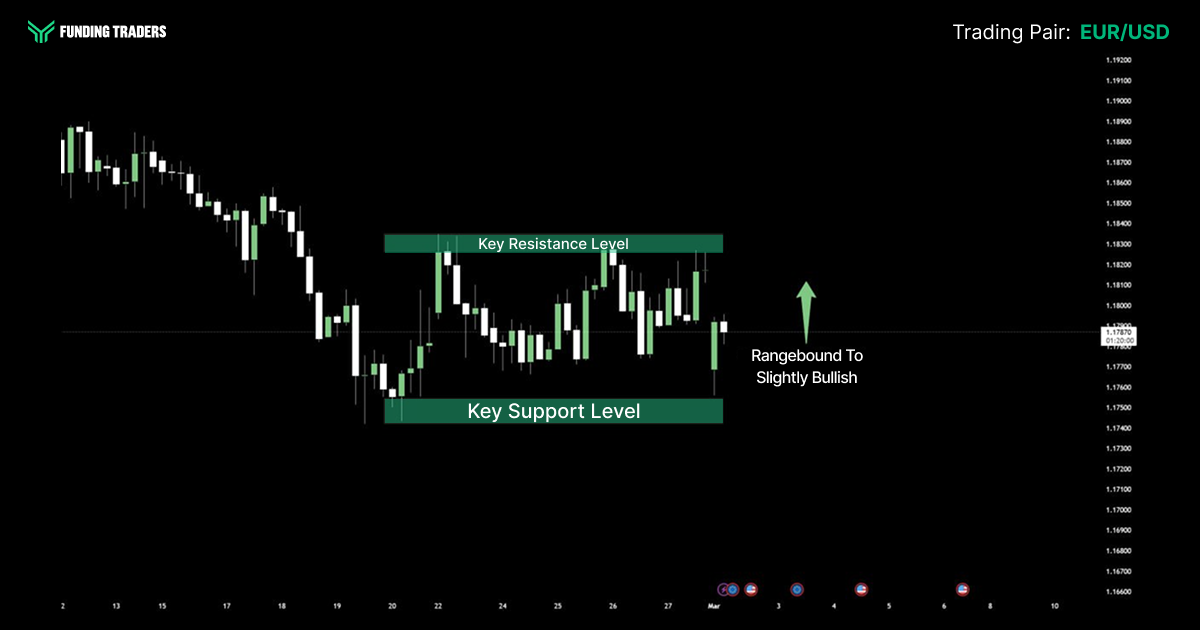
EUR/USD enters the week near 1.1700, having retreated from recent highs as a messy, two-sided dollar dynamic plays out. The US dollar may weaken initially due to risk-off flows, but higher oil prices could boost the dollar later as the United States is a net energy exporter. This creates an unusual push and pull where EUR/USD bulls cannot simply ride a straightforward dollar weakness theme, and traders need actionable intelligence rather than broad directional assumptions to navigate it.
The near-term range tightens to 1.1620 to 1.1800. A risk-off capitulation or a sustained oil rally that repositions the dollar as a petrocurrency would pressure EUR/USD toward the lower bound, while any signal of ceasefire negotiations or a contained conflict would likely see the pair recover toward 1.1800. The ECB’s rate hold posture remains intact but will be tested if energy prices entrench above $90 per barrel and reignite European inflation expectations. Friday’s US NFP remains formally on the calendar, but Iran headlines will dominate EUR/USD direction and volume throughout the week, revealing weaknesses in the euro’s near term bid and informing a clearer forecast for the weeks ahead.
GBP/USD: Sterling Caught in the Crossfire
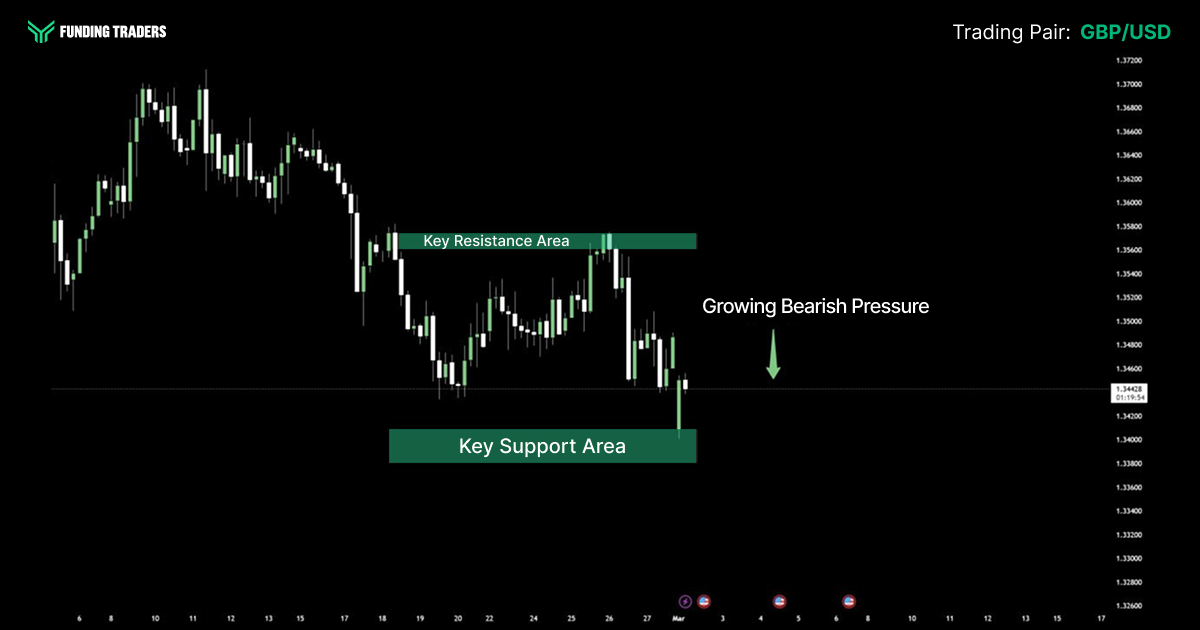
GBP/USD is trading near 1.3380, under pressure as the UK government confirmed it will support allied collective self-defense in the region despite not participating in the initial strikes. UK Prime Minister Starmer stated that “Iran is pursuing a scorched earth strategy” and confirmed the UK is supporting the collective self-defense of allies while allowing the US to use British bases. That political proximity to the conflict adds a sovereign risk premium to sterling that was absent in prior weeks, a timely example of how geopolitical decisions translate directly into currency market consequences.
Support sits at 1.3300 with resistance at 1.3450. Any escalation that directly implicates UK assets or bases in the region would accelerate selling pressure on GBP. Conversely, de escalation headlines or a strong UK Construction PMI print on Tuesday could help the pair stabilize. BoE easing expectations remain intact with a May cut still fully priced, limiting aggressive sterling recovery potential even in a risk-on scenario and highlighting how geopolitics can erode brand confidence in a currency faster than any central bank meeting, creating a complex competitive landscape for sterling bulls to navigate.
USD/JPY: Safe Haven Yen Threatens Carry Unwind
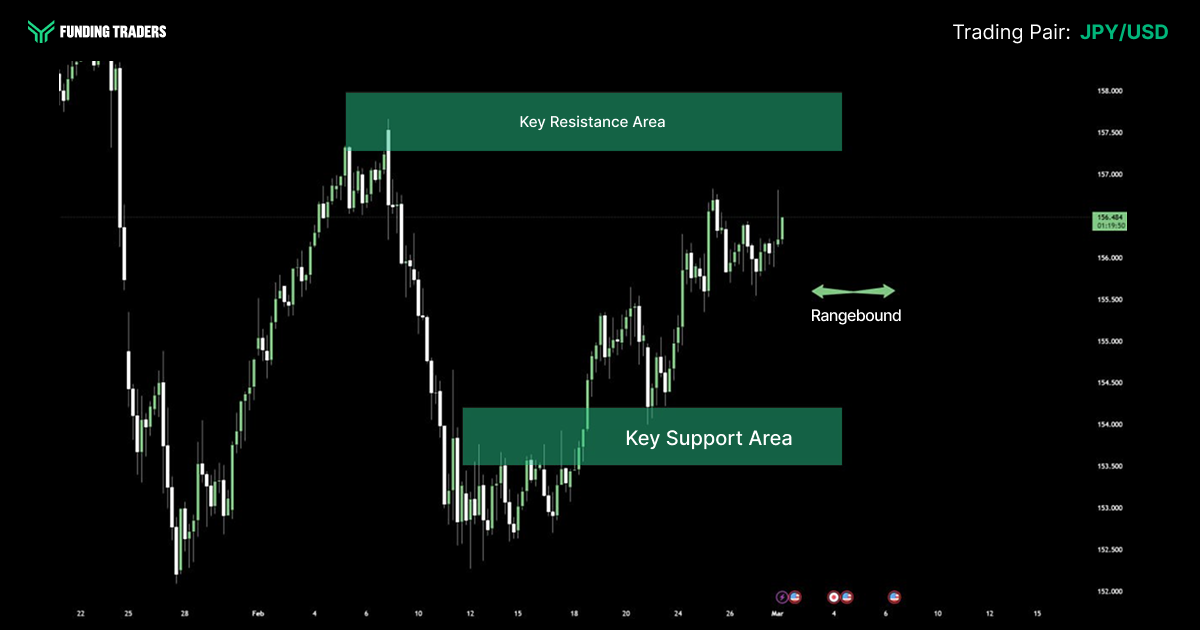
USD/JPY faces the most severe near-term risk of this week’s G10 watchlist. The pair has broken below 153.00 in early trading as the safe-haven yen bid surges on the scale of Middle East hostilities. Safe-haven currencies like the Swiss franc and Japanese yen are likely to receive high demand as institutional money evacuates risk assets and carry trades unwind rapidly. Investors who understand these dynamics and access timely research are far better positioned to manage the risks this environment delivers.
The critical technical level is 151.50. A sustained break below it would open a fast move toward 149.00 to 150.00 and would likely prompt Fed and BoJ communication. On the upside, a stabilization of the conflict or a stronger-than-expected NFP print could see the pair recover toward 154.50 to 155.00. Traders should note that intervention rhetoric from Tokyo will likely be dormant this week, as Japanese officials will not be fighting a yen strengthening trend driven by global war fear. Friday’s NFP adds an additional binary that will shape investor understanding of Asia-linked FX trends for the rest of March.
XAUUSD (Gold): The Ultimate Safe Haven Is Being Tested in Real Time
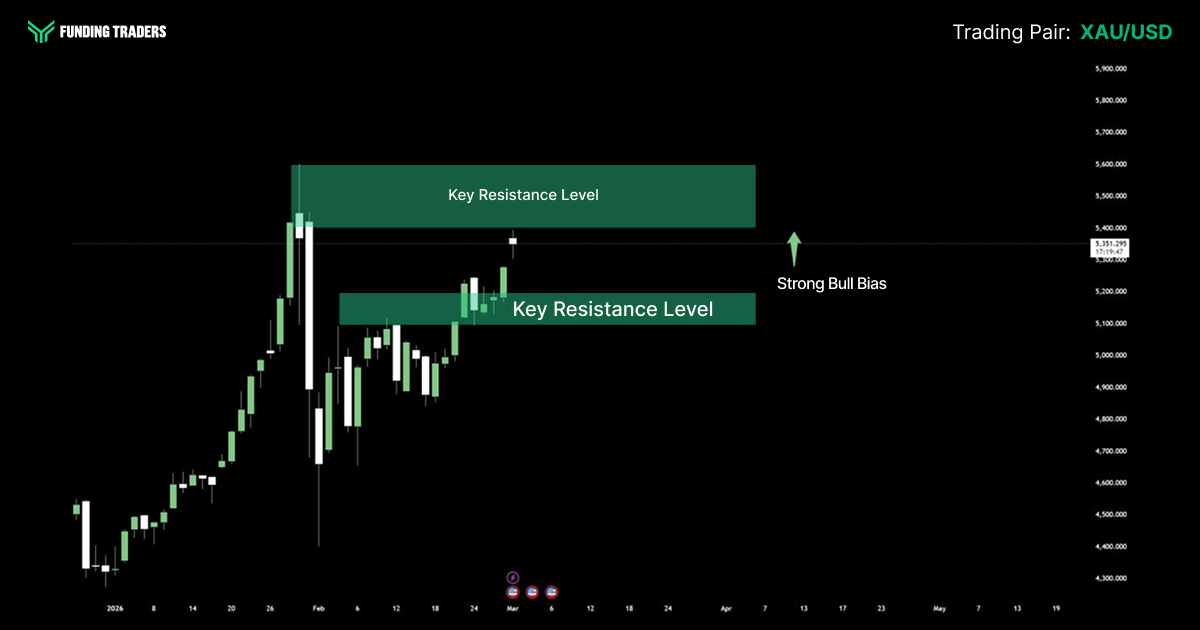
Gold is trading near all-time highs above $5,300 per ounce, having gapped sharply higher at Sunday’s electronic open as the full scope of the US-Israel-Iran conflict became clear. The spot price of gold surged past $5,278 per ounce amid escalating geopolitical tensions in the Middle East, with analysts noting that gold prices could hit new highs if the situation intensifies, potentially becoming the ultimate safe haven for global capital. This is the kind of moment that defines quarterly market updates and reframes the broader narrative for institutions, clients, and individual traders alike.
The structural case for gold has never been stronger in this cycle. Analysts note that precious metals will experience enhanced volatility with upward movement, with the extent of the move depending on the effect the conflict has on the energy market and whether regime change in Iran is within reach. Regime change is precisely the scenario that removes any near term ceiling on safe haven demand and makes bold predictions about a gold price peak essentially impossible.
Bitcoin has not acted as a safe haven during geopolitical tensions recently, implying that investors seek tangible hedges such as gold in times of conflict. This dynamic concentrates institutional safe haven buying into gold and Treasuries rather than spreading across alternatives, amplifying gold’s move and reflecting a quality over innovation mindset that emerges in the most uncertain moments.
Key levels: immediate support at $5,180 to $5,200, where buyers stepped in heavily at the pre-war close, with a soft upside target of $5,400 and an extreme scenario target of $5,600 or higher if the Strait of Hormuz is formally disrupted. The primary risk to gold this week is a ceasefire signal or credible diplomatic overture. Trump has indicated that Iran’s new temporary leadership council has signaled a desire to talk, which could trigger a violent $150 to $200 pullback as war risk premia unwind. For prop traders, XAUUSD remains the single highest conviction vehicle this week, though position sizing must account for intraday swings of $80 to $120 per ounce as headline risk is extreme.
Oil: The Strait of Hormuz Is the Number That Matters
No commentary on markets this week is complete without oil. Roughly 15 million barrels of crude oil per day, about 20% of the world’s oil, are shipped through the Strait of Hormuz, making it the world’s most critical oil chokepoint. Attacks on vessels traveling through the strait could restrict countries’ ability to export oil, likely resulting in higher prices for crude oil.
Perpetual swap futures tied to oil jumped nearly 5% to $71.70 per barrel in early electronic trading, while some major oil companies and top trading houses suspended crude oil and fuel shipments via the Strait of Hormuz. The binary for the economy is stark: if the strait remains open and navigable, oil spikes are likely to retrace as markets did in June 2025 after Israel struck Iranian nuclear sites. A 10 to 25% premium on oil is not outlandish even without a blockade, which is easily a 50% premium risk event.
Oil above $100 per barrel would reshape the entire macro narrative, reigniting inflation, pushing back Fed rate cut timelines, and creating a stagflationary backdrop that would be deeply negative for equities and risk FX but supportive of energy-linked currencies and gold. Organizations across energy-intensive industries should be analyzing their exposure now, as the window to implement hedges and risk controls is narrowing by the hour.
Key Economic Events: March 2–6 (GMT+1)
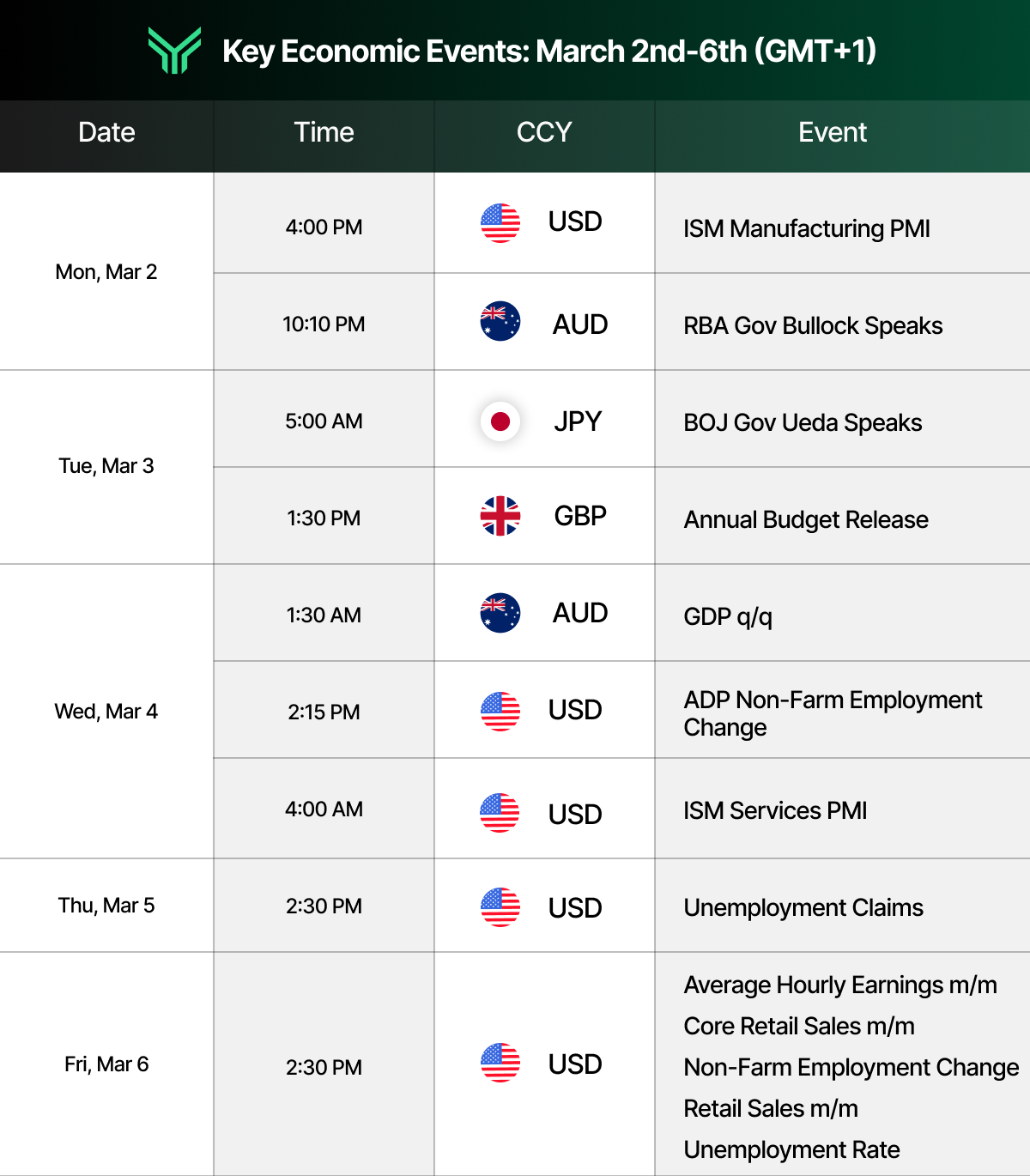
This condensed calendar is adapted from the Forex Factory economic calendar at forexfactory.com, a leading resource professional traders use to track market‑moving macro news and central bank events in real time.
What Each Release Means for FX: Actionable Insights
ISM Manufacturing PMI: In a normal week, this would be the Monday catalyst. This week, it functions as a temperature check on pre-war US economic resilience and delivers useful data on how businesses and consumers were positioned before the shock. A strong reading provides some support to the dollar’s safe haven appeal and limits EUR/USD upside. A weak number compounds recession fears alongside war risk, pressuring equities and risk FX further and deepening concern about the economy’s ability to absorb an energy price surge.
Congress War Powers Resolution: With Congress set to begin voting on a war powers resolution to halt Trump’s assault on Iran, lawmakers are grappling over whether to buck the president after Khamenei’s killing. Should the resolution pass, even symbolically, it would signal political fracture and inject fresh uncertainty into the dollar, creating headline-driven volatility across USD pairs and forcing traders to explore a new set of risk scenarios they had not previously priced.
ADP and JOLTS: Labor market data remains important for Fed rate cut pricing, but this week, its market-moving power is diluted by geopolitical noise. Soft prints keep rate cut hopes alive and limit dollar recovery. Strong prints would be largely absorbed rather than celebrated, though they do support the broader confidence that the US economy entered this conflict from a position of relative strength.
Australian Q4 GDP: A strong growth number validates RBA hawkishness and provides AUD some protection from risk-off pressure. A weak print removes the fundamental floor and opens AUD to a deeper corrective move, highlighting how a single data release can shift regional forecasts and reveal the underlying growth weaknesses that geopolitical stress tends to amplify, offering a timely example of how economic data and global events interact.
US Nonfarm Payrolls: Despite everything, NFP retains binary power. A significant beat above 200k would reassert dollar strength and could trigger a violent unwind of safe-haven gold and JPY positioning as rate cut predictions evaporate. A miss below 120k in the context of a war-driven oil spike would create a genuine stagflation scare, the worst possible macro outcome, accelerating flows into gold, CHF, and JPY while crushing equities and high beta FX across the board. This is the data release that will set the tone for the entire month and frame how investors approach risk in Q2.
Canadian Employment: Closely watched this week, given oil’s outsized move. Strong Canadian jobs data combined with elevated oil would see CAD meaningfully outperform, potentially pushing USD/CAD below 1.3600 for the first time since January and revealing where CAD’s structural energy advantage may re-emerge to drive growth in the Loonie’s value against the broader dollar.
G10 FX Watchlist Snapshot
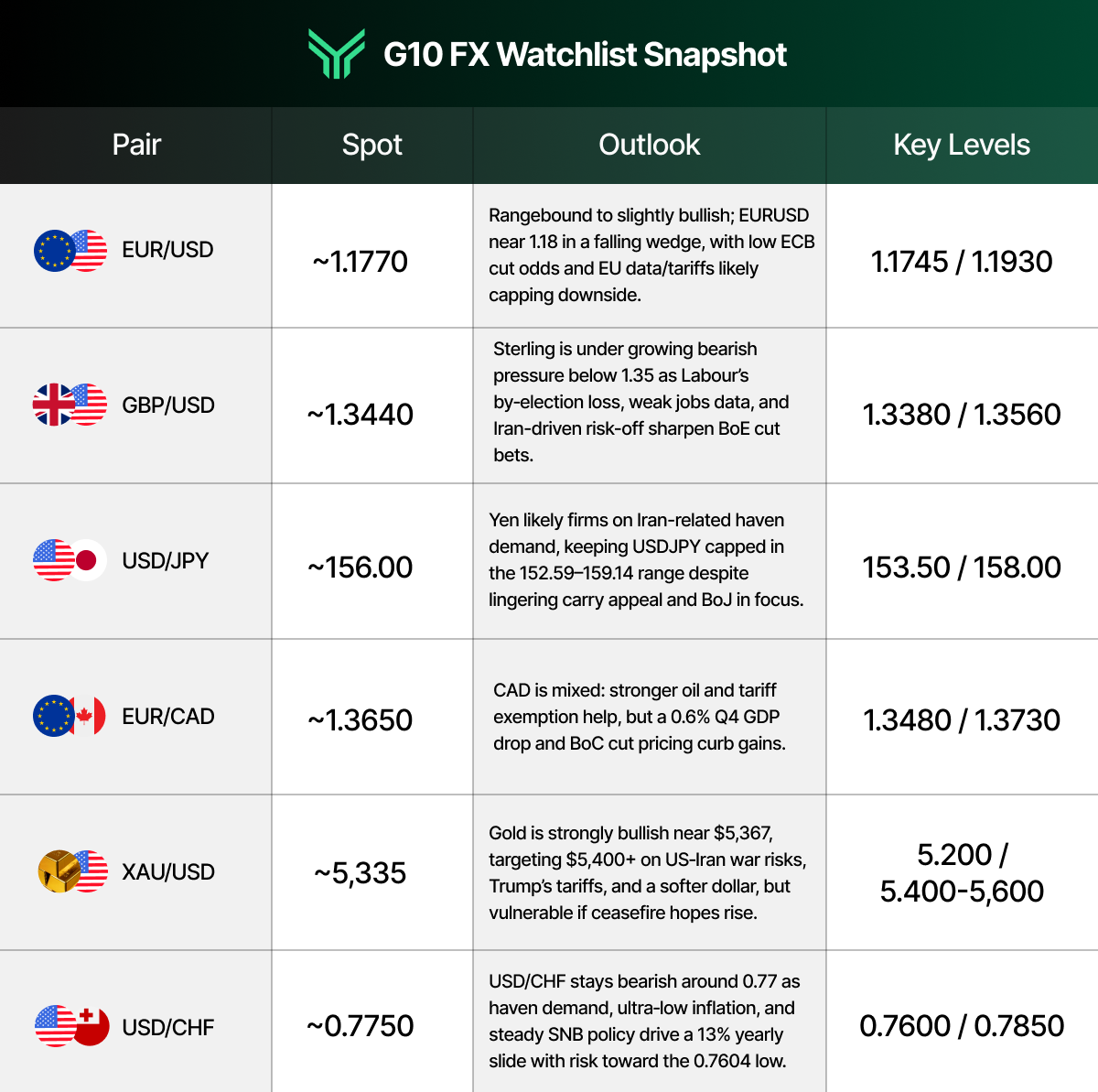
This concise table delivers market insights at a glance, helping traders quickly analyze key levels, understand current trends, and inform their own report‑driven strategies.
Insights for the Week to Drive Growth
This week demands a complete reset of how traders approach their setups. The baseline assumption of a range-bound dollar and orderly macro-driven price action is gone. Geopolitical risk has become the main driver of markets, increasing volatility across oil, currencies, equities, and safe-haven assets, with disruptions in the Strait of Hormuz supporting higher oil and precious metals prices while putting pressure on global equities. Leading analysts and research teams at institutions across the globe are still working to fully understand the scope of what has unfolded, and the honest answer is that the full economic impact has not yet been priced in.
To learn more about who we fund, our models, and how our prop firm operates, visit the FundingTraders.
The playbook has two phases. Phase one, which is already underway, is the reflexive risk-off move: buy gold, buy JPY, buy CHF, sell equities, sell high beta FX. If the conflict is short and contained, the risk-off move and oil spike could be brief. If it turns into a longer three-to-five-week regime change endeavor, markets would react rather badly as investors price in a wider conflict and longer oil disruption. Phase two will be dictated entirely by whether the Strait of Hormuz remains open, and that single variable will determine whether this week’s moves retrace or accelerate into something structurally larger that reshapes forecasts for the entire first half of the year.
Generative AI tools and modern data platforms are helping traders process the flood of information faster than ever before, but no algorithm replaces the process of sound judgment, risk discipline, and the ability to stay calm when the competitive landscape shifts overnight. For prop traders, the priority is not chasing directional conviction but managing exposure with precision. USD/JPY and XAUUSD offer the clearest directional setups with the best risk-reward profiles, but intraday swings of 150 or more pips in FX and $100 or more in gold are live risks on any single headline. Position sizing at half or less of normal, clearly defined stops, and the discipline to sit out the noise between catalysts are worth more than any technical analysis or innovative strategy this week.
If you need clarity on evaluation rules, risk limits, or payout procedures, you can review our Help Center for detailed, self‑service guides.
The traders who stay ahead, drive growth in their accounts, and successfully navigate this environment are not the ones with the boldest predictions. They are the ones who focus on quality over volume, implement their process with confidence, and treat each catalyst as one data point within a comprehensive view of a rapidly evolving world.
Turn your insights into income, apply the data, trade with confidence, and unlock your potential by opening your account with FundingTraders today.
Disclaimer: This content is for informational and educational purposes only and does not constitute financial, investment, or trading advice. Trading forex and other financial instruments involves significant risk and may not be suitable for all investors. Past performance is not indicative of future results. Always conduct your own research and consult with a licensed financial advisor before making any trading decisions. FundingTraders is a proprietary trading firm and is not a broker-dealer or registered investment advisor.