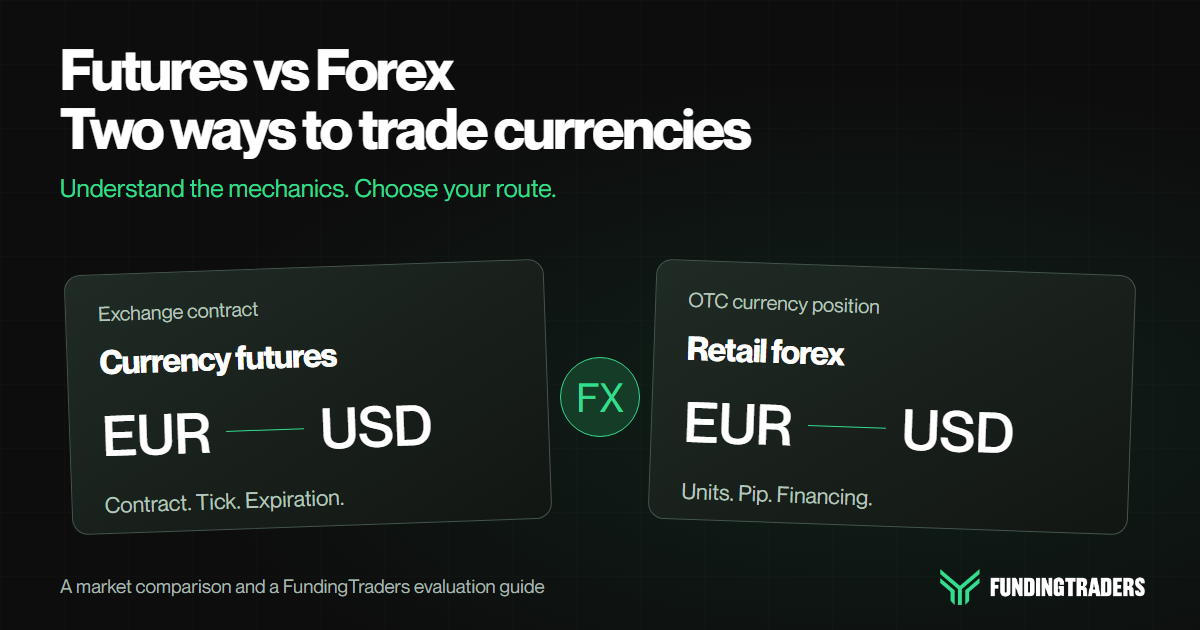
Futures vs forex is a choice about how a trade is structured: an exchange-listed contract or a retail currency position with an OTC provider. The categories overlap because currency futures also track exchange rates. Neither structure is the right answer for every trader.
This guide separates two decisions: which market mechanics suit your strategy, and which account model suits your next step. You will compare sizing, costs, holding periods and venue, then see how FundingTraders evaluations can fit a forex trading plan. Start with the instrument and its rules, not the advertised account balance.
What you are actually trading
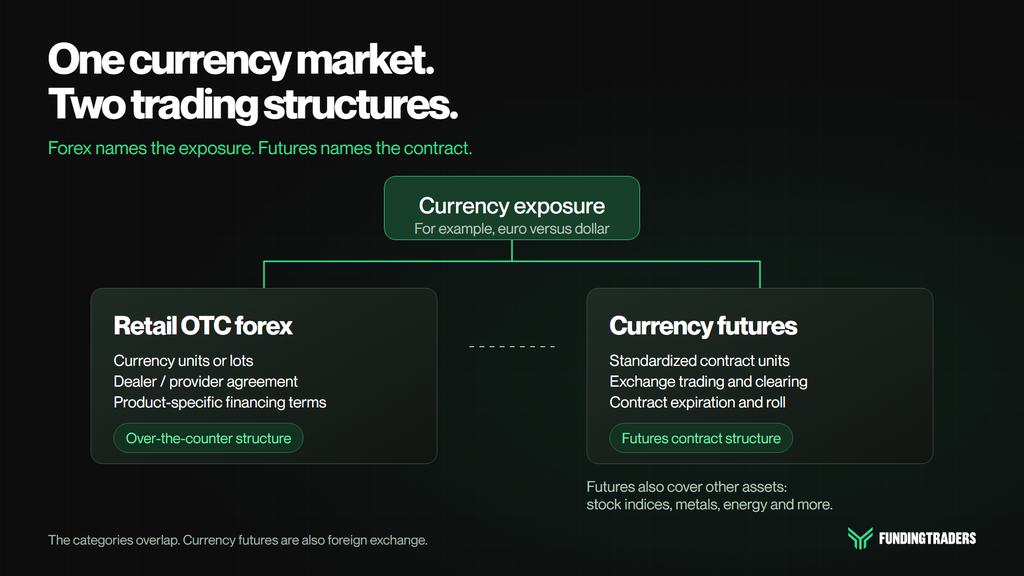
Forex trading concerns the relative value of currencies. Buying EUR/USD expresses a view on the euro against the dollar. Futures trading describes a contract format: standardized terms for an underlying asset, with a defined settlement arrangement. Futures markets include currencies, energy, metals and stock indices.
A futures contract trades on an exchange and is centrally cleared. Its specification tells you the contract size, permitted price increments and expiration terms. Currency futures are therefore part of the foreign exchange market as well as the futures market.
Retail over the counter forex involves a provider rather than an exchange-listed contract. Deliverable spot currency exchange differs from leveraged rolling positions that can remain open under the provider’s rollover and financing terms. A forex CFD settles price differences rather than delivering the currencies. Terminology depends on the product and jurisdiction: UK rules, for example, include rolling spot forex within their CFD product scope.
Read the provider agreement to identify what you are buying. A label such as “forex” does not establish the legal form of the account.
Futures vs forex: differences that change your trading plan
The practical futures vs forex comparison is exchange-traded futures versus retail OTC forex. Contract specifications and the provider agreement supply the details behind this framework.
| Decision | Exchange-traded futures | Retail OTC forex |
|---|---|---|
| Venue and clearing | Listed contracts trade on an exchange with central clearing. | A dealer/provider relationship; no single exchange order book for the whole forex market. |
| Position size | Whole contracts, each with a specified unit and tick value; micro contracts exist for selected products. | Currency units or lots, with minimums and size increments set by the provider. |
| Keeping a position open | Contracts expire; closing, rolling or settlement requires a plan. | Rolling positions can incur overnight financing; check product terms. |
| Trading hours | The contract calendar sets sessions, breaks and holiday changes. | Provider schedules set availability and holiday interruptions. |
| Cost categories | Bid-ask spread, broker commissions, exchange/clearing charges and potentially data costs. | Bid-ask spread, possible commission and financing for qualifying overnight positions. |
| Margin and leverage | Initial and maintenance requirements apply; broker requirements can differ. | Provider and jurisdiction determine margin rules and available leverage. |
| Protections | Depend on the exchange, broker, clearing arrangement and jurisdiction. | Depend on the provider’s legal entity, product and jurisdiction. |
The CFTC’s U.S. retail OTC forex advisory explains that customers trade against their dealer and should check its registration and disciplinary history. That is U.S. guidance, not a worldwide licensing rule.
For futures, margin is a performance bond, not the purchase price or a maximum-loss promise. Leverage makes a given price movement larger relative to the cash committed. Compare exposure and loss tolerance, not just the amount needed to open the position.
Initial margin supports opening the position; maintenance margin sets a threshold for keeping it. Futures positions are marked to market, and additional funds may be required after losses. Your broker can require more than the exchange minimum. Central clearing changes how obligations are managed, but it does not remove trading losses or every counterparty risk.
Position sizing, costs and holding a trade
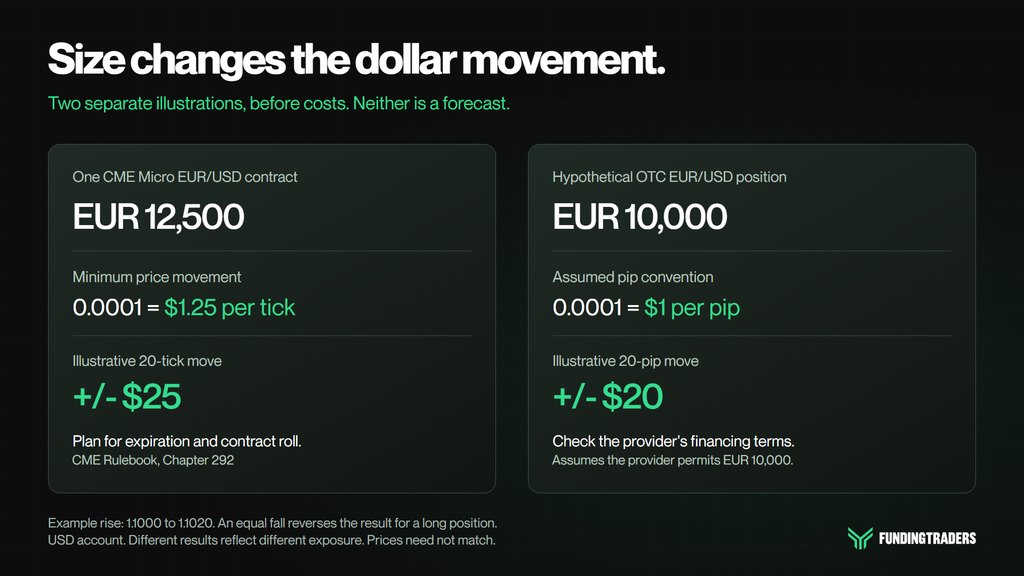
Use contract specifications to convert price movements into dollars before comparing account sizes. These are hypothetical illustrations, not forecasts; both calculations exclude costs and assume a U.S. dollar account.
Futures: one Micro EUR/USD contract
CME’s Micro EUR/USD rules specify EUR 12,500 per contract. A 0.0001 price increment is worth $1.25. A hypothetical move from 1.1000 to 1.1020 is 20 ticks: 20 x $1.25 = $25. A long position gains $25 on that rise or loses $25 on an equal decline, before costs. The contract’s exposure at 1.1000 is $13,750; that is distinct from the margin requirement.
OTC forex: a hypothetical EUR 10,000 position
Assume a provider permits EUR 10,000 of EUR/USD exposure and quotes a pip as 0.0001. Each pip then changes position value by $1. The same hypothetical 20-pip movement produces a $20 gain or loss, depending on direction. The example defines an exposure; it does not claim every provider offers the same lot increments.
Both markets have bid-ask spreads, and applicable commissions and other fees affect the net result. The different dollar outcomes reflect different exposures, not a more profitable market. The example also does not assume spot and futures prices must match.
Holding periods introduce another distinction. Rolling a futures position means closing one contract month and opening another, with transaction costs and a potentially different price. OTC financing and transaction costs depend on the provider and position. Compare the full cost over your intended holding period.
For a futures vs forex cost comparison, a missing overnight debit is not proof that holding costs disappear. CME explains that futures carry is reflected in price. That differs from explicit financing adjustments on a rolling position. Use the actual product, direction and holding period when you compare alternatives.
Which market structure fits your approach?
Start with five questions, using the actual instrument you intend to trade:
- What exposure do you need? A currency view can be expressed through either structure. A particular exchange-listed commodity contract requires access to that contract.
- Can you size the trade sensibly? Compare the contract or unit increment with your planned stop distance. A smaller minimum position can help with sizing, but it does not make leverage harmless.
- When can you monitor it? Check the published session and your local time, including holidays. A market being open does not promise the same execution quality throughout the day.
- How long will you hold it? A day trading approach and a multi-session strategy face different financing, rollover and contract-expiration decisions.
- What venue information matters to you? Decide whether an exchange’s contract-specific order book is central to your process, then compare it with the pricing and execution information your OTC provider supplies.
Apply the same questions when comparing futures trading vs forex trading. Choose the mechanics you understand and can accommodate. Selecting a market is separate from selecting a broker, dealer or prop-firm evaluation.
Where FundingTraders fits your forex plan
If your next step is a forex-oriented evaluation, FundingTraders gives you several defined Pro routes to consider. Our forex prop trading programs let you choose an evaluation structure and measure your trading against published objectives. The useful question is which rule set complements the way you already plan, size and review trades.
The evaluation fee purchases participation in the program; it is not a brokerage margin deposit. This distinction keeps the market comparison useful without treating an evaluation balance as cash you deposit with a broker.
For this guide, the choice centers on 2-Step Pro PRO6, 2-Step Pro PRO10 and 1-Step Pro. Each gives you a different combination of targets and loss limits to assess. Choosing deliberately means comparing those conditions with your trading record, rather than assuming the largest displayed account or the fewest phases will suit you best.
Turn that choice into a short written plan: name the instruments, define the session, and calculate the room your usual position needs. A FundingTraders evaluation then becomes a specific set of objectives to work with. This is the practical benefit of selecting a program around your process instead of rebuilding your process around an unfamiliar rule set.
Choose a FundingTraders evaluation around your trading plan
FundingTraders’ 2-Step Pro rules offer two ways to structure a two-phase evaluation. PRO6 uses a 6% target in each phase, a 3% daily loss limit and a 6% static maximum loss. PRO10 uses targets of 10% and then 5%, with a 5% daily limit and a 10% static maximum loss.
The practical appeal of a static maximum loss is a fixed reference point: that floor does not rise with profitable trading. You still need to respect the daily limit. PRO10 provides a larger percentage loss allowance than PRO6, alongside a higher first-phase target; those features belong together when you evaluate fit.
| Evaluation | Phase targets | Daily loss limit | Maximum loss | Consistency score |
|---|---|---|---|---|
| 2-Step Pro PRO6 | 6%, then 6% | 3% | 6%, static | None |
| 2-Step Pro PRO10 | 10%, then 5% | 5% | 10%, static | None |
| 1-Step Pro | 10% | 3% | 10%, trailing | 50%, for payout eligibility |
The 1-Step Pro rules give you one evaluation stage. Its maximum-loss floor follows the highest recorded balance, so it needs a different approach from a static floor. Its largest profitable day must also remain within 50% of total profits for payout eligibility. Exceeding that score requires further trading to qualify; the score itself is not an immediate account failure.
PRO6 and PRO10 have no consistency-score requirement, as set out in the product consistency conditions. That removes this particular payout calculation while leaving the other rules in place. Targets use balance with positions closed. Daily-loss reference points and minimum trading-day requirements remain product-specific; consult the linked rules alongside these headline figures.
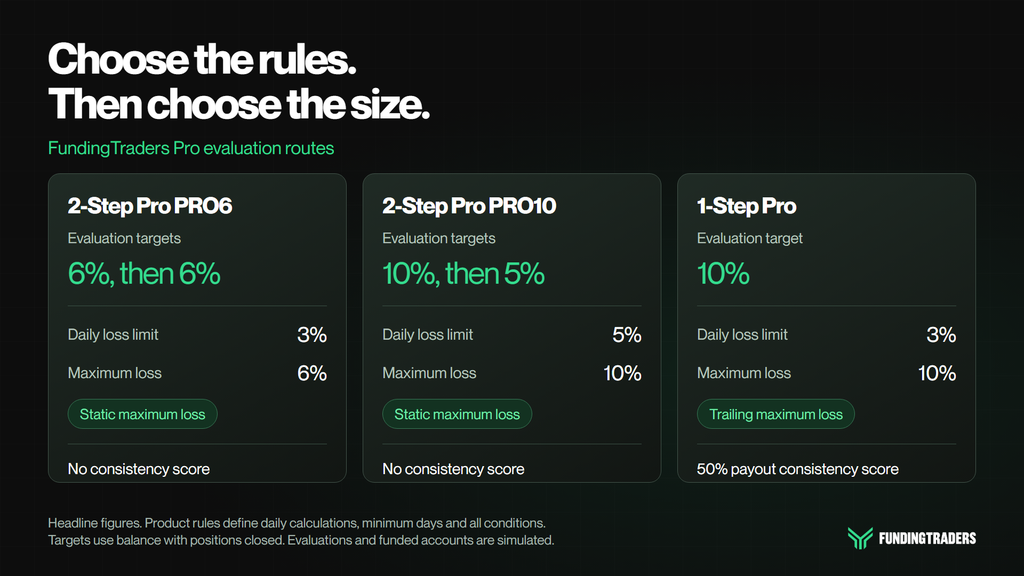
Start with the loss-limit behavior you can manage, then consider how many evaluation stages you prefer.

Put your forex decision into practice
FundingTraders offers MT5 and TradeLocker selections at checkout. That lets you consider your preferred trading workflow alongside your evaluation route. Confirm the available product, platform and symbols for your own eligibility before purchasing; a platform choice does not establish that every instrument is available in every location.
Our published instrument categories include FX, crypto, indices, metals and oils. For a forex strategy, begin with your planned currency pairs and inspect their contract size, spreads and other specifications. Avoid transferring a lot size from another account without checking what it represents here.
Holding flexibility can also matter. FundingTraders’ General Trading Guidelines permit Pro accounts to hold positions overnight and over weekends. That can accommodate a plan extending beyond one session, with swap charges, widened spreads and slippage still relevant. News and other trading rules continue to apply.
Once your product fits, translate its percentage limits into the dollar amounts for your chosen size. Our guide to choosing a prop firm account size explains that next decision. Write down the intended position, stop distance and loss allowance before you place the trade.
Know the path to funded-stage eligibility
Published requirements let you prepare for the next stage while working through your evaluation. FundingTraders requires KYC verification before funded-account access. Prepare your identity and address documents, and keep profile details consistent with them. Reaching a target still requires the relevant review and approval.
For funded Pro accounts, the standard trader profit split is 80% on 2-Step Pro and 90% on 1-Step Pro, with upgrades available. The linked Risk Management Group rules can replace standard splits and apply payout deductions. Read those conditions together with the product split, rather than treating the headline percentage as unconditional.
FundingTraders’ Clarity Desk gives funded-account holders a place to review account status, flagged trades, product requirements and payout information. It helps you see what needs attention without a separate FirmGuard login. It is available at the funded stage and does not remove eligibility requirements.
That visibility gives you a useful review routine: check the account’s status, inspect any flagged activity and identify outstanding product conditions before making a request. A flag is not automatically a strike; review determines the outcome. Use the information to understand the account’s position, without treating a displayed amount as a promised payment.
The payout request process uses the dashboard, account selection and two-factor authentication. Close all positions and limit orders first, then check the applicable product gates and payment-method minimums. Submission starts a request; approval and settlement remain separate steps.
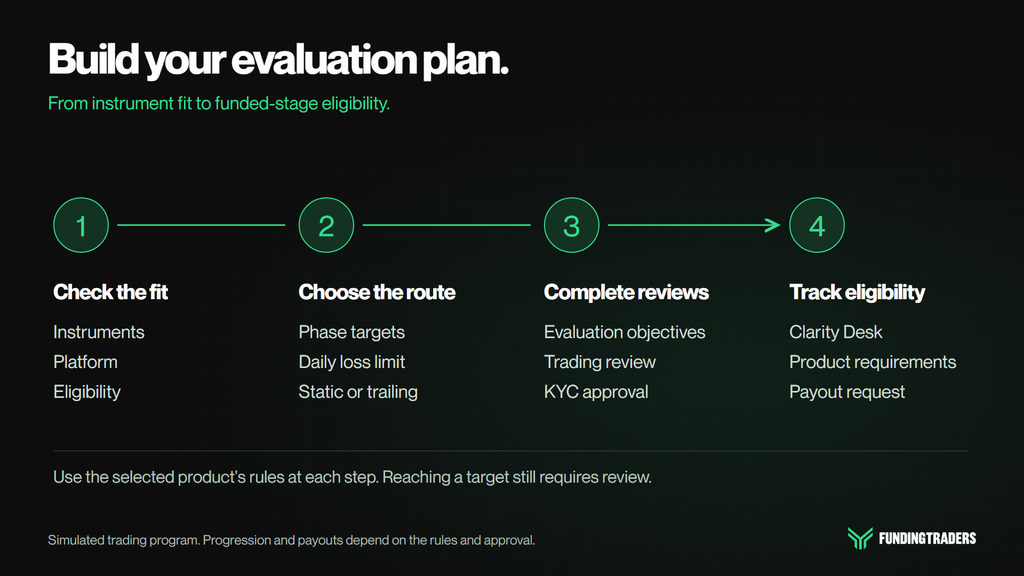
Build those checks into your routine before a payout request, rather than discovering an unmet condition afterward.

How we compared
We compared trading structures using exchange specifications, regulator guidance and provider documentation. Examples illustrate exposure and price movement, not expected returns. FundingTraders publishes this article and promotes its own programs; its product discussion uses first-party help pages, terms and checkout information, with material conditions beside the benefits.
FAQs
Are currency futures also forex?
Yes. Currency futures provide foreign exchange exposure through standardized futures contracts. “Forex” identifies the currency market; “futures” identifies the contract format. A euro currency future and a retail EUR/USD position can both respond to exchange-rate changes, but their contract units, settlement, pricing and account arrangements differ. That overlap is essential to an accurate currency futures vs spot forex comparison.
Is futures or forex automatically cheaper or easier?
Neither. A futures vs forex comparison should use the same exposure and holding period, including spreads, applicable commissions, fees and financing or roll costs. Then consider the minimum trade size, margin and mechanics you need to manage. A low advertised opening cost does not establish the lowest total cost or the least demanding trading experience.
What type of trading account does FundingTraders provide?
FundingTraders provides trading programs with evaluation and funded stages governed by its published terms. An evaluation fee is separate from a broker margin deposit. For the Pro routes covered here, compare targets, loss limits, platform availability and funded-stage conditions before choosing. The account name and displayed size are starting points; the selected rules define the program you join.
How do I choose between FundingTraders evaluation routes?
Start with your trading plan. Compare the static maximum-loss structure of PRO6 and PRO10 with the trailing maximum loss on 1-Step Pro. Then consider the phase targets, daily limit and consistency condition shown above. A single evaluation stage may suit your preference, but it does not promise faster or more likely completion. Check instrument availability and the selected checkout terms before paying.
Conclusion
The futures vs forex decision begins with exposure, sizing, venue, costs and holding period. Once you understand those mechanics, choose the account model that supports your approach.
For a forex-oriented evaluation, FundingTraders offers distinct Pro routes with published objectives and a defined review process. Bring your instrument list, holding period and risk limits to that choice.
Ready to apply your forex plan? Find your FundingTraders evaluation and check the selected terms before you begin. HALLOWEEN gives you 50% off plus a free matching account instantly, with all add-ons included.

Disclaimer: Trading involves significant risk and is not suitable for every investor. Past performance is not indicative of future results. The information provided in this article is for educational and informational purposes only and should not be considered financial, investment, or trading advice. All account rules, payout structures, profit splits, and promotional offers described in this article are subject to change at the discretion of FundingTraders. Promo codes may expire or be modified without prior notice. Always trade responsibly and only risk what you can afford to lose.