What’s New With FundingTraders this July comes down to a question most prop trading outfits never think to ask: what should a payout actually do once it lands? The industry’s default answer has always been “leave.” Money clears, the trader posts a screenshot, the cycle resets. On 28 July the firm broke that pattern. A funded trader can now put a payout straight into their next challenge at 55% off, or convert it into FT Points and redeem whenever they want. Eight days earlier, four countries quietly came off the restricted list. A day later, an entire affiliate commission stream got pointed at a children’s hospital. Three announcements, one thread worth pulling.
A Payout With Somewhere To Go
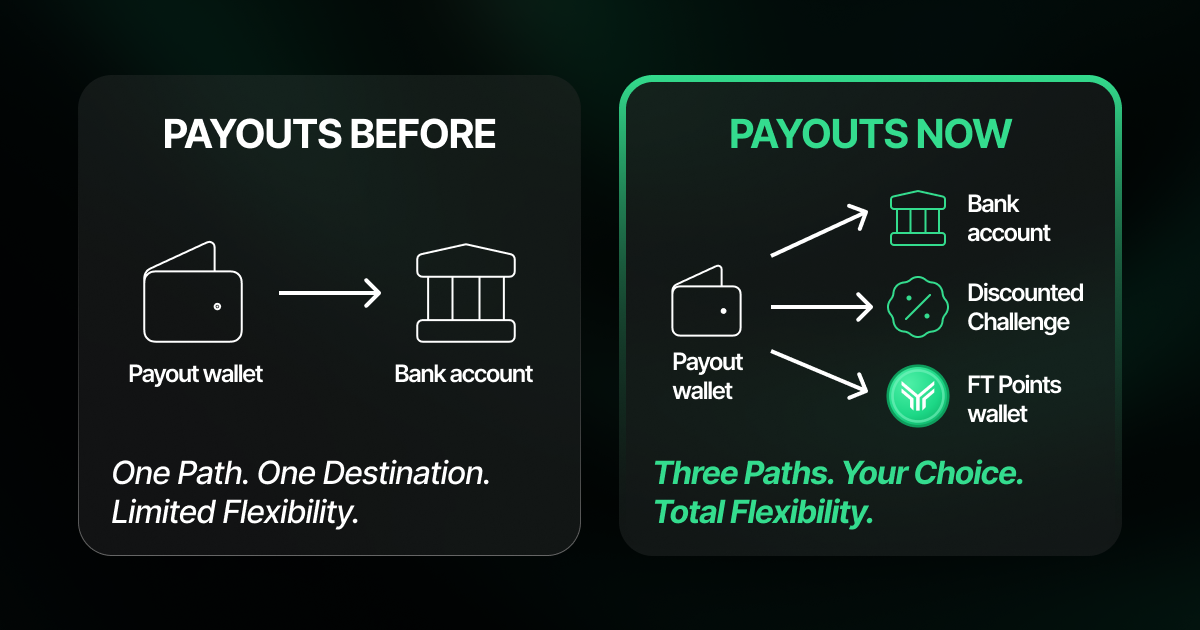
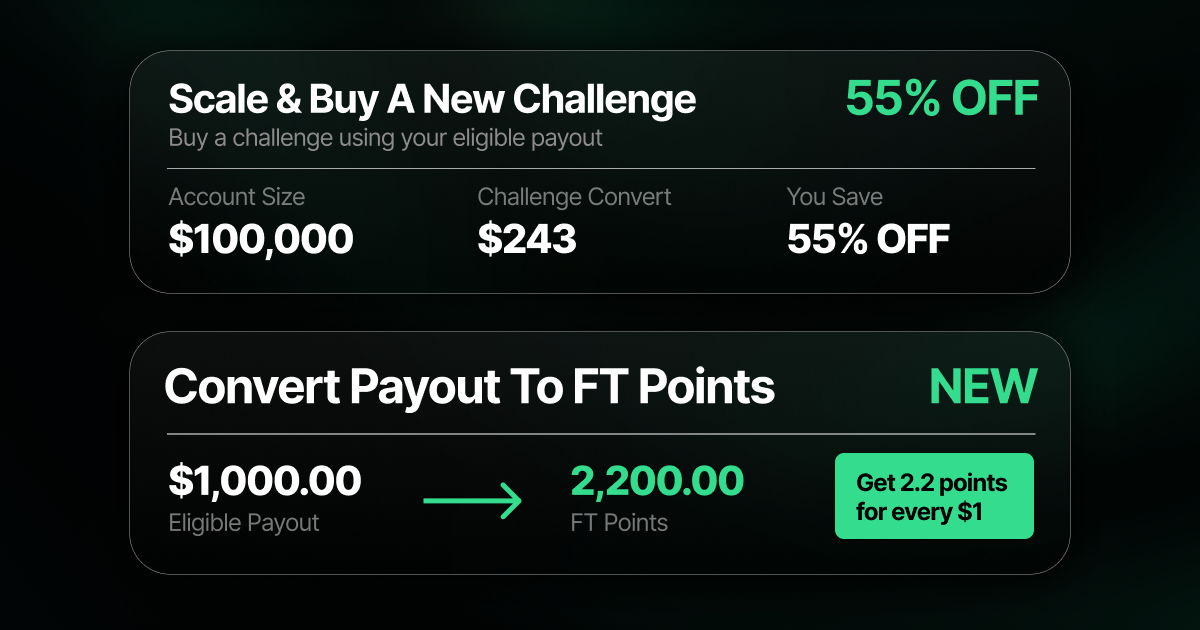
The mechanic explains in a sentence, which is usually a good sign. Fresh off a payout, a trader opens the payout request page and finds two new buttons. Challenge Convert applies the payout straight to a new challenge at 55% off. The second turns the same balance into FT Points, bankable and redeemable later.
What makes this interesting isn’t the discount. Discounts are the cheapest thing a prop firm can manufacture. It’s where the decision now sits, the exact moment a trader holds cash and chooses whether to bank it or redeploy it. Traditional prop firms treat that as a cost center; every approved payout is money out the door. Putting a scaling option at the highest-intent second in the whole relationship is product design that reads as commercial as it does generous.
The Math Serious Traders Should Run First
Work backwards from the numbers. If $270 is 55% off, the undiscounted figure sits near $599 for a $100,000 challenge. That’s arithmetic, not a company statement, and it’s worth running before treating the offer as free money.
FT Points are where the timing question lives. Challenge Convert is the immediate move; points are the patient one. Most prop firm discounts are time-boxed by design, which forces the decision on the firm’s calendar rather than the trader’s. Points invert that. Someone running a considered plan around total profits and their own appetite for risk can make the account-size call when it suits their equity curve. Serious traders prefer the version where they control the timing.
If the conversion math works for you, the entry math should too. Code MINI takes 50% off any account size and carries a 100% profit split, the same split you’d be compounding into on the way back around. Start your evaluation
Four Countries, One Line of Text, and What It Says About the Prop Firm
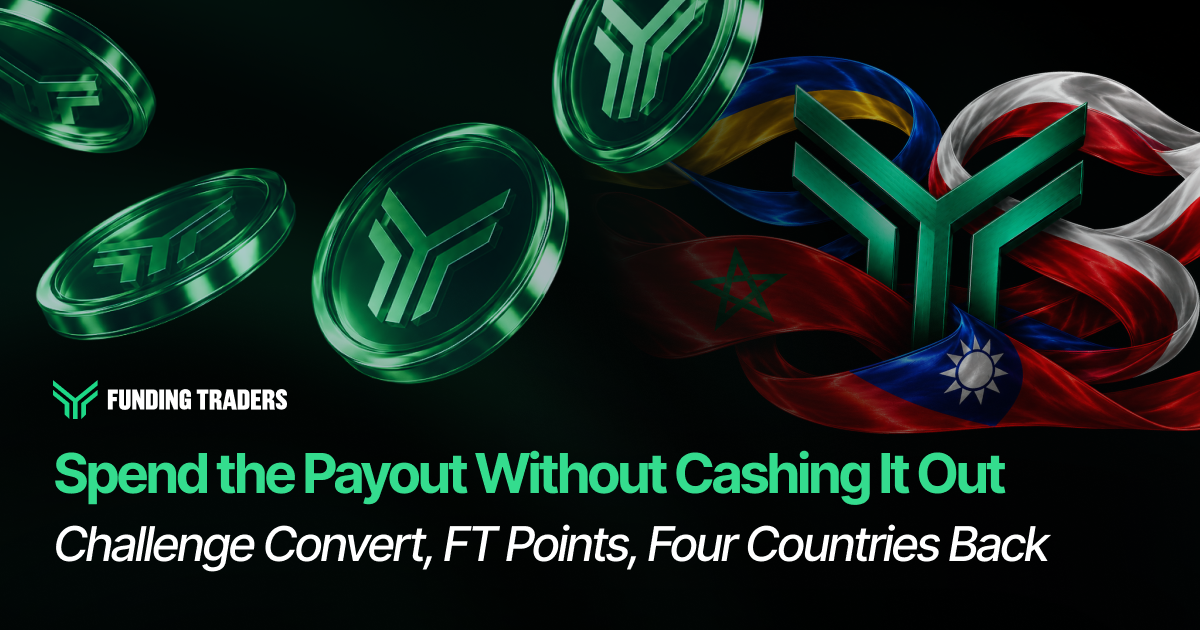
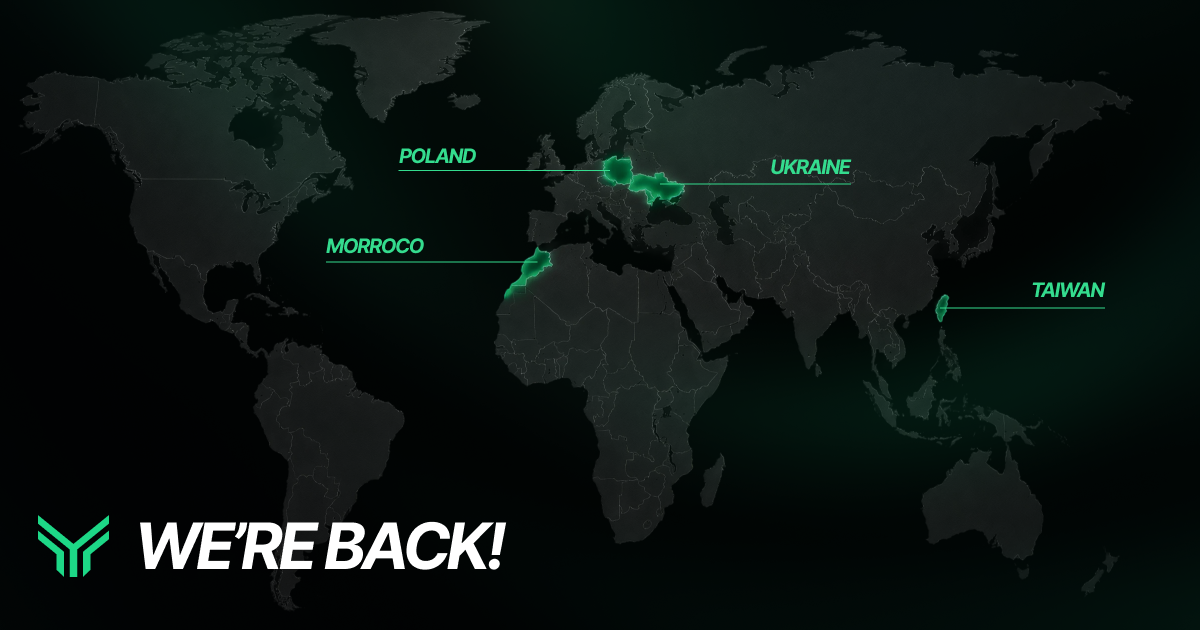
On 20 July, FundingTraders announced it was back in Poland, Ukraine, Morocco, and Taiwan. Traders in all four can create a new account, take challenges, and get funded without restrictions.
The post ran four lines. No explanation of why the restrictions existed, none of what changed, normal for the industry and slightly frustrating all the same. Country restrictions usually trace to payment processing, sanctions screening, elevated fraud rates, or a broker relationship that couldn’t service a jurisdiction.
The direction is the story. This is the second consecutive month the firm has subtracted from its restricted list rather than added to it, and the four names span genuinely different regulatory environments, Poland inside the EU framework, Ukraine with a stubbornly resilient retail base, Morocco among North Africa’s faster-growing markets, Taiwan mature and well-capitalized. Reopening all four at once suggests an operations fix rather than four separate negotiations. Traders in those markets get every account size and the same trading conditions as everyone else.
55% Off, 100% Donated
On 29 July the firm launched a charity campaign alongside the trader known as I_Am_The_ICT. Code ICT delivers 55% off all account types and sizes with unlimited uses, and 100% of affiliate commissions generated go to St. Jude Children’s Research Hospital.
Prop firm marketing rarely earns much goodwill, so precision matters. The commission, the affiliate’s cut, is what’s donated, not the firm’s revenue, and the post states that plainly rather than blurring it. Unlimited uses with no stated expiry also means the discount isn’t engineered as artificial scarcity. Whether a discount code is the right vehicle for charitable giving is a fair debate. What isn’t is that the structure is legible: a trader sees exactly which pot of money moves and where.

Real Capital, and Three Separate Rulebooks
Here’s what gets glossed over in most coverage of any prop firm, this one included. A trader operates a simulated account fed by real time data, and what’s real is the firm’s capital behind the payouts. But FundingTraders doesn’t run one rulebook against that capital. It runs three: 1-Step Pro, 2-Step Pro, and Instant Funding.
The gap isn’t cosmetic. On 1-Step Pro the profit target is 10% of the starting account balance, measured on balance rather than equity, all positions closed. On 2-Step Pro it splits by variant, PRO6 asks 6% each phase, PRO10 asks 10% then 5%. Instant Funding skips the challenge phase entirely and puts the trader on the firm’s capital from day one, which is exactly why its rules run tightest. Experienced traders comparing FundingTraders to another firm on a single headline number are comparing the wrong thing.
The Maximum Risk Limit, the Daily Loss Limit, and the Fine Print Behind Them
Full transparency about the upside requires the same about the downside, and this is where the three diverge hardest.
The daily loss limit is 3% on 1-Step Pro and Instant Funding, and 3% or 5% on 2-Step Pro depending on variant. The reference point differs though. 1-Step Pro measures against the starting day’s equity. 2-Step Pro measures against the starting day’s balance. Instant Funding’s daily drawdown rule measures against whichever of the two is higher, enforced in real time and inclusive of floating losses on open positions. Three account types, three answers to the same question, and a trader who assumes the number carries over finds out the hard way.
Maximum loss limits split the same way. On 1-Step Pro it’s 10% against the highest recorded account balance, it trails upward as the balance grows, so profits never fully bank as cushion. On 2-Step Pro it’s 6% or 10% of the challenge account size, fixed, explicitly not trailing when a trader is in profit. On Instant Funding it’s 6%, trailing until 3% profit is made, then locking to the initial account size. Trailing versus fixed is worth more to a working trader than most of the marketing any firm publishes.
Then the rule that catches people. There is a maximum risk limit per position and it is not optional. On Pro accounts, max risk per trade idea is 2% of the initial account balance, both phases on 1-Step Pro, funded phase only on 2-Step Pro. A trade idea means positions in the same symbol and direction held simultaneously, or reopened there within two minutes; different symbols or opposite directions count separately. On a $50,000 account that’s $1,000 of combined floating or closed loss for a single trade idea, however many entries build it. Instant Funding is stricter: floating PnL across all active trades must not drop to -1% of initial account balance relative to current balance.
These risk parameters aren’t buried, but the risk limits differ enough between account types that reading the right page matters. Breaching a hard breach rule means account termination immediately, with no recovery action, an account breach at that level isn’t appealable. Risk management isn’t a compliance box here. It’s the difference between a good month and a rule violation.
Profit Split, Payout Schedule, and What Reaches the Funded Trader
The profit split headline is 100%, and the fine print is that 100% is an add-on. Default is 90% to the trader on 1-Step Pro and Instant Funding, 80% on 2-Step Pro, with checkout add-ons taking either to 100%. A real offer, but a purchase rather than a baseline.
Payout schedule splits by account type again. Pro accounts run 21 days by default, with a 14-Day Payout add-on pulling the first payout, and every one after, forward to 14 days from the first trade on a funded account. Instant Funding moved to 7 days on 29 June, down from 14, and picked up an on demand payout add-on for requesting on the trader’s own timing rather than waiting on a cycle. Rise handles bank transfers at a $200 minimum, crypto through Coinbase Commerce at $50, both clearing in 24 to 48 hours excluding weekends.
Two mechanics deserve more attention. First, the consistency score: a trader’s largest single profit day must stay at or under 50% of total profits on 1-Step Pro, and 15% on Instant Funding. Fifteen is aggressive, one outsized session can stall a payout until further trading dilutes it. Second, the Instant Funding safety cushion: the first 3% of profit is a mandatory buffer, calculated based on initial account size rather than accumulated gains, and requesting a payout that includes it triggers account termination. Not a footnote. A trapdoor, published plainly, which is more than most prop firms manage.
There’s also a refund bonus: the evaluation fee returns on a qualifying payout, first payout for accounts bought before 8 May 2026, second payout on or after, for every account type except Instant Funding. Pro accounts reset to initial balance while a payout processes so a trader can continue trading uninterrupted; Instant Funding resets to initial balance plus remaining cushion. Anything ambiguous is a support team question rather than a guess.
Payouts every 7 days on Instant Funding, 100% profit split with the add-on, and a refund bonus waiting on a qualifying payout. Code MINI takes 50% off any account size, or going straight to $100,000 and above, EXTRA adds a 200% refund and a free account. Take the challenge
Phase 1, the Challenge Phase, and the Trading Styles the Rules Allow
Minimum trading days are the quiet constraint, functioning as a floor rather than a time limit. Phase 1 on 1-Step Pro requires two trading days plus two more funded. 2-Step Pro asks four in each challenge phase, eight across both, plus two funded. A trading day counts only when at least one trade is placed, and must show genuine activity.
Instant Funding replaces that with something sharper: within every rolling 30-day period, at least five profitable days each clearing 0.25% of the starting balance. Miss it and the account terminates. A companion rule requires that a trader’s biggest single loss never exceed their biggest single win. None of it rewards a lucky session, which is the point, different trading styles survive these rules unevenly, and swing trading in particular depends on which account a trader holds.
News Trading Rules, Weekend Holding, and the June Add-Ons
The news trading rules are the widest gap in the lineup. On Pro accounts, news trading is fully permitted during the challenge phase with no restrictions on profit percentage, timing, or penalties. In the funded phase it stays allowed, capped at 30% of total profits from trades influenced by high impact news events, exceed it and payout processing pauses until further trading brings the ratio down. A trade counts as a news trade if opened, held, or closed inside a ten-minute window straddling the release, five minutes either side of red folder news. Pro accounts also get a swing-trader carve-out: positions opened five or more hours before a release don’t count at all.
On Instant Funding, funded-phase news trading is prohibited outright, and holding open trades through news events causes termination. The 15% News Holding add on, launched 29 June, is the single exception, it permits holding through news events, though the five-minute open and close restriction around high impact news still applies to all Instant Funded accounts, with or without it.
Weekend holding arrived the same day, Instant Funding only. The old requirement to flatten an hour before Friday’s close is gone across all instruments including crypto, no forced exit, no automatic failure. The firm flagged gap risk, widened spreads at the Asian open, and ongoing swap costs in the same breath, which is the right way to ship a permission like that. Commissions follow the split: $3 per lot roundtrip on Pro, $6 on Instant Funding, indices excluded, with a Zero Fees add-on removing commission and enabling swap-free trading. The firm says the structure covers operational costs. Evaluations carry none, commission starts in the funded phase.
The Loop FundingTraders Just Closed
What’s New With FundingTraders in July isn’t one big launch. It’s three moves that each reduce a different friction, between a payout and its next use, between a trader and a passport, between marketing spend and something worth doing with it.
The payout conversion is the one that will still matter in six months. Every prop firm competes on entry, cheaper challenges, bigger accounts, faster funding. Very few compete on what happens after money leaves. Putting the scaling decision on the payout request page turned the end of one cycle into the beginning of the next.
None of which substitutes for homework, and three rulebooks are exactly why. Check which account type a rule attaches to before assuming it attaches to yours. Read the drawdown reference point, not the headline percentage. Successful traders here are the ones who read all the rules for their specific account, not the summary. Watch what traders do with FT Points next, redemption patterns over the next two quarters will say more about the next twelve months than any discount code.
Three account types, three rulebooks, one decision. Read the one that fits your style, then trade it. Code MINI, 50% off, 100% profit split. Get funded
Disclaimer: Trading involves significant risk and is not suitable for every investor. Past performance is not indicative of future results. The information provided in this article is for educational and informational purposes only and should not be considered financial, investment, or trading advice. All account rules, payout structures, profit splits, and promotional offers described in this article are subject to change at the discretion of FundingTraders. Promo codes may expire or be modified without prior notice. Always trade responsibly and only risk what you can afford to lose.