The best prop firms in South Africa for a trader who wants payouts in rand can look quite different from the firms with the lowest entry fees. A $100,000 account tells you little about what you pay to enter, how far the account can fall, or what it costs to move an approved payout to your bank. FundingTraders is a prop firm and is one of the four firms in this comparison. Below, you can check each firm’s country list, compare challenge fees at the same account size, and follow a dollar payout through Rise to a South African bank. Start with the route you would actually use, then compare the rules you would have to trade under.
Prop firms in South Africa and their country restrictions
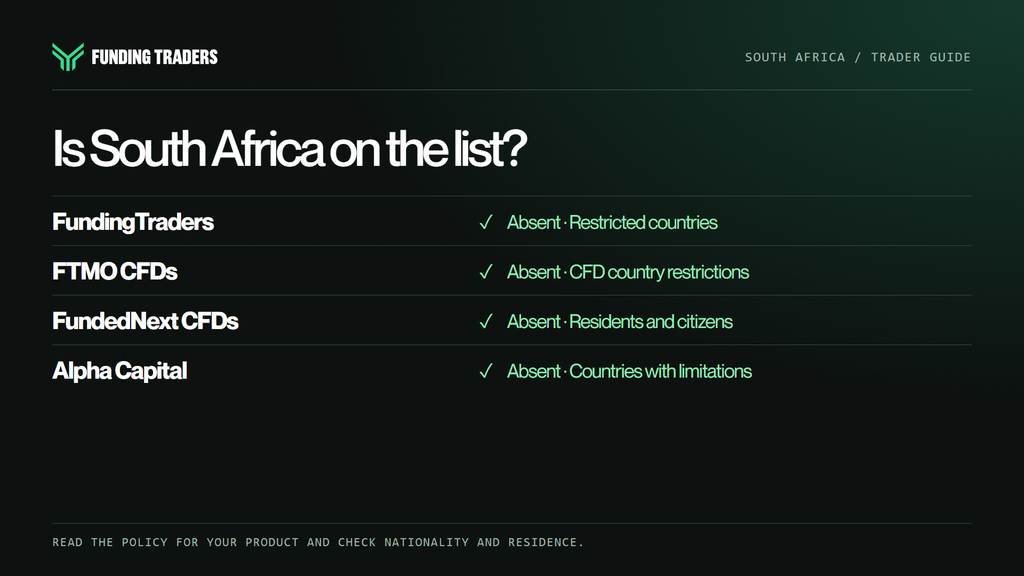
Where South Africa appears on the four firms’ lists
| Firm | Published country policy |
|---|---|
| FundingTraders | South Africa is absent from its restricted-countries list. |
| FTMO | South Africa is absent from its FTMO CFDs country restrictions. |
| FundedNext | South Africa is absent from its CFD restrictions for residents and citizens. |
| Alpha Capital Group | South Africa is absent from its Countries with limitations list. |
How to check your country before you pay
When comparing prop firms in South Africa, read the eligibility page for the exact product you want. FTMO publishes the policy above for CFDs. FundedNext and Alpha Capital both refer to nationality as well as residence. If you live in Cape Town and hold a passport from another country, check how the policy treats both facts. A billing-country dropdown alone cannot establish eligibility.
For a walkthrough of the FundedNext policy, see FundedNext’s restricted-countries list. Check the payment provider separately. South Africa is absent from Rise’s unsupported-country list, and Rise publishes a withdrawal route in rand. You still need to complete identity checks and qualify for a payout under your account rules.
Price comparison at the same account size
List prices before any promo code
Compare like-sized accounts in the $100K column. The middle column pairs each firm’s smallest balance with its entry fee. Dollar fees are in USD. FTMO prices its dollar-denominated challenge in euros.
| Firm | Program | Smallest size / fee | $100K fee |
|---|---|---|---|
| FundingTraders | 2-Step Day | $5K / $79 | $669 |
| FundingTraders | 2-Step Swing | $5K / $108 | $900 |
| FundingTraders | 2-Step PRO10 | $5K / $90 | $750 |
| FundingTraders | 1-Step Pro | $5K / $59 | $589 |
| FTMO | CFD 2-Step | $10K / €89 | €540 |
| FundedNext | Stellar 2-Step | $6K / $59.99 | $549.99 |
| Alpha Capital | Alpha Pro 8%, Bi-Weekly | $5K / $40 | $577 |
FundingTraders fees are the USD list prices with MT5 selected in the account selector. At $100,000, Swing costs $231 more than Day. The two have the same targets and loss limits. If you often hold forex positions overnight, weigh that $231 against Swing’s holding rules and its lower initial payout split. Alpha Capital also varies the price by payout schedule. Its row uses Bi-Weekly.
At $100,000, FundedNext costs $27.01 less than Alpha Pro. At the smallest sizes, Alpha costs less and has a smaller balance. To compare the euro fee, use the conversion quote from your own card issuer. For a broader comparison beyond these four firms, see the challenge fee comparison.
Compare Day, Swing and PRO10 fees at the size you would trade. Use BLACKFRIDAY for up to 70% off your next account.

Getting paid in South Africa in rand
From Rise to a South African bank account
First, request the payout from your FundingTraders dashboard. For 2-Step Day, Swing, PRO10 and 1-Step Pro, the Rise minimum is $200. Close all positions and limit orders before requesting. Direct USDT on ERC20 through Coinbase Commerce has a $50 minimum and is offered only when Rise is unavailable. The Day and Swing payout rules and Requesting a Payout help article explain these conditions.
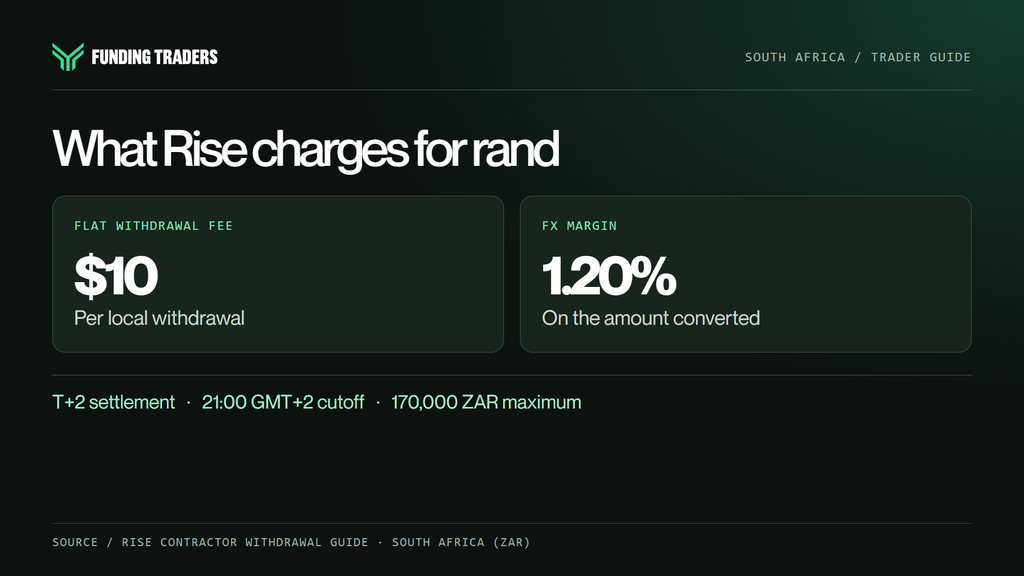
Second, a trader with a funded Rise wallet requests a local-currency withdrawal. In its contractor withdrawal guide, Rise lists a $10 flat fee and a 1.20% foreign exchange margin for South Africa. It shows T+2 settlement, a 21:00 GMT+2 cutoff and a maximum of 170,000 ZAR. That timing belongs to the bank withdrawal. The firm’s approval comes first.
Worked example of the two fees on $1,000
On an illustrative $1,000 withdrawal, the flat fee is $10. Separately, a 1.20% margin on $1,000 is about $12. Rise does not specify in the guide whether it calculates the margin before or after deducting the flat fee. Use the quote shown for your withdrawal to see the exchange rate and resulting amount in rand.
A flat charge matters more on a smaller transfer. On $200, the $10 charge alone represents 5% of the amount. On $1,000, the same charge represents 1%. Both percentages exclude conversion.
Which other routes do the firms publish?
FTMO lists bank wire, Visa Direct or Mastercard Send, Skrill and crypto for its Reward. The minimum closed profit for wire or card transfer is $20. A South African trader weighing a wire against Rise needs the receiving bank’s currency and fee quote. FTMO’s Reward withdrawal options do not provide a ZAR quote for that bank.
FundedNext lists bank transfer, card and RiseWorks among its Performance Reward methods. South Africa is absent from both exclusion lists. Its method-specific limits start at $50 for RiseWorks, $1,000 for bank transfer and $20 for card. A $250 eligible Performance Reward, for example, clears the RiseWorks floor and falls below the bank transfer floor. Check the provider’s fee before comparing the final rand value.
Alpha Capital lists Rise, Wise and bank transfer for Qualified Account performance fees. Its payment methods specify that crypto withdrawals go through Rise. If you want your bank credited in rand, check the currency offered on the chosen method. Rise’s published ZAR fee and cutoff apply to its own local route.
Comparing prop trading firms in South Africa on rules
Profit targets and drawdown limits
| Program | Evaluation targets | Daily loss | Maximum loss |
|---|---|---|---|
| FundingTraders 2-Step Day | 10%, then 5% | 5% | 10% static |
| FundingTraders 2-Step Swing | 10%, then 5% | 5% | 10% static |
| FundingTraders PRO10 | 10%, then 5% | 5% | 10% static |
| FundingTraders 1-Step Pro | 10% | 3% | 10% trailing |
| FTMO CFD 2-Step | 10%, then 5% | 5% | 10% static |
| FundedNext Stellar 2-Step | 8%, then 5% | 5% | 10% static |
| Alpha Pro 8% | 8%, then 5% | 4% | 8% static |
| Program | Funded payout condition | First eligible request |
|---|---|---|
| FundingTraders 2-Step Day | At least 4 funded trading days before each payout | 21 days after first funded trade, or 14 with add-on |
| FundingTraders 2-Step Swing | At least 2 funded trading days | 21 days after first funded trade, or 14 with add-on |
| FundingTraders PRO10 | No consistency score | 21 days after first funded trade, or 14 with add-on |
| FundingTraders 1-Step Pro | Largest profit day at most 50% of total profit for payout | The payout cycle depends on the account and its add-ons. See the 1-Step Pro help article. |
| FTMO CFD 2-Step | No consistency objective on the 2-Step tab | Day 14 or later after first trade |
| FundedNext Stellar 2-Step | Listed as N/A | 21 days, then every 14 days |
| Alpha Pro 8% Bi-Weekly | 40% Best Day rule belongs to On-Demand | Bi-Weekly, at least 5 trading days for first request and $100 minimum |
Choosing between FundingTraders Day, Swing and Pro accounts
On a standard trading day, 2-Step Day closes forex, gold, index and oil positions at 16:55 New York time. In South Africa, that is 22:55 during U.S. daylight saving time and 23:55 during U.S. standard time. Crypto positions can stay open overnight and over the weekend. Neither evaluation phase has a minimum number of trading days. On the funded account, the standard split is 80%, with 90% or 100% available through add-ons.
2-Step Swing allows overnight and weekend holding across its supported markets. Each evaluation phase requires four trading days. The split is 70% on the first paid payout, 80% on the second and 90% from the third on that account. Swing has no split add-on. In deciding between Day and Swing, check your last few trades: how often would the Day close have taken you out before your planned exit?
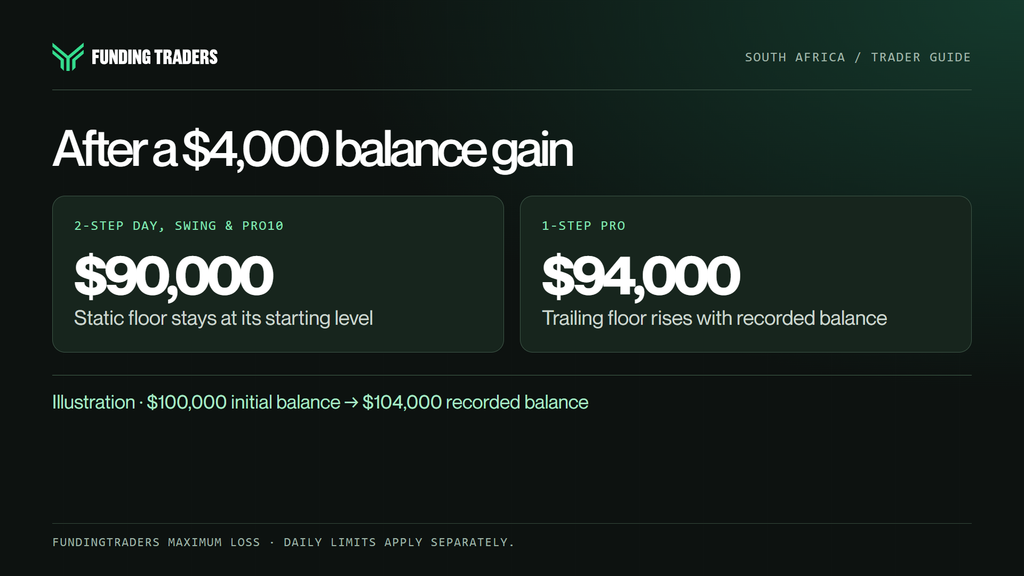
Day, Swing and 2-Step PRO10 all have a static maximum loss. On $100,000, the floor stays at $90,000 even if your balance rises. The 5% daily limit applies separately. Standard PRO10 requires four trading days per evaluation phase and two on the funded account. Its standard split is 80%.
The 1-Step Pro rules remove the second target, but the maximum loss trails the highest recorded balance by 10% of the initial size. If a $100,000 account reaches a recorded balance of $104,000, that floor moves to $94,000. One large winning day can also delay a payout until it accounts for 50% or less of total profit. The 1-Step Pro help article sets the minimum trading days for each phase. For either Pro line, the evaluation fee is refunded once with a qualifying payout.
These are CFD accounts. FundingTraders applies a 2% risk cap per trade idea on the funded phase of Day, Swing and PRO10. On 1-Step Pro, the cap applies in both phases. South African traders looking to buy JSE shares or trade exchange-listed futures need a different product. On a FundingTraders Instant Funding account, weekend and news holding, the profit split, payout timing and any lot limit depend on the account and the add-ons chosen at checkout, so check the Instant Funding help article before you trade. Instant Funding payouts require a consistency score of 15% or lower and a 3% safety cushion left in the account. The Instant Funding help article lists every condition.
FTMO: a fixed floor and a fee in euros
FTMO’s two phases use different targets while keeping the same maximum loss. At $100,000, the first phase calls for $10,000 of closed profit and Verification calls for $5,000. Its two-step trading objectives require four trading days in each evaluation phase. A trader who reaches the target on day two still has a trading-day requirement to meet. The subsequent 2-Step FTMO Account has no profit target.
For a South African trader comparing entry fees, the potential drawback is the currency comparison. A $100,000 label tells you the scale of the simulation, while the actual list fee is €540. To compare it with a USD-priced challenge, ask your bank what each purchase would cost in rand on the same day. The FTMO price cards distinguish the listed price from a promotional price.
The Reward terms introduce a second timing consideration. You can request from day 14 after the first trade on the account once the requirements are met and positions and pending orders are closed. A trader intending to hold a position through that date needs to plan around closing it before making the request. Getting to the request date does not fix the exchange rate your South African bank will use.
FundedNext: a lower first target with a longer first cycle
Stellar 2-Step combines an 8% first target with a 5% second target. It requires at least five trading days per phase, with no evaluation time limit. The maximum loss stays based on the initial balance. That combination may suit a trader whose setups occur infrequently. On a $100,000 account, the first target is $8,000 and the maximum loss limit is $10,000, while the daily loss limit still applies on each trading day. The Stellar 2-Step program lists the same loss percentages across the two phases.
The trade-off for someone budgeting in rand comes after the evaluation. The first Performance Reward cycle is 21 days. Budgeting for the 14-day repeat interval from day one puts the first request a week too early. There is a separate decision about how to withdraw. A trader with an eligible $900 Performance Reward may prefer a direct bank transfer, yet that amount still falls below FundedNext’s published $1,000 floor for that method. Its Performance Reward limits also describe provider processing fees. Factor those into your comparison before applying Rise’s local ZAR withdrawal costs.
Alpha Capital: the schedule changes what you buy
Alpha Pro 8% starts at $40 for a $5,000 account on the Bi-Weekly schedule. It uses a fixed maximum loss, so you can calculate the floor before your first trade. At $5,000, an 8% maximum loss is $400 and a 4% daily limit is $200. The same percentages at $100,000 mean a different amount of room per position. Alpha Capital’s published plan prices identify the size and the base fee for each version.
On the Qualified Account, the Bi-Weekly schedule requires a $100 minimum performance fee and five trading days for the first request. The standard split is 80%. A trader comparing that offer with the optional 90% split needs to look at a different purchase: Alpha Capital assigns the 90% option to On-Demand and applies a 40% Best Day rule there. Its Alpha Pro account terms say the two schedules cannot be mixed on one account.
Holding positions also requires a second look after evaluation. Alpha Capital permits weekend holding during the evaluation and restricts it on the Qualified Account. If you usually hold forex positions from Friday to Monday, that change matters even when the fee and static loss floor fit your plan.
What South African traders can check with the FSCA
The Financial Sector Conduct Authority regulates and supervises the market conduct of financial institutions in South Africa. Take the legal entity name and any FSP number from the firm’s contract and enter them in the financial services provider search. Compare the name and details on the record with the business you’re dealing with. Then look for the name, trading name or website in the FSCA’s warnings and alerts.
A similar name can point to the wrong business. An empty result alone does not settle the firm’s legal status. For a legal opinion on a specific provider or arrangement, consult a qualified South African professional. This section is general information and does not provide legal advice.
What to check before buying a challenge
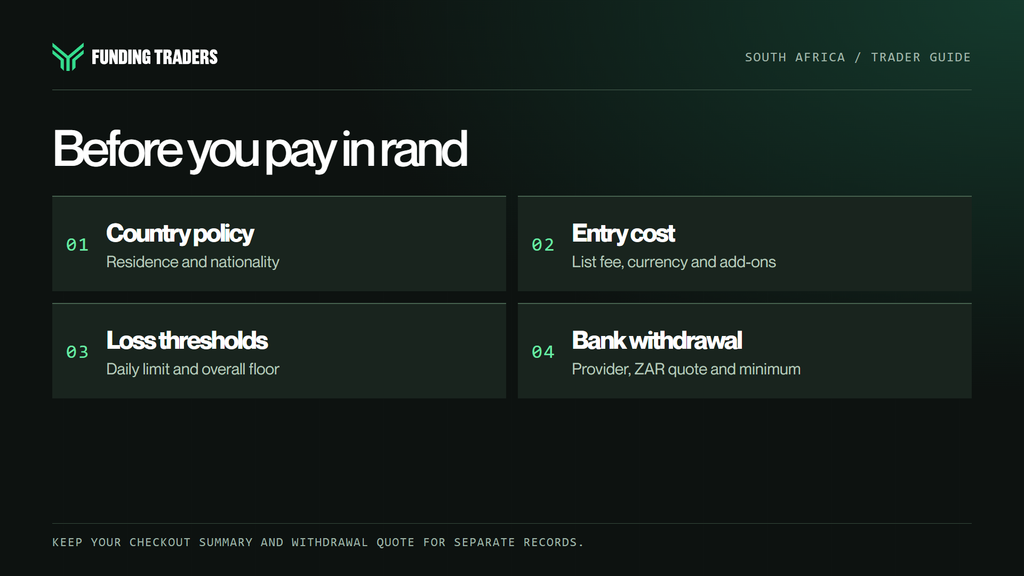
- Identify the purchase. Record the firm, exact program, balance, fee currency and add-ons. Get the amount in rand from your card provider before comparing two offers.
- Write down both loss limits. Work out the daily threshold and the overall floor for your chosen account size. For a trailing rule, repeat the calculation after a profitable day.
- Check your documents. FundingTraders asks for both sides of a government-issued ID, a selfie holding it and proof of address dated within three months. Its KYC verification guide places verification before access to the funded account. Rise has its own identity checks before you receive payments.
- Trace the bank transfer. Identify the firm’s minimum, the provider, the settlement currency and any receiving-bank charge. Keep the withdrawal quote and your evaluation receipt.
FundingTraders for South African traders
For forex, indices, metals or oil trading, compare FundingTraders’ prop trading programs against your usual exit time. A trader in Johannesburg who holds gold past the New York close can keep the position on Swing. On Day, gold is subject to the automatic close. For Day and Swing, the order form lists MT5, TradeLocker and QTerminal. FundingTraders is not a broker and does not take a deposit to provide trading capital. For the evaluation accounts in the table, check the $200 Rise minimum and the separate ZAR withdrawal costs against your expected transfer size.
Do you usually close before the end of the trading day? Review the two-step account options against your trading hours. On 2-Step Day and PRO10, BLACKFRIDAY offers a 100% split on eligible profits and zero commissions and swap fees.

How we compared
FundingTraders publishes this comparison and is one of the four firms covered. We used each firm’s country policy, program terms and published prices, keeping the listed currency and matching account sizes wherever possible. We checked which FundingTraders programs a reader could actually select. Rise’s South Africa entry supplied the local bank withdrawal terms.
Frequently asked questions
Do these prop firms restrict traders in South Africa?
South Africa is absent from the cited country lists for FundingTraders, FTMO CFDs, FundedNext CFDs and Alpha Capital. Nationality, residency and individual verification can also affect eligibility. Use the four policy links above for your own circumstances.
How do South African traders receive prop firm payouts in rand?
On FundingTraders 2-Step Day, Swing, PRO10 and 1-Step Pro, an eligible trader can request a payout through Rise, then select a local ZAR withdrawal to a South African bank. The firm approves the payout and Rise handles the conversion and local withdrawal.
What does Rise charge to withdraw in ZAR?
Rise lists a $10 flat withdrawal fee and a 1.20% FX margin. Its South Africa entry gives a T+2 settlement schedule, a 21:00 GMT+2 cutoff and a 170,000 ZAR maximum.
How can South African traders check a prop firm with the FSCA?
Use the firm’s legal name and any FSP number to search the FSCA register. Match the details and read the FSCA’s warnings and alerts. This is a records check and does not provide legal advice.
Which prop firm is cheapest for South African traders?
Of the USD fees in the table, Alpha Pro 8% Bi-Weekly has the lowest entry fee at $40 for $5,000. At $100,000, FundedNext Stellar 2-Step has the lowest USD list fee at $549.99. FTMO charges in euros, so a ranking in rand needs a conversion quote. See more prop firm entry prices for other account sizes.
Do I need KYC to trade from South Africa?
FundingTraders allows access to the purchased trading account before profile verification. It requires KYC before you access the funded account. Rise requires its own verification before you can receive payments there.
Choosing between prop firms in South Africa
When comparing prop firms in South Africa, start with the country policy and the route to your bank. Then compare the account size, entry fee in rand, loss floor and earliest eligible payout request. If two accounts still look similar, calculate where each loss floor would sit after your best trading day.
Check your account, platform and add-ons at checkout before paying. On eligible 2-Step PRO10 purchases, BLACKFRIDAY includes a 200% refund rate with a qualifying payout.

Disclaimer: Trading involves significant risk and is not suitable for every investor. Past performance is not indicative of future results. The information provided in this article is for educational and informational purposes only and should not be considered financial, investment, or trading advice. All account rules, payout structures, profit splits, and promotional offers described in this article are subject to change at the discretion of FundingTraders. Promo codes may expire or be modified without prior notice. Always trade responsibly and only risk what you can afford to lose.