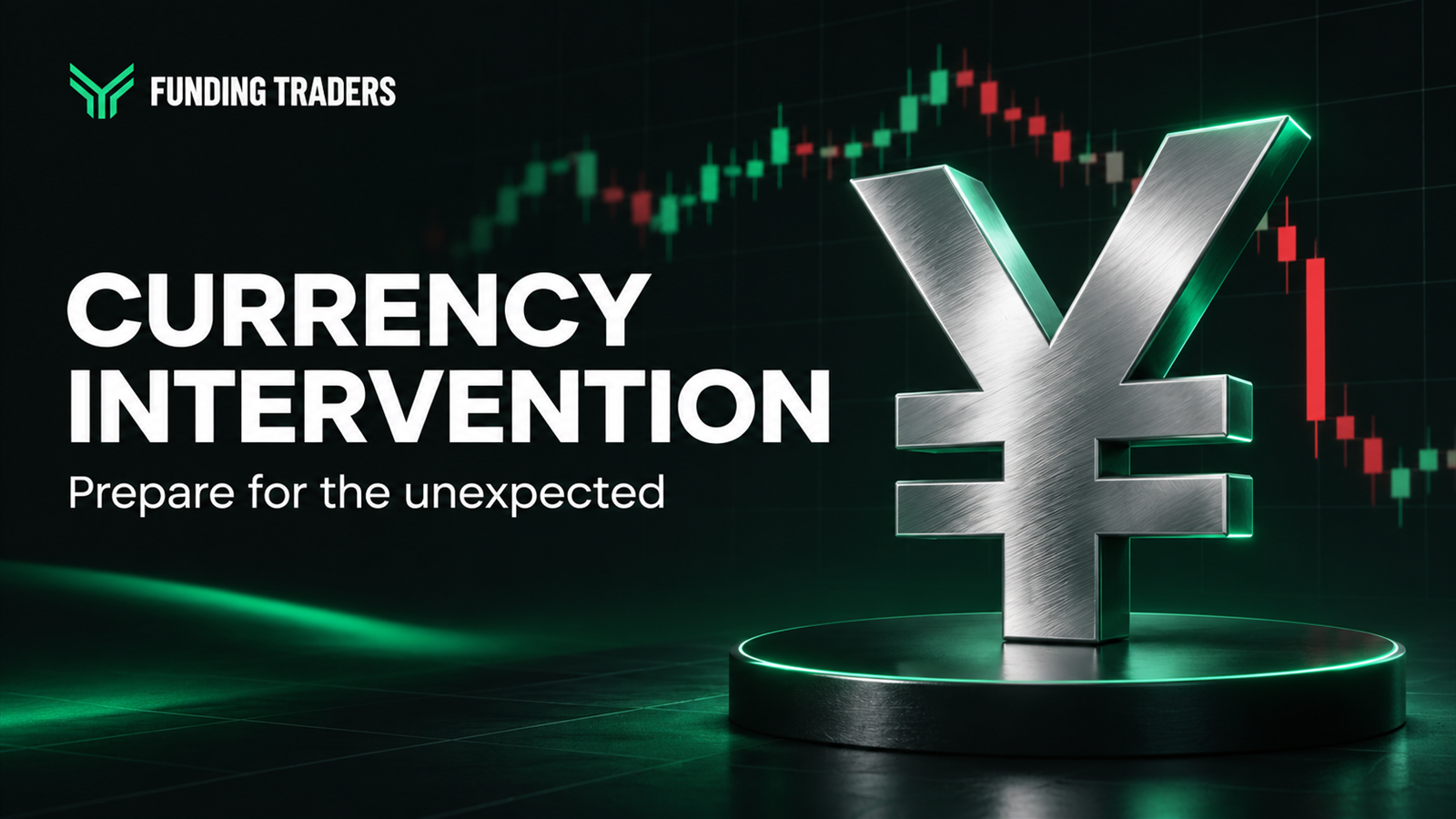
Currency intervention can turn an orderly forex session into a sharp repricing before traders know what caused it. A position that looked manageable a moment earlier can face wider spreads, a missed stop price and a fast reversal.
For traders watching USD/JPY, the temptation is to identify the exact level where Japanese authorities will step in. That is a fragile basis for a trading plan. Official action is not a scheduled economic release, and a sudden move alone does not prove that intervention has happened.
A more useful approach is to understand how intervention works, recognize conditions that deserve extra caution and decide how much exposure your account can carry. For funded traders, that preparation also means knowing how a volatile session interacts with daily loss limits, overall drawdown and the rules of the account being traded.
What Is Currency Intervention?
Currency intervention is the purchase or sale of currencies by monetary authorities to influence exchange rates. It differs from an interest-rate decision: authorities are transacting in the foreign exchange market itself.
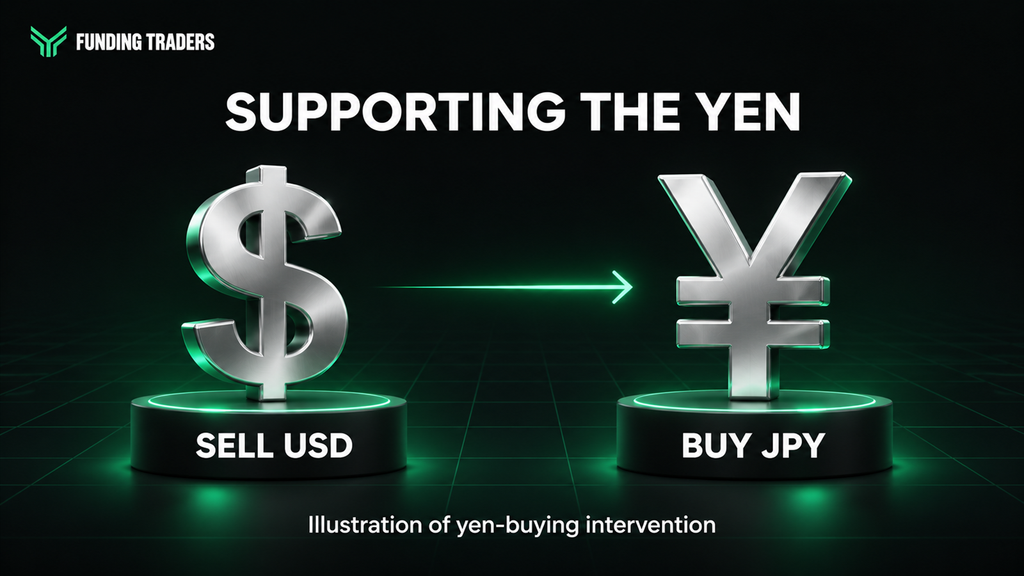
Japan provides a useful example. The decision to intervene rests with the Minister of Finance, while the Bank of Japan executes the operation under the minister’s instructions. To support a weakening yen, authorities can sell US dollars and buy yen. They can take the opposite side when seeking to restrain yen appreciation.
For a trader, the distinction matters. A Bank of Japan rate decision and a Ministry of Finance intervention are separate actions, even though both can affect the same currency pair.
Verbal Warnings and Actual Transactions
Verbal intervention means officials use public comments to influence market expectations. A warning about excessive currency moves can make traders reassess their positions without authorities buying or selling anything.
Actual intervention involves transactions. It changes market flows directly, although its lasting effect still depends on how other participants respond and whether the underlying economic picture changes.
Neither is a reliable entry signal by itself. Officials can issue repeated warnings without acting immediately. Equally, a sudden currency spike can result from economic news, thin liquidity or position unwinding. Treat suspected intervention as an explanation to investigate, rather than a fact established by the shape of a candle.

Why Intervention Is Difficult to Trade Around
A scheduled release gives you a time to prepare for. Intervention does not offer the same dependable warning. Even if you correctly identify a vulnerable currency, you can still be wrong about when authorities act, how strongly the market reacts and whether the first move lasts.
Execution adds another layer of uncertainty. A stop order establishes an exit trigger, but the fill may differ from that price in a fast market. Wider spreads can also increase trading costs just when prices are moving most quickly.
The risk runs in both directions. A trader caught against the initial move can take a loss; a trader who chases it can then be caught by a rebound. There is no dependable rule that intervention must start a new trend, or that its effect must reverse immediately.
That makes a prediction such as “the authorities will defend this price” especially dangerous. Historical intervention levels provide context, not a standing order that the market must respect.
Conditions That Deserve More Caution
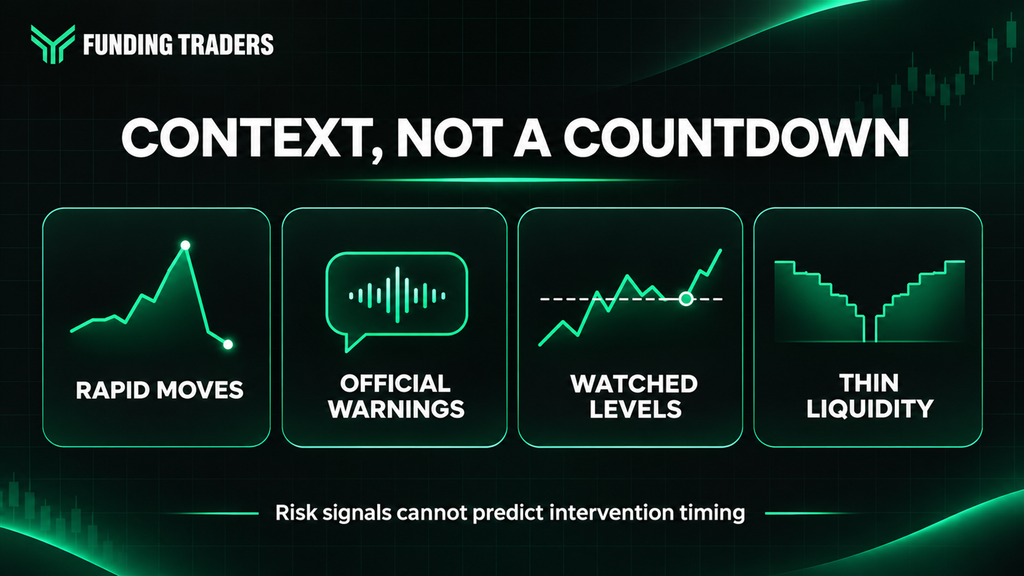
Intervention risk cannot be reduced to a countdown. Still, several conditions are useful prompts to review exposure:
- Rapid, one-sided movement. Consider the speed and disorderliness of the move, rather than focusing only on the latest price.
- Escalating official commentary. Stronger warnings deserve attention, but do not establish the timing or certainty of action.
- Widely watched price zones. Previous intervention areas can attract speculation. They are not guaranteed boundaries.
- A persistent policy gap. Interest-rate differences can help explain a currency trend. Intervention does not automatically remove those forces.
- Thin liquidity. Limited market depth can amplify a price shock, regardless of whether authorities caused it.
When several of these conditions coincide, review what would happen to your existing positions if the currency moved abruptly against them. That exercise is more actionable than trying to guess the next official headline.
Build the Risk Plan Before the Price Shock
Size the Position Around the Stop
Choose the point at which the trade idea is invalid, then calculate a position size that fits your planned risk. Starting with a preferred lot size and stretching the stop until the trade feels comfortable reverses that process.
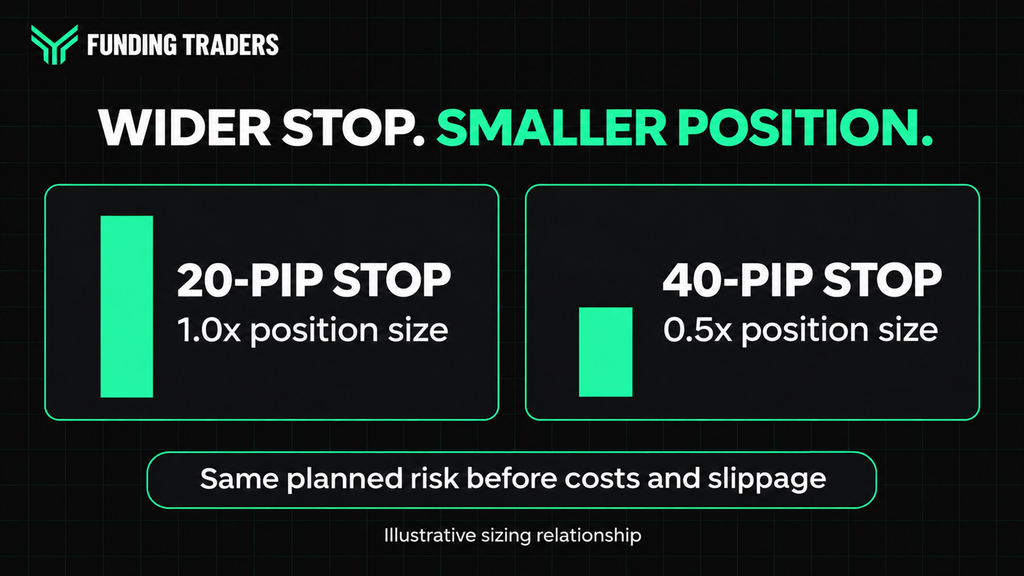
For illustration, if a setup needs a 40-pip stop instead of a 20-pip stop, the position would be roughly half as large to keep planned price risk unchanged, assuming the same pip value. Commissions, spread and slippage need separate allowance. This describes the sizing relationship; it is not a recommended stop distance.
An unusually wide stop can also make a trade unsuitable. Taking a smaller position or staying flat may fit the plan better than expanding the amount you are willing to lose.
Avoid moving a stop farther away simply because an existing position is losing. That increases exposure after the risk has already started to materialize.
Count the Currency Exposure Across Your Trades
Separate tickets do not necessarily represent separate risks. Long positions in USD/JPY, EUR/JPY and GBP/JPY all include exposure to a weaker yen. If the yen strengthens abruptly, those positions can move against you together.
Review the combined effect of your trades, including pending orders. Assess how much loss the account could absorb if several stops filled worse than expected at the same time. A group of individually modest positions can still create a concentrated currency bet.

Plan for Execution Risk
A hard stop remains an important control, but it is not a promise of an exact exit price. Learn how your platform handles stop orders, spread changes and fast markets before those details become urgent.
Keep a margin between your planned loss and the account’s remaining loss allowance. A trade sized to consume nearly all that allowance leaves little room for costs, slippage or another open position moving against you.
Replacing a stop with a promise to exit manually adds another failure point. Our guide to mental stop losses explains why an exit decided in advance can become harder to execute once a trade is under pressure.
Let the Market Establish a New Setup
Once a sharp move begins, distinguish managing existing exposure from opening a new trade. The size of a candle is not, by itself, evidence that the next entry offers an advantage.
Before considering another position, reassess the spread, liquidity, invalidation point and distance to the next meaningful price area. If you cannot define the trade clearly, there is no requirement to participate.
Continue watching the scheduled calendar too. A rate decision, press conference or major data release can create another shock after the initial move. A quieter few minutes does not establish that the event risk has passed.
What This Means for FundingTraders Accounts
On a FundingTraders simulated trading account, an intervention scare does not remove the account’s risk limits. The practical question is how much room remains under the rules for your product and phase.
For example, the 1-Step Pro rules specify a daily loss limit of 3% of account size measured from the starting day’s equity. The maximum loss limit is 10% of account size measured from the highest recorded account balance, so that threshold trails upward as the balance increases. These are limits, not suggested amounts to risk in one session.
Review the applicable news and holding rules separately. An unscheduled intervention rumor is not automatically the same thing as a scheduled high-impact release, and you should not assume that one account type’s conditions apply to another.
Our risk management framework also addresses behavior such as oversized exposure, stacked entries and trading without a stop. The lesson for a volatile session is straightforward: a profitable outcome does not, by itself, establish that the process followed the rules.
Funded account holders can use the Clarity Desk to review flagged trades, risk status and product requirements. It is available on funded accounts, not evaluation logins. Use that information alongside your account rules when assessing whether another trade fits the remaining risk allowance.
A Short Checklist for the Next Session
Before trading a pair exposed to intervention speculation, write down:
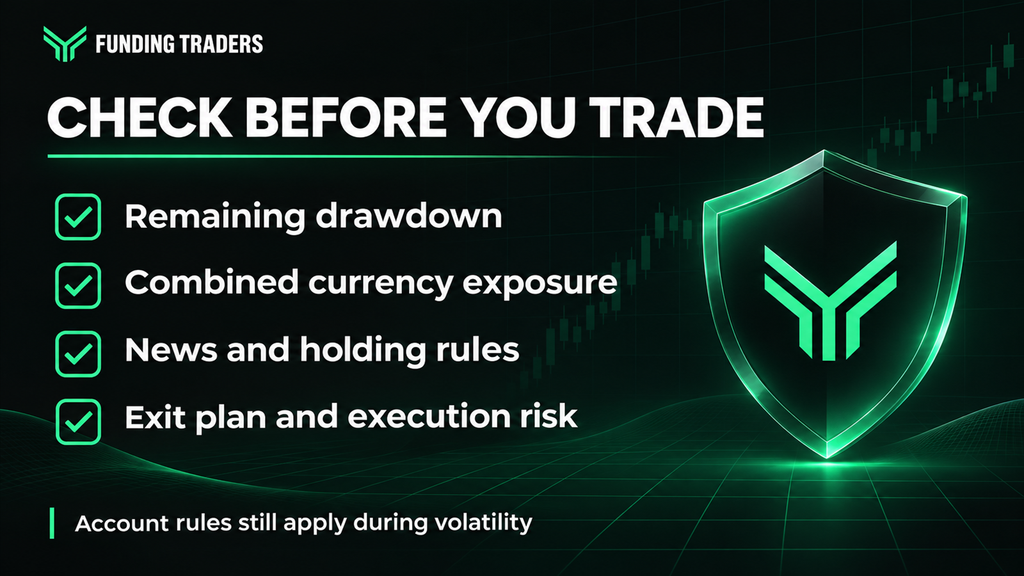
- Your remaining loss allowance. Check both daily and overall limits, including how open losses affect them.
- Your combined currency exposure. Include positions on other pairs and orders that could activate during a spike.
- Your exit plan. Confirm the stop, position size and allowance for execution costs.
- Your account conditions. Review the relevant phase, news rules, holding rules and any restrictions on your account.
- Your reason to stay out. Define the spread, volatility or uncertainty that would make a new trade unacceptable.
Currency intervention will always leave something outside your control. You cannot choose when authorities act or the price available when an order executes. You can choose your exposure, keep room within the account’s limits and decline a trade whose risk you cannot reasonably assess.
At FundingTraders, that preparation belongs in the trading plan before the session starts. The aim is to make the next decision with a clear view of the account, even when the market moves faster than the headlines.

Disclaimer: Trading involves significant risk and is not suitable for every investor. Past performance is not indicative of future results. The information provided in this article is for educational and informational purposes only and should not be considered financial, investment, or trading advice. All account rules, payout structures, profit splits, and promotional offers described in this article are subject to change at the discretion of FundingTraders. Promo codes may expire or be modified without prior notice. Always trade responsibly and only risk what you can afford to lose.