If you want to know how to learn forex trading, start with market mechanics, risk control, and a repeatable practice routine before paying for an evaluation or risking personal trading funds. For a beginner, the challenge is deciding what to study first and how to tell whether that knowledge is becoming a usable skill.
A few winning trades cannot answer that question. A written plan, a realistic practice routine, and a journal give you something more useful to review: evidence of how you make decisions when the market moves against you.
This FundingTraders guide walks through six learning stages, from reading a currency quote to assessing evaluation readiness. You will learn how to calculate position size, structure demo practice, evaluate educational support, and recognize the mistakes that can undermine your progress.
How to Learn Forex Trading in Six Stages
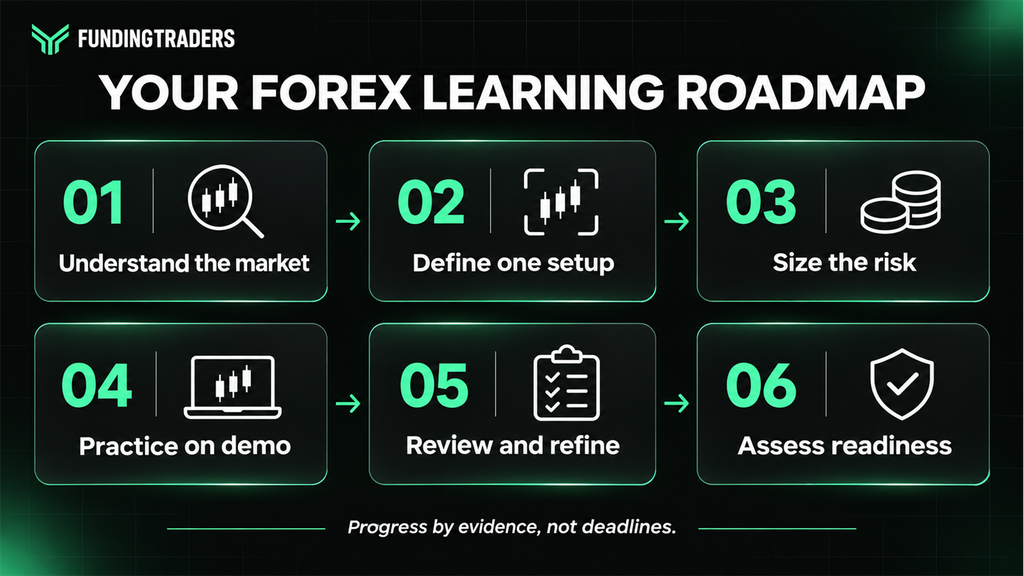
Use the sequence below as a study plan. Move forward when you can demonstrate each skill, rather than treating a certain number of weeks as proof that you are ready.
| Stage | Your focus | A practical checkpoint |
|---|---|---|
| Understand the market | Currency pairs, pips, costs, and order types | Explain a quote and place a practice order correctly |
| Define one setup | Price structure and economic context | Write down what qualifies as a trade and what rules it out |
| Size the risk | Stops, position size, and combined exposure | Calculate the planned loss before entering |
| Practice on demo | Repeatable execution | Record trades taken under the same written rules |
| Review and refine | Journal analysis and useful feedback | Separate a strategy problem from an execution mistake |
| Assess readiness | Budget, account rules, and emotional discipline | Explain how your plan fits the account you are considering |
1. Understand What a Forex Trade Represents
A forex quote expresses the value of one currency in another. In EUR/USD, the euro is the base currency and the US dollar is the quote currency. A price of 1.0850 means one euro is worth 1.0850 dollars.
Buying EUR/USD gives you exposure to the euro strengthening relative to the dollar. Selling expresses the opposite view. Neither side of the trade can be understood by looking at one currency in isolation.
Start with a small watchlist. Learning how one or two pairs behave during your available trading hours is more manageable than watching every market at once.
Learn the Terms That Affect Every Order
Before practicing a strategy, become comfortable with these basics:
- Bid and ask: The bid is the price at which you can sell; the ask is the price at which you can buy. The difference is the spread.
- Pips: A pip commonly represents 0.0001 for pairs such as EUR/USD and 0.01 for many yen pairs. Platforms may also display fractional pips.
- Lots: A standard forex lot commonly represents 100,000 units of the base currency. Confirm the contract specification for the instrument you use.
- Margin and leverage: Margin supports an open position. Leverage lets a position’s value exceed the funds supporting it, magnifying the effect of price changes on your account.
- Trading costs: Include spreads, any commissions, and applicable overnight financing when reviewing results.
For example, EUR/USD quoted at 1.0848 bid and 1.0850 ask has a two-pip spread. Those two pips matter when you assess the distance to your target and the cost of entering a position.
Practice placing, modifying, and closing orders in a demo environment. Know the difference between a market order, a pending entry, and a stop loss before speed becomes part of the task.
2. Turn Market Analysis Into One Written Setup
Technical analysis studies price behavior. Fundamental analysis considers economic information that can affect currencies. Both can help organize a trading idea, but neither removes uncertainty.
Start with basic price structure: trends, ranges, and areas where price previously attracted buying or selling. If you use a moving average or another indicator, define its purpose. Adding more indicators does not automatically produce a better decision.
Economic releases need context. An interest-rate increase does not automatically strengthen a currency. The announcement may already be expected, while the accompanying guidance may change the market’s outlook. Check the FundingTraders economic calendar so scheduled events are part of your preparation.
Write Rules You Can Actually Test
Your first setup should answer five questions:
- Which pair and trading session will I study?
- What market conditions must be present?
- What exact event triggers an entry?
- Where is the idea invalidated, and how will I exit?
- What conditions require me to skip the trade?
“Buy when the chart looks strong” leaves too much room for interpretation. A defined trigger, invalidation level, and news filter give you decisions that can be reviewed later.
Collect historical examples of the setup, including failures. Then test it on data you did not use to design the rules. A strategy that looks convincing on selected screenshots may behave differently when you follow every qualifying signal.
3. Learn Position Sizing Before Increasing Exposure
Risk management connects an idea to the amount you could lose. It starts before you enter, with an invalidation point and a position size that fits your budget and account constraints.
A fixed percentage can make practice more consistent, but there is no universal percentage that makes trading safe. A prop evaluation’s loss limits may require much smaller exposure than a generic trading rule suggests.
A Worked Forex Position-Size Example
The following figures are hypothetical and illustrate the calculation, not a FundingTraders account rule or a recommended risk level.
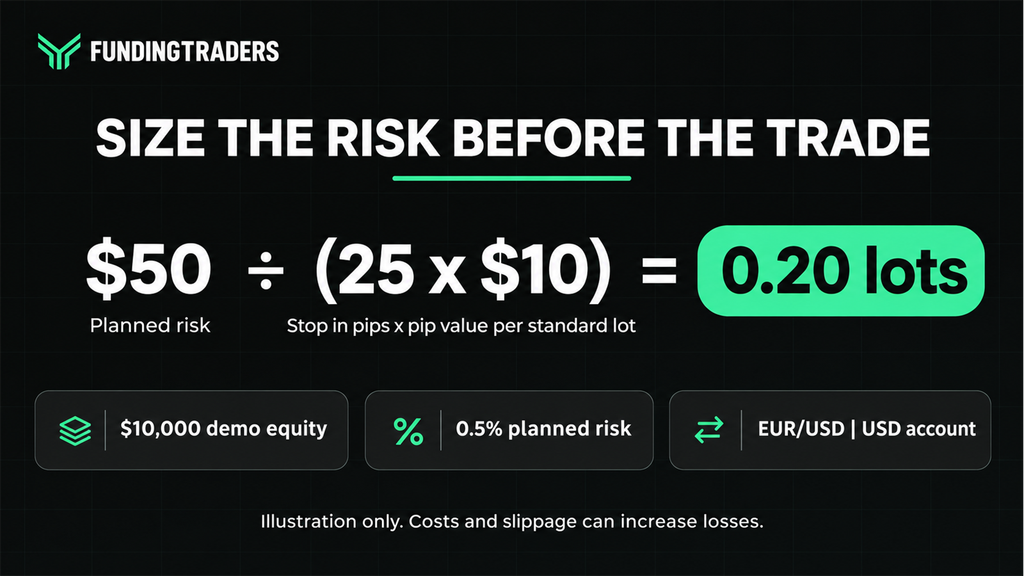
Suppose a USD-denominated demo account has $10,000 in equity. You allocate 0.5%, or $50, as the planned price-movement risk on an EUR/USD trade. Your stop is 25 pips from entry. Assuming a standard lot is 100,000 euros, each pip is worth $10 per standard lot.
Position size in lots = planned risk ÷ (stop distance in pips × pip value per standard lot).
In this example: $50 ÷ (25 × $10) = 0.20 lots, equivalent to 20,000 euros of base-currency exposure.
The calculation excludes commissions, financing, and execution differences. Account for costs separately and allow room for adverse slippage. A standard stop loss can execute at a worse price during a gap or fast market, so $50 is the planned price-movement loss, not an absolute maximum.
Use the FundingTraders trading calculators alongside your platform’s instrument specifications to check the inputs.
Look Beyond the Risk on One Trade
Several positions can express the same underlying view. Buying EUR/USD and GBP/USD, for example, creates two positions that both involve selling the dollar. Separate tickets do not necessarily mean independent risk.
Leverage also needs careful interpretation. If total exposure equals ten times account equity, an adverse 0.5% price move represents approximately 5% of that equity before costs, assuming a simple linear position with no earlier exit. That is why available leverage should never determine your position size by itself.
Define a personal session stop and a limit on combined open risk. For an evaluation, leave a buffer before the firm’s loss boundary rather than treating the entire permitted drawdown as a daily spending allowance.

Compare Planned Reward With Actual Results
A target twice as far from entry as the stop creates a planned reward-to-risk ratio of 2:1. It does not prove the setup has an advantage. You still need to know how often the target is reached and whether your realized wins and losses resemble the plan after costs.
For practice, record results in R, where 1R represents the planned risk at entry. A $50 planned risk and a $100 net gain produce +2R. A $60 net loss produces -1.2R. This makes execution differences visible without confusing them with changes in position size.
Our guide to why a mental stop loss gives way under pressure explains why an exit written in a notebook still needs a clear execution method.
4. Make Demo Practice Resemble Your Intended Routine
A demo account gives you room to learn the platform and test decisions without depositing personal trading capital. It does not reproduce every feature of funded or personal-account trading. Execution can differ, and a fee or personal financial stake can change how you react to the same loss.
Use a demo balance, position-size range, and trading schedule that resemble the conditions you intend to work under. Avoid resetting the account after every difficult session. Keeping the record intact makes weaknesses easier to identify.
Set a review interval before you start. For example, a first block of 30 trades taken under unchanged rules can be a useful exercise. It is not proof of profitability or a universal readiness threshold. A small sample may reflect one favorable market condition.
Keep a Journal That Explains Your Decisions
For each trade, record:
- The pair, date, session, and setup.
- An entry screenshot and the reason the setup qualified.
- The entry, stop, target, position size, and planned risk.
- The exit, costs, net result, and result in R.
- Whether you followed the rules, including any stop or target changes.
- Your emotional state and one observation to review later.
At the end of the review block, separate trades that followed the plan from trades that broke it. A profitable rule-breaking trade still exposes an execution problem. A losing trade that followed the plan may simply be an expected outcome within the strategy.
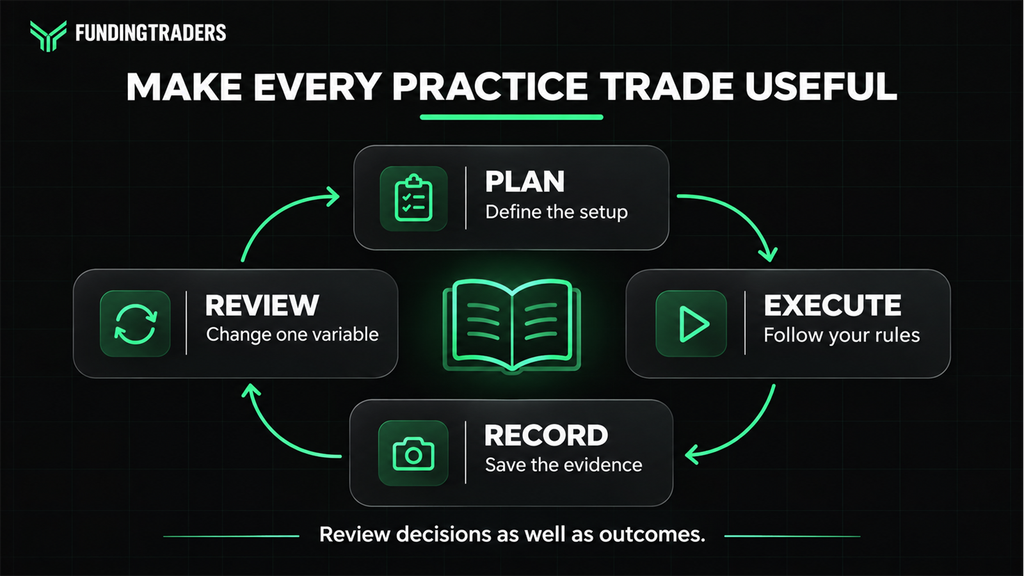
Look for repeated behavior, not just the biggest win or loss. Are you entering late? Exiting profitable trades before your planned condition? Holding losing positions after the idea has failed? Our article on the disposition effect in trading examines that imbalance between how traders handle winners and losers.
Change one variable at a time, document the reason, and test the revision on a fresh sample. Otherwise, you cannot tell which change affected the result.
5. Choose Education and Feedback That Improve Your Process
You can learn forex trading through a combination of structured reading, platform tutorials, deliberate practice, and honest review. A paid course or mentor is optional. The useful question is whether the resource helps you identify and correct a specific gap.
A good explanation should let you describe the reasoning yourself. Useful feedback should identify where your actions departed from your plan, where the plan is ambiguous, or where the evidence is too weak to support a conclusion.
Before paying for educational support, review the syllabus, instructor background, total cost, and cancellation terms. Ask whether the program reviews student decisions or mainly distributes entries to copy. Screenshots of winning trades cannot establish teaching quality or typical student outcomes.
Live instruction can provide timely discussion, while recorded lessons can make repetition easier. Neither format automatically makes a trader profitable. Choose based on the quality of the material and how you will use it.
Keep learning separate from account management. FundingTraders’ general trading guidelines prohibit copying trades from accounts owned by other traders. Educational feedback should help you make your own decisions.
6. Assess Whether You Are Ready for an Evaluation
Knowing how to learn forex trading includes knowing when more practice is the appropriate next step. A challenge fee should not become pressure to trade faster, recover a loss, or force a setup that is not there.
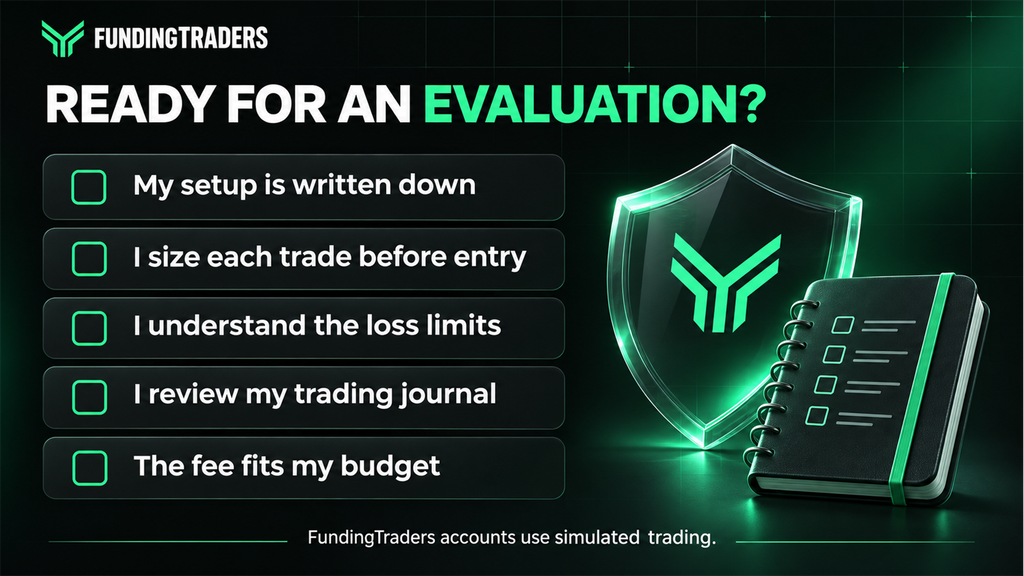
Before considering a paid evaluation, review your records and ask:
- Can I explain my entry and exit rules without changing them to fit the latest chart?
- Do I calculate position size before placing an order?
- Can I stop trading when my written session limit is reached?
- Have I practiced through losing periods without abandoning the plan?
- Can I afford the fee without relying on a future payout?
- Do I understand the exact rules of the account I am choosing?
Where FundingTraders Fits
FundingTraders provides a prop trading evaluation route for traders who want to apply an established process within defined account rules. FundingTraders is not a broker and does not accept deposits as personal trading capital.
Account labels are only the starting point. Compare the profit objective, daily loss calculation, maximum drawdown, trading restrictions, and payout conditions before choosing. The 1-Step Pro account rules, for example, describe a maximum-loss limit that trails higher as the recorded account balance increases. That changes how you must monitor the remaining loss buffer.
Use the rules for the specific account and phase you select. The payout request guide explains the request process and method requirements; the relevant account rules determine eligibility. Passing an evaluation or receiving a payout is not assured.

Beginner Forex Mistakes to Catch Early
Several habits can undo otherwise useful study. Use this table during your weekly review.
| Habit | Why it gets in the way | A practical response |
|---|---|---|
| Switching strategies after every loss | You never collect comparable results | Finish a defined review block before revising the rules |
| Increasing size to recover a loss | The next outcome carries more risk because of the previous one | Recalculate from the written risk budget |
| Moving the stop farther away | The trade no longer has its original risk | Keep changes tied to a predefined exit rule |
| Trading every available session | Activity replaces selectivity | Define your trading hours and qualifying conditions |
| Ignoring costs | Gross results overstate what the process produced | Review net results after applicable charges |
| Buying an evaluation to create discipline | Financial pressure arrives before the routine is established | Practice the routine first and budget the fee separately |
If you eventually consider a personal brokerage account, assess the provider independently, including its status with the relevant regulator and the terms that apply in your jurisdiction.
Frequently Asked Questions
How long does it take to learn forex trading?
There is no dependable timetable for becoming profitable. Learning terminology is different from executing a tested process under pressure. Use milestones such as accurate sizing, consistent recordkeeping, and rule-following across different conditions. Time spent studying does not by itself establish an edge.
Can I learn forex trading for free?
You can study the fundamentals and practice with free educational material and demo tools where available. Paid teaching is optional. Evaluate it by the quality of its explanations and feedback, rather than assuming a higher price produces better trading results.
Do I need a mentor to learn forex?
No. A mentor can help identify mistakes, but structured self-study can also support learning. In either case, you need your own written plan and trade record. Avoid educational offers built around promised returns or pressure to copy trades without understanding them.
Is a small account enough to start?
You do not need a large personal trading deposit to begin learning on demo. For a personal account, minimum trade size, costs, and your loss budget determine whether the intended sizing is practical. For a prop evaluation, distinguish the purchase fee from the account size and its permitted drawdown.
How do I know when to move beyond demo?
Look for a repeatable process, a record of following it, and a clear understanding of the next account’s risks and rules. A profitable week or a fixed number of trades is insufficient evidence on its own. Continue practicing if the journal still shows repeated avoidable mistakes.
Is a funded evaluation the same as forex training?
No. An evaluation assesses trading against a firm’s conditions. It does not replace learning market mechanics, testing a strategy, or developing risk discipline.
Build the Process Before Taking the Next Step
The practical answer to how to learn forex trading is to build skills in an order you can verify: understand the instrument, define a setup, size the risk, practice consistently, and review the evidence. Let the journal show you what needs work before increasing the financial commitment.
For your next practice session, choose one pair, write down one setup, and calculate the planned risk before entry. When that routine is established, compare account rules against the way you actually trade.

Disclaimer: Trading involves significant risk and is not suitable for every investor. Past performance is not indicative of future results. The information provided in this article is for educational and informational purposes only and should not be considered financial, investment, or trading advice. All account rules, payout structures, profit splits, and promotional offers described in this article are subject to change at the discretion of FundingTraders. Promo codes may expire or be modified without prior notice. Always trade responsibly and only risk what you can afford to lose.