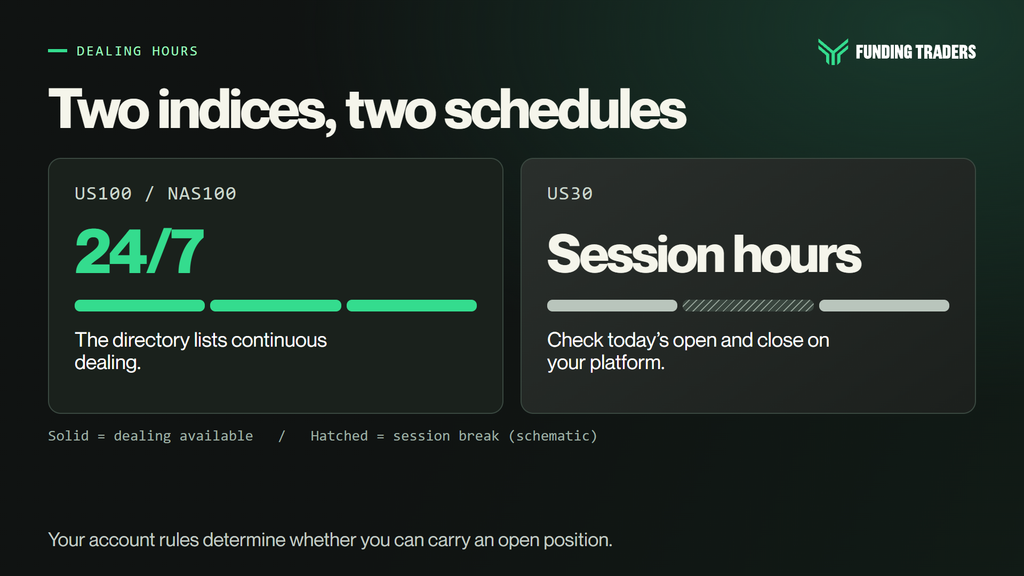
If you’re switching markets at FundingTraders, start with the symbol you plan to trade and the time you expect to close it. Say you usually trade US100 and want to try US30 on Friday. Both are US stock indices. Both carry zero index commission. Yet the platform lists different dealing hours, and the same dollar exposure requires different amounts of margin. Your account type adds one more question. Can you keep the position open until your planned exit?
Open the FundingTraders markets directory alongside your account. Pick a symbol, then work through three checks before entering an order. You can use the same process for a move from forex to gold, oil or crypto.
1. Find the dealing hours for your exact symbol
Start with the ticker in the order window. US100, which may appear as NAS100, tracks the Nasdaq 100. FundingTraders lists that instrument for 24/7 trading. US30 tracks the Dow Jones Industrial Average and follows its own trading session. A Sunday chart on US100 tells you very little about whether you can place a US30 order at the same time.
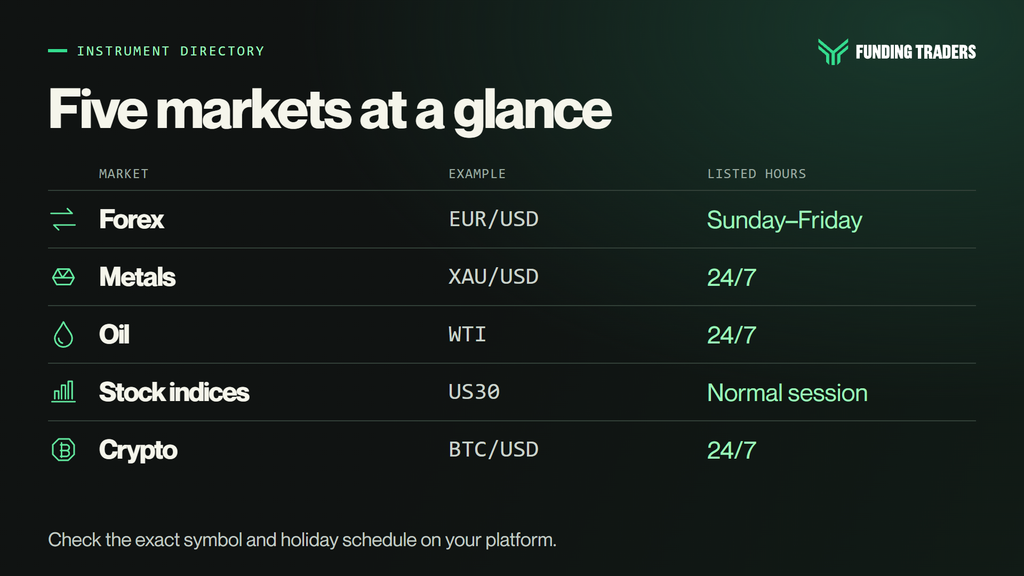
These five examples give you a starting point for switching markets at FundingTraders. The hours describe the instruments available on its accounts.
| Market | Example | What to check |
|---|---|---|
| Forex | EUR/USD | Trading runs from Sunday to Friday. Find the weekly close before planning a Friday exit. |
| Metals | XAU/USD (gold) | Gold is listed for 24/7 trading. Check the quoted spread when you intend to enter. |
| Oil | WTI crude | WTI is listed for 24/7 trading. Look up its contract size before reusing a lot size from gold. |
| Stock indices | US100 and US30 | US100 is listed as 24/7. Look up the normal session for US30 in your platform. |
| Crypto | BTC/USD | Bitcoin is listed for 24/7 trading. Check its leverage separately from other crypto pairs. |
On MT5 desktop, right-click the symbol in Market Watch and choose Specification. Find the trading sessions for the day you want, along with the volume step and contract size. A contract size tells you what one lot represents. The volume step tells you which increments the platform accepts. If your planned exit falls on a holiday, check the trading-hours notice for that instrument as well. MT5 Market Watch guide
Keep the ticker beside your notes. FundingTraders explains that contract sizes and spreads can vary across its available trading instruments. A lot size copied from your last EUR/USD order could give you quite different exposure on your first gold order.

2. Price the same exposure on both instruments
Imagine a 2-Step Swing account and two possible trades. Each represents $24,000 of index exposure. That amount, also called the notional value, gives you a fair basis for comparison even though each instrument has its own price and contract size. For this USD example, divide the notional value by the leverage multiplier to estimate the margin required.
| Index | Leverage | Calculation | Margin |
|---|---|---|---|
| US100 | 1:30 | $24,000 ÷ 30 | $800 |
| US30 | 1:40 | $24,000 ÷ 40 | $600 |
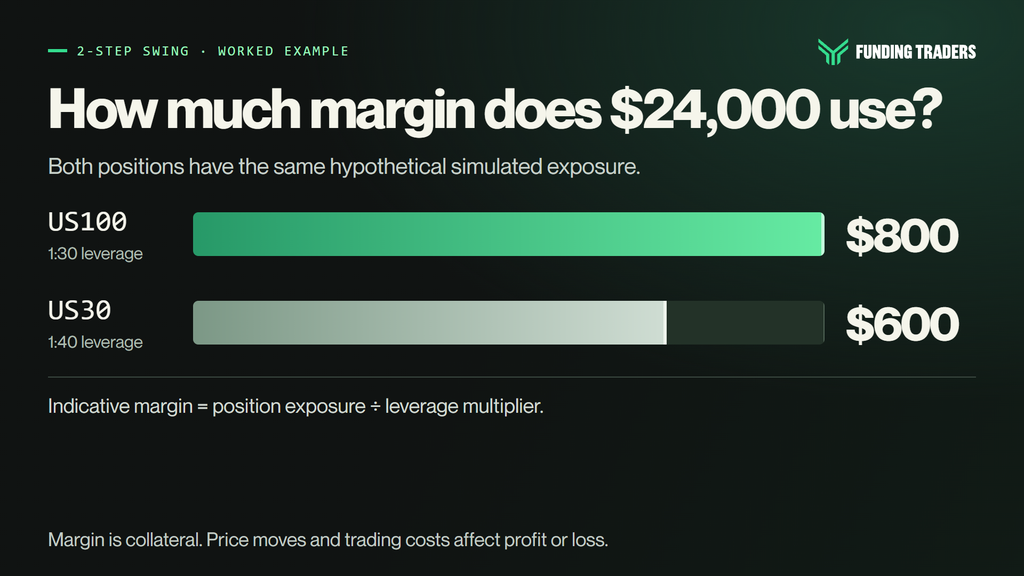
US30 ties up $200 less margin in this example. What happens if either index falls 1% while you hold a long position? At the same $24,000 starting exposure, each would lose roughly $240 before trading costs. Margin is the collateral required to open the position. Your gain or loss depends on the price move and how much exposure you actually took. When switching markets at FundingTraders, check the order ticket again after rounding to the permitted lot increment. The dollar exposure may have changed.
Index trades at FundingTraders carry zero commission. You still cross the spread when you buy at the ask and sell at the bid. If both quotes stand still, you could immediately sell only at the lower bid. Read both prices at the hour you intend to trade. Compare a potential loss with the room left under your account’s daily loss limit. At the funded stage, also check how FundingTraders assesses position sizing under its risk management rules.

3. Match the account’s holding rule to your exit
Keep the symbol fixed this time. Suppose it’s Friday at 16:50 in New York, you hold US100 and you want to exit an hour later. On 2-Step Day, the ordinary cutoff for this position is 16:55 New York time. The account closes it automatically five minutes from now, even though FundingTraders lists US100 for 24/7 dealing. The realized gain or loss still counts toward your account limits.
If you’re switching markets at FundingTraders over a holiday, look up the early close for the individual symbol. When its market closes before 17:00 New York time, the Day cutoff moves to five minutes before that market closes. For example, if the published early close were 13:00 New York time, the cutoff would be 12:55. Crypto is the Day exception. A BTC/USD position can stay open overnight and through the weekend. Check the 2-Step Day and Swing account rules for the instrument you hold.
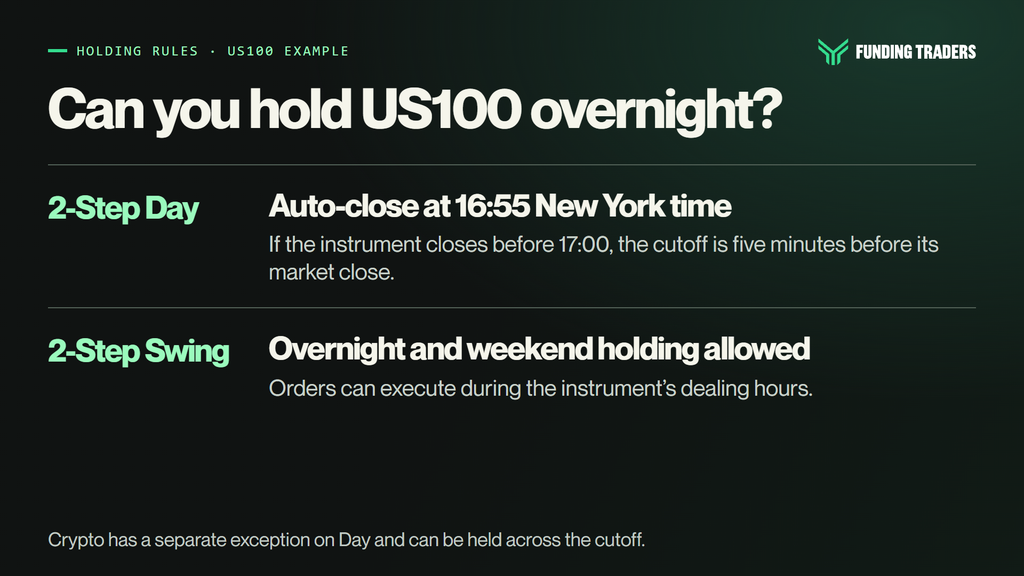
On 2-Step Swing, you can carry US100 overnight and over the weekend. You can also carry US30 while its session is closed, but you must wait for a tradable session to execute an exit. If US30 reopens at a different price from its last quote, that gap affects an open position. Before you leave the screen on Friday, write down when the instrument next accepts trades. Put any account cutoff beside it in the same time zone.
Common questions about switching markets at FundingTraders
Can I trade forex and gold on the same account?
Yes. FundingTraders offers currency pairs and metals on the same account. EUR/USD follows a Sunday-to-Friday schedule, while XAU/USD is listed for 24/7 dealing. Open each symbol’s specification to check what one lot represents.
Does a 24/7 symbol stay open overnight on 2-Step Day?
The position’s treatment depends on the instrument. On an ordinary day, a US100 position closes at 16:55 New York time on 2-Step Day. A crypto position such as BTC/USD can remain open. Use the account rule together with the symbol’s trading hours.
Is the required margin the most I could lose?
No. For the $24,000 US30 example, the $600 figure is the indicative margin required. The loss on an open trade changes with price and position size. Account loss limits are a separate constraint.
Do all crypto pairs use Bitcoin’s leverage?
On 2-Step Swing, FundingTraders lists BTC/USD at 1:10 and ETH/USD at 1:5. For the same dollar exposure, the ETH/USD position would require twice as much margin in this simple calculation. Look up the exact pair when changing crypto instruments.
Before your next order
When you’re switching markets at FundingTraders, write down the symbol, the dollar exposure and the time you plan to exit. Compare the platform’s session with your account’s cutoff. If you can explain why Friday’s US100 position closes on Day and can stay open on Swing, you have answered the question the 24/7 label alone leaves open.

Disclaimer: Trading involves significant risk and is not suitable for every investor. Past performance is not indicative of future results. The information provided in this article is for educational and informational purposes only and should not be considered financial, investment, or trading advice. All account rules, payout structures, profit splits, and promotional offers described in this article are subject to change at the discretion of FundingTraders. Promo codes may expire or be modified without prior notice. Always trade responsibly and only risk what you can afford to lose.