A forex risk management plan gives you a cash allowance before you click Buy or Sell. How much room does this order have within the limits you already set? The answer changes during the week. A $100 trade budget on Monday can become a $60 allowance on Tuesday, even if the setup and stop distance look identical.
This guide follows a fictional trader working in a USD account. You’ll size a ticket, reserve room for open orders, group two trades that both sell the dollar and write a response to a decline in equity. The numbers are personal examples. The worksheet near the end gives you a place to enter your own limits and any separate rules that govern your account.
Put cash limits in your forex risk management plan
Start with a reference value and a clock. The example trader records $20,000 of equity before the week begins. Their plan allows up to $100 per trade, $200 of losses per trading day, $400 per week and $150 combined on positions exposed to the same currency move. The $100 trade ceiling equals 0.5% of the reference equity. These dollar caps stay fixed for this example week.
Write down what counts as a loss. This trader adds up the cash lost on closed trades after fees. Winning trades do not refill the daily or weekly allowance. While orders are open or waiting to trigger, the trader reserves their planned cash risk. If all committed orders reached their stops, would another order still fit?
Set one daily boundary and one weekly boundary in a named time zone. Trading London in the morning and New York later does not start a second personal day. At a reset, carry forward the risk on any position or pending order that remains active. An order is still a commitment even if it was entered yesterday.
Convert the cash budget into an order size
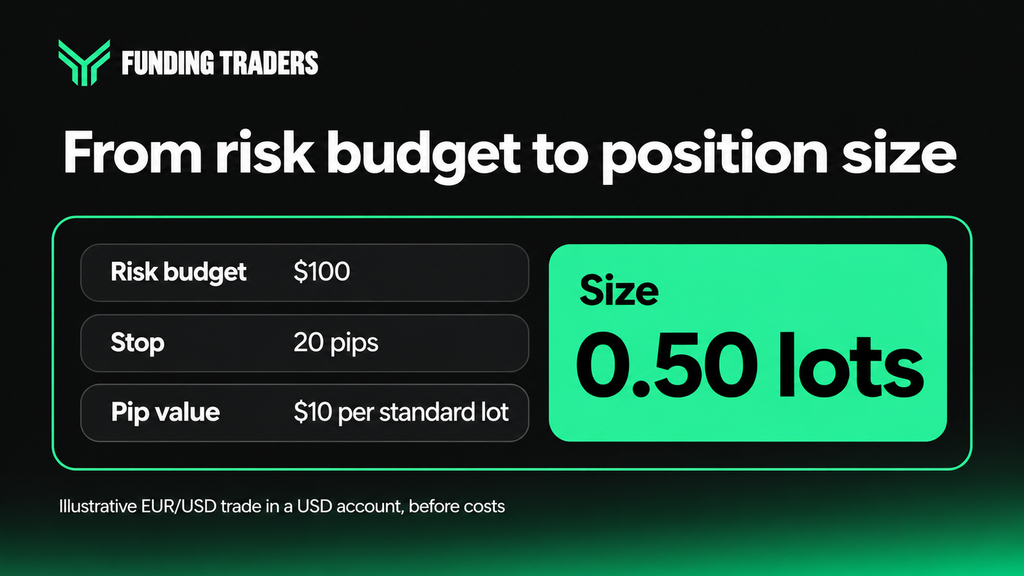
Mark the price where you would abandon the original trade idea. For a hypothetical EUR/USD long, suppose the executable entry is 1.0860 and the sell stop is 1.0840. The difference is 0.0020, or 20 pips. One standard lot represents 100,000 EUR in this example, so a 0.0001 move is worth $10 per lot in a USD account.
Lots before costs = cash budget ÷ (stop distance in pips × cash value of one pip per standard lot).
With the full $100 available, $100 ÷ (20 × $10) gives 0.50 lots before costs. At that size, the planned price move alone uses the entire allowance.
Now set aside $10 of the $100 for estimated costs and a possible worse fill. That leaves $90 for the move to the stop, or 0.45 lots. The price risk is $90 and the total reservation is $100. The trader chose $10 for this example. When the entry and exit already use the executable ask and bid, count the spread only once. Check the estimated costs again for the final ticket size.
If the chart calls for a 27-pip stop, dividing $90 by $270 gives 0.3333 lots. With a 0.01-lot volume step, round down to 0.33. The price risk becomes $89.10 and the reservation including the $10 allowance is $99.10. Skip an order if the smallest permitted size exceeds your cap. If the market gaps through an ordinary stop, the fill can be worse and the loss larger than the amount reserved.
Pip value depends on the pair, contract size and account currency. A EUR/GBP pip is first valued in GBP and must be converted for a USD ledger. Use the symbol specifications and the current conversion when you size it. FundingTraders’ position size calculator provides a second calculation to compare with your ticket.

Carry one loss ledger through the week
On Monday, the trader closes positions with $170 in losses. On Tuesday morning, another closed trade loses $80 including its costs. There is also an open EUR/USD long with $60 of reserved risk. The running weekly loss is $250, including Tuesday’s $80. The trader is considering a GBP/USD long.
| Personal limit | Amount already used or reserved | Room for the next order |
|---|---|---|
| $100 per trade | New ticket | $100 |
| $200 per day | $80 closed losses today + $60 open risk | $60 |
| $400 per week | $250 closed losses this week + $60 open risk | $90 |
| $150 shared short-USD risk | $60 on the open EUR/USD long | $90 |
The new order must clear every row. Its allowance is $60, the smallest available amount. For a 20-pip GBP/USD stop at $10 per pip per standard lot, reserving the same hypothetical $10 for costs leaves $50 for price risk. The largest size that fits is 0.25 lots. The two short-dollar trades would then reserve $120 together. The new $60 reservation uses the last of Tuesday’s daily room.
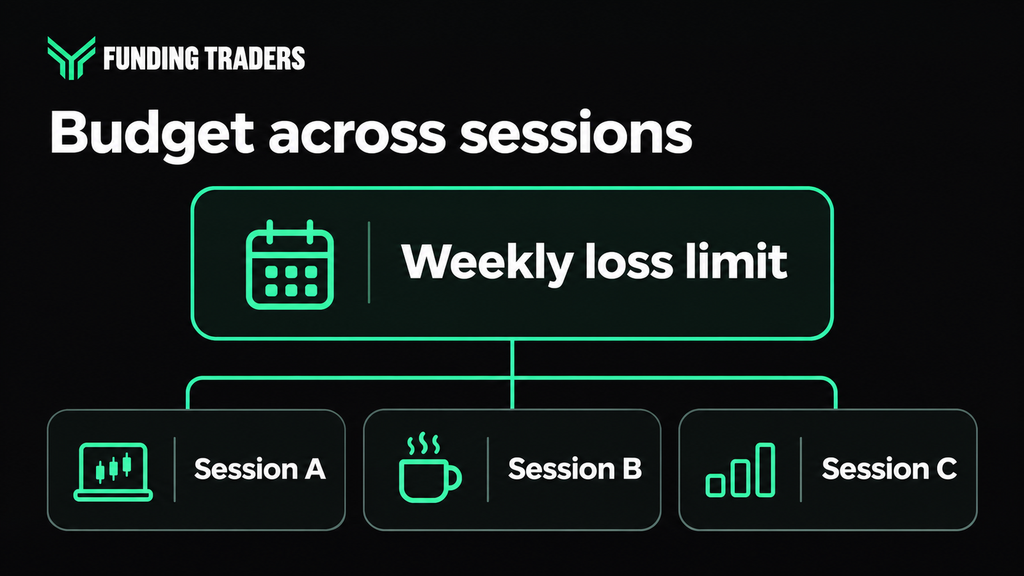
Replace a reservation with the actual result when the order closes. If the GBP/USD trade loses $45 in total, release its $60 reservation and add $45 to closed losses. The original EUR/USD position is still open. Daily room is now $200 − $125 − $60 = $15. Weekly room is $400 − $295 − $60 = $45. Charging both the closed loss and the old reservation would count the same risk twice.
A quiet morning later in the week doesn’t erase earlier losses. With $365 of closed losses for the week and no open orders, only $35 remains even at the start of a fresh trading day. Record a zero or negative allowance as a stop on new orders. If an unexpectedly bad fill takes the ledger past a cap, review any remaining commitments immediately.
Group trades by the currency they share
Buy EUR/USD and you are long euros and short dollars. Buy GBP/USD and you are long pounds and short dollars. If USD strengthens against both currencies, both orders can lose together. The $150 personal group limit asks what the two planned stops could cost in cash under that scenario.
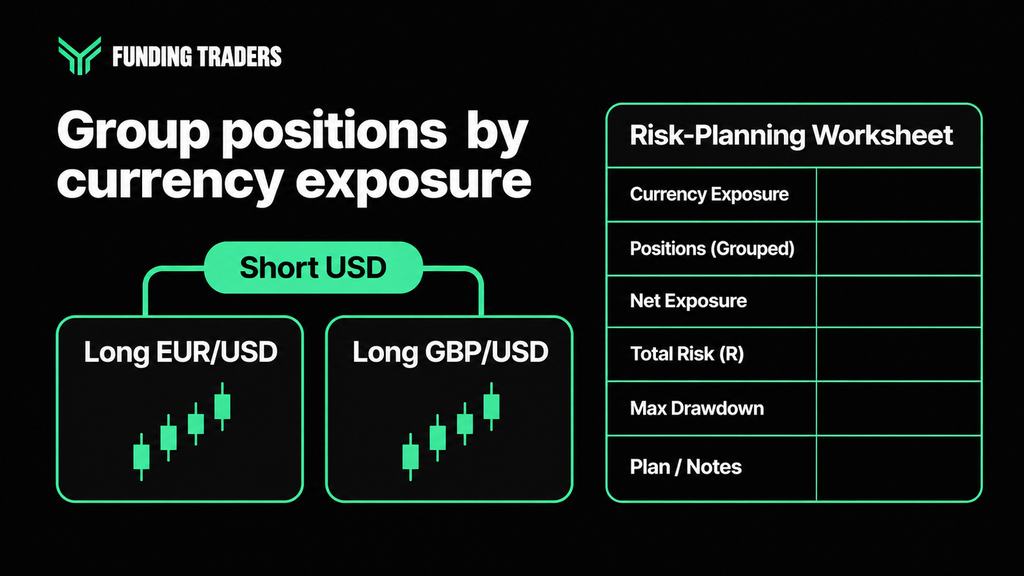
Put each position in every relevant currency group. The EUR/USD long belongs to both the long-EUR and short-USD groups, yet it enters total open risk only once. Include pending orders that could trigger together. Compare sizes in cash risk, because two tickets with the same lot size can have different stop distances.
Shared exposure comes from which currencies you buy and sell. Correlation describes how returns moved together over a particular sample and can change. A long EUR/USD and a short GBP/USD have opposing dollar legs. If the first sells exactly as many dollars as the second buys, those legs offset and the pair of trades leaves EUR/GBP exposure. If one sells $11,000 and the other buys $10,000, you are also short $1,000. Those are currency amounts. Record the cash at risk to each stop separately.
Leave room inside the firm’s limits
Keep the platform’s loss floors in a separate row. For example, the published 2-Step Day rules set daily loss at 5% of the initial challenge size relative to the day’s starting balance, and maximum loss at 10% of initial size with a fixed floor. Either equity or balance reaching a floor breaches the rule.
On a $100,000 Day account starting the day at $102,000, the two boundaries are $97,000 for that day and $90,000 for the account. The $5,000 daily distance is a program boundary. Your smaller personal cap, the current equity including floating losses, pending orders and a buffer for slippage can leave much less room. Recheck the platform before sending an order. This program example is separate from the $20,000 practice ledger.

Write the drawdown response before a losing week
Drawdown measures how far equity sits below a chosen peak. This fictional trader takes a snapshot at the end of each session, including unrealized gains and losses. A peak of $20,400 followed by equity of $19,992 gives a $408 drawdown, or 2% of the peak. A weekly loss ledger can reset while that drawdown continues. Intraday program limits still apply between snapshots.
| Personal trigger | Action already written in the plan |
|---|---|
| Session close at least 1% but less than 2% below peak | Reduce the ordinary $100 per-trade cap to $50 for new orders. Keep all tighter limits. |
| First session close at least 2% below peak | Pause new orders. Review outstanding risk and cancel working entries that would add exposure. |
| Before restarting | Reconcile fills, fees and order sizes to the journal. Record any rule breach and its correction. Complete two practice sessions that follow the written limits. |
| On resuming | Restart at the $50 cap. Record restart equity. Pause again for a fresh closing low below that value. Return to $100 only after two compliant resumed sessions and a closing drawdown under 1%. |
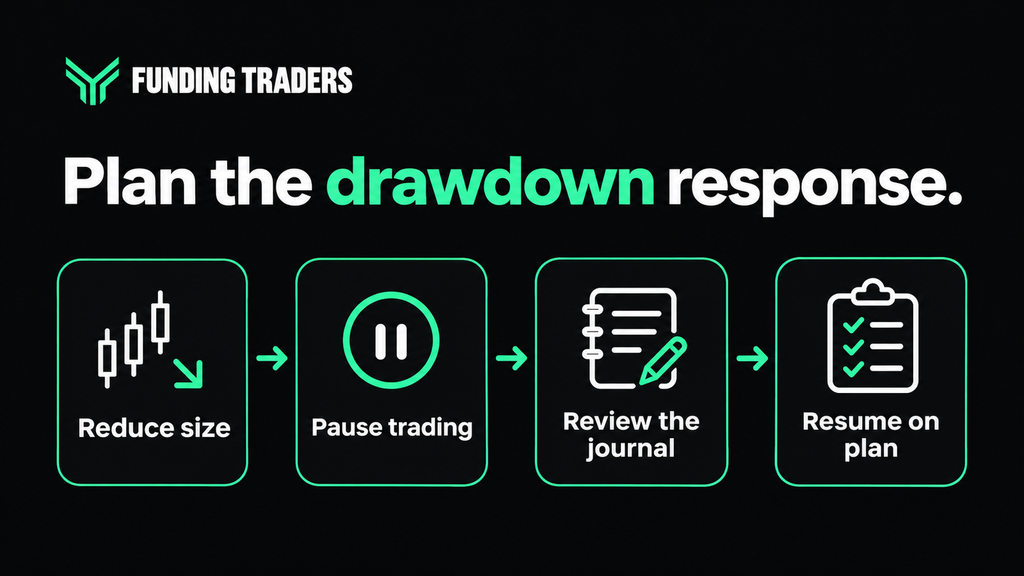
The review has a decision to make. If exits slipped during a news release, compare expected and actual fills and revise the cost allowance or the times you trade. If the losses were within plan, document that finding before changing the strategy. The drawdown recovery guide goes into more detail on the pause and restart process.
Copy this forex risk management plan worksheet
Copy the table into your journal. Fill the rule column before the first trade of the week. Record cash in your account currency. Keep the same worksheet open while you have working orders.
| Field | My rule or current value |
|---|---|
| Reference equity | Amount ___ · currency ___ · measurement date and time ___ |
| Per-trade allowance | Maximum all-in cash risk ___ · fee and slippage allowance ___ |
| Daily limit | Cash cap ___ · reset time and time zone ___ · treatment of winning trades ___ |
| Weekly limit | Cash cap ___ · week begins ___ · treatment of carried orders ___ |
| Shared currency exposure | Currency and direction ___ · maximum combined risk ___ |
| Firm limits, if applicable | Account and phase ___ · current daily floor ___ · maximum-loss floor ___ · buffer ___ |
| Drawdown response | Peak measurement ___ · reduce at ___ · pause at ___ · minimum review evidence ___ · restart size and conditions ___ |
| Proposed order | Pair and side ___ · executable entry ___ · stop price ___ · pips from entry ___ · cash value of a pip for one lot ___ |
| Available risk | Closed losses today / this week ___ / ___ · total open and pending risk ___ · same-currency risk ___ · smallest remaining allowance ___ |
| Order decision | Allowed lot step ___ · size rounded down ___ · planned loss including costs ___ · send, reduce or skip ___ |
| After execution | Actual entry and exit ___ · fees ___ · net result ___ · released risk reservation ___ · daily and weekly room left ___ |
At the weekly review, record one decision to keep or change. Date the next version and give the new rule a clear start time.
Common questions
How much should one forex trade risk?
Choose a personal cash ceiling that fits your account, loss tolerance, strategy and other commitments. Then apply the smallest remaining allowance from the trade, day, week, currency group and account rules. The worked ticket falls from $100 to $60 without changing the trade idea.
Should a winning trade restore my daily budget?
Define the policy in advance. The example uses gross losing amounts after costs, so a winner leaves the day’s spending limit unchanged. A net-profit-and-loss policy would give different answers and needs its own explicit rule.
Does margin available tell me how large to trade?
Free margin concerns the collateral needed to hold a position. A stop-based budget concerns the cash a move against you could cost. Check both before entering. Passing the margin check alone tells you little about the loss at your chosen stop.
How do I handle an order that might trigger overnight?
Reserve it alongside open positions while it can execute. Carry the reservation into the next personal period and include any other order that could trigger at the same time. Check the selected account’s holding and market-session rules before leaving it active.
Before the next order
A usable forex risk management plan leaves you with a number and an action. On Tuesday’s ticket, the day has $60 left, even though the weekly and shared-currency checks each show $90. The resulting 0.25 lots fits the assumptions on the page. When the price, costs, other orders or remaining loss room change, calculate the ticket again. A completed worksheet can also give you a clear reason to leave the order unplaced.

Disclaimer: Trading involves significant risk and is not suitable for every investor. Past performance is not indicative of future results. The information provided in this article is for educational and informational purposes only and should not be considered financial, investment, or trading advice. All account rules, payout structures, profit splits, and promotional offers described in this article are subject to change at the discretion of FundingTraders. Promo codes may expire or be modified without prior notice. Always trade responsibly and only risk what you can afford to lose.