What’s new with FundingTraders in May 2026 isn’t a bigger account or a louder challenge, it’s a pane of glass. The Dubai-based prop trading firm spent the month doing the two things a funded trader actually cares about: proving it pays, and helping its traders win. First came the Live Payout Tracker, a public, real-time feed of every withdrawal, with real names and real amounts and no cherry-picking. Then came FT Intel, a market-intelligence layer that hands retail screens the kind of positioning data trading desks have always kept for themselves. For serious traders comparing prop firms, those aren’t small gestures. They’re an argument about trust and edge, made out loud. Here’s what the firm shipped, why it lands, and where it still owes you homework.
Every Payout, On a Public Wall
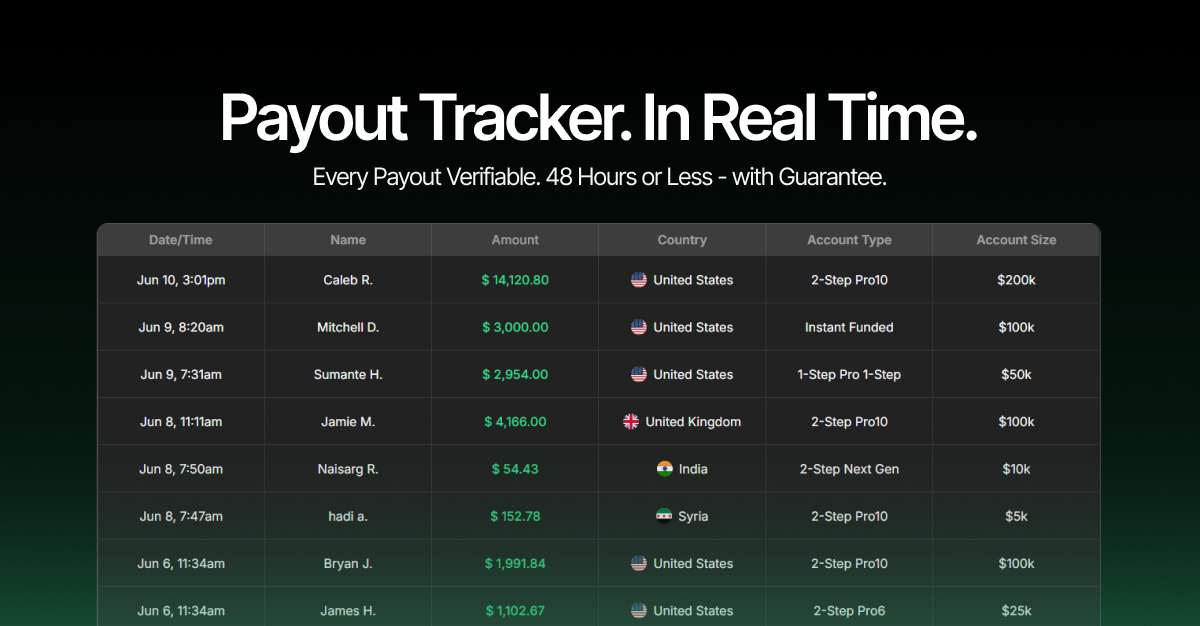
Most prop trading marketing asks you to take its word. FundingTraders stopped asking. The Live Payout Tracker that went live in May is a single public page, a running ledger of withdrawals as they clear, each row stamped with a trader’s name, the amount, their country, the account type, and the account sizes behind it. It reads less like a brochure and more like a stock ticker, which is exactly the point.
The firm’s stated mission for the feed is blunt: the fastest payout times in the industry. That’s a claim, not a fact, and a smart reader treats it as one, but the tracker at least lets you check the firm’s work, which is more than most operators offer. The payouts on display run through FundingTraders’ daily payouts rails, settled via Rise or Crypto.
Public payout feeds are no longer exotic, a handful of firms now run some version of a live wall, and “we show our payouts” is sliding toward table stakes rather than a moat. What separates a credible tracker from a decorative one is whether it’s unfiltered. FundingTraders is selling the unedited version: real names, real amounts, no curation. If that holds up over months rather than launch week, it’s a genuine differentiator. If it quietly starts filtering the embarrassing days, it’s wallpaper. May’s version looked like the real thing.
The traders on that wall started exactly where you are now — at the evaluation. Code FT50 takes 50% off any account from $5K to $200K, so the cost of finding out is the lowest it’ll be.
It helps to remember why this became a battleground at all. The prop sector’s credibility took real damage over the past couple of years, enough that the question “will they actually pay me” curdled from paranoia into the first thing any informed trader asks. A live payout wall is the most direct possible reply: not a testimonial, not a screenshot a marketing team hand-picked, but a feed that updates whether the firm likes the day’s numbers or not. FundingTraders is betting that the firms left standing after the next shakeout will be the ones that competed on proof, and on the evidence of May, it intends to be one of them.
The Intelligence Play: FT Intel and the News-Trading Edge
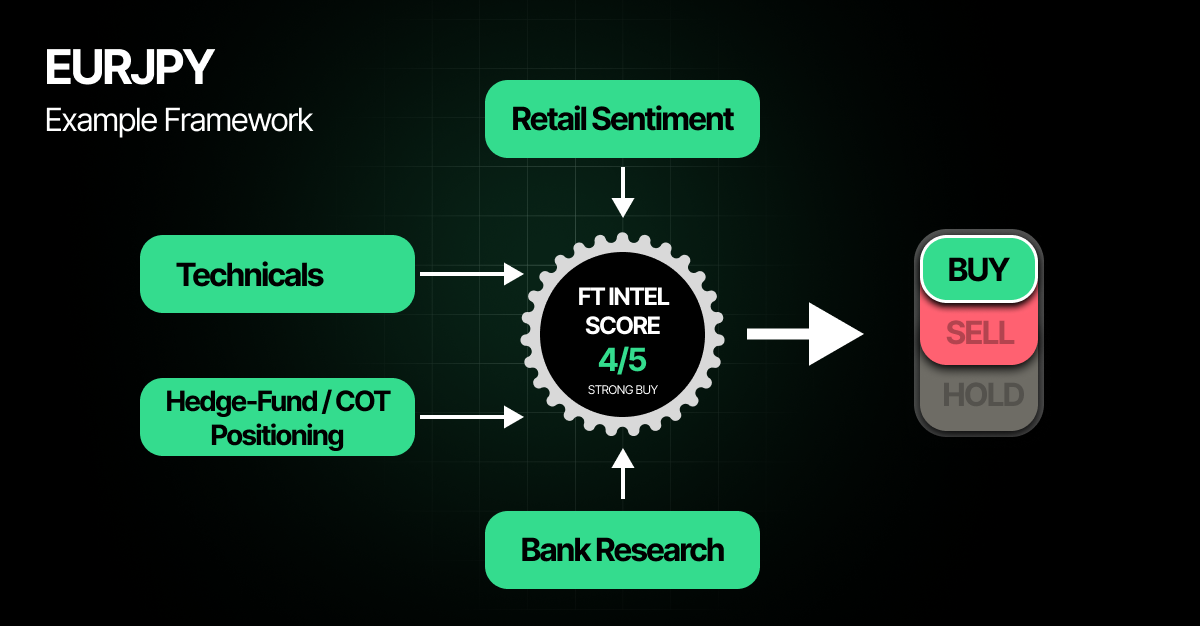
If the tracker was the trust play, FT Intel was the edge play, and arguably the more interesting of the two. The pitch, laid out in the firm’s own May posts: most retail traders lose because they’re reading half the board. FT Intel hands them the other half. It bundles four inputs that rarely sit on one screen, clean technical reads, retail sentiment, hedge-fund positioning pulled from COT data, and actual bank research, then compresses them into an FT Intel Score and a plain BUY, SELL, or HOLD tag.
The firm showed its homework with a worked example. A late-May EURJPY trade idea carried an FT Intel Score of 4/5: weekly and daily uptrend with a forming support level near 184.500, hedge funds neutral on the euro and bearish on the yen per COT, retail selling it heavily, and a CACIB report flagging the pair as undervalued. That’s not a signal service barking entries. It’s a confluence model, the kind of multi-factor read a desk analyst would assemble before a meeting, handed to a retail trader as a pre-session cheat sheet.
FundingTraders is candid about the trade-off, which is refreshing. Layer FT Intel onto a real trading strategy, the firm argues, and you get fewer trades, not more, but higher-quality ones, because the tool keeps you out of setups where the smart money sits on the other side. For disciplined traders already running their own trading rules, that’s a feature. For anyone hunting volume, it’ll feel like a brake. Both reactions are correct.
There’s a quieter psychological wager underneath. The hardest discipline in trading isn’t finding setups, it’s sitting on your hands when the board is mixed, and most traders are constitutionally bad at it. A tool that actively subtracts trades is fighting the user’s own dopamine, which means FT Intel only earns its keep for someone willing to let it veto a position they’d otherwise take. The risk cuts the other way too: lean on the score as gospel and you’ve simply outsourced your judgment to a four-input model that, like every model, will be confidently wrong sometimes. Used as a filter it sharpens a process. Used as an oracle it just relocates the mistake.
The intel layer also sharpens what’s always been one of the firm’s quieter advantages: news trading. FundingTraders permits event-driven strategies across every stage of evaluation and funding, no rule that ankle-cuffs you the moment a print drops. Pair that permission with FT Intel’s instant market-moving alerts and the firm’s weekly Market Insights briefings (May’s edition tracked a hawkish Federal Reserve under a new chair, fading oil, and a jobs-week showdown), and you get a coherent thesis: trade the market when it actually moves, with institutional context instead of vibes. Plenty of prop firms still treat news trading as a liability to be policed. FundingTraders is treating it as a product.
The timing isn’t accidental. May handed traders a genuinely event-heavy tape, a Federal Reserve leadership handover, an outgoing chair due to speak, oil sliding, a jobs print looming, the exact conditions under which a no-news-trading rule forces you to sit out the most tradeable hours of the month. A firm that lets you trade those windows, and hands you context going in, is making a fundamentally different bet about where edge lives than one that files volatility under “compliance risk.”
Most firms bench you the moment a print drops. FundingTraders clears you to trade the news at every stage — and now hands you the bank-level read going in. Take FT50 for 50% off your evaluation and put the edge to work the next time the tape actually moves.
Funded Accounts, Platforms, and the Plumbing
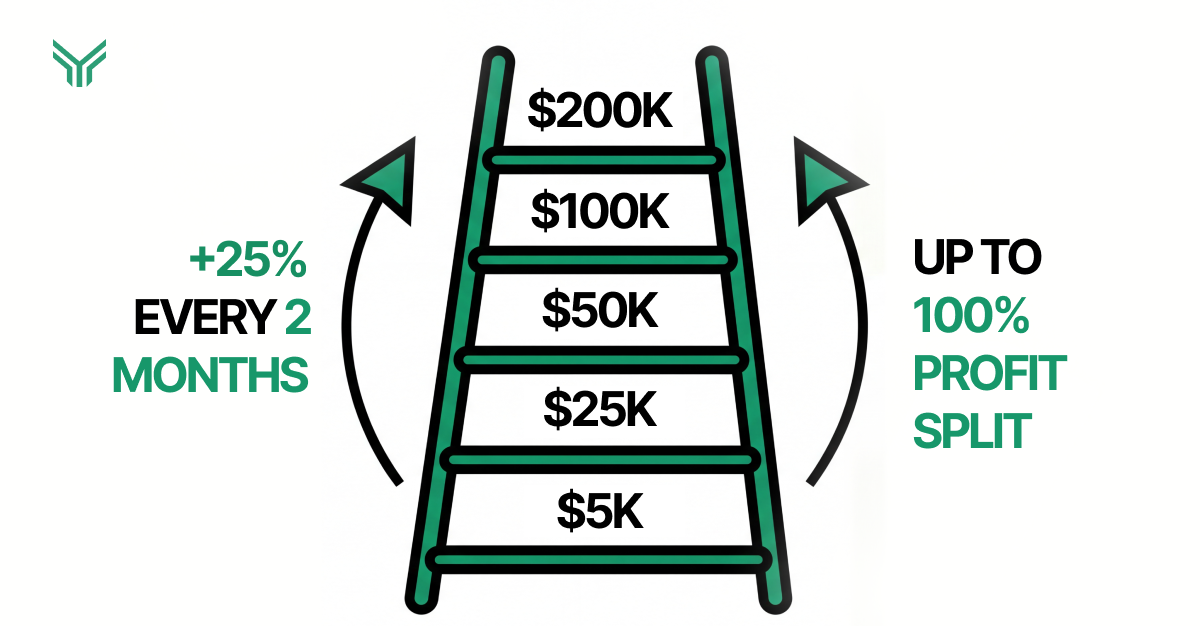
Strip away May’s two launches and the machinery underneath is what makes them matter. FundingTraders runs funded accounts from a $5K starting balance up to $200K, across a tiered lineup the payout tracker quietly exposed, 1-Step Pro, 2-Step Pro6 or Pro10, and a fully instant funding route for traders who’d rather skip the evaluation entirely and open a new account already funded. That spread of funding options is the firm’s real answer to “different kinds of traders” and different trading styles; the $25k Pro6 trader and the $200k instant-funded trader showed up on the same wall this month.
The profit split runs up to 100%, with zero commissions charged on evaluations, a profit share structure that only makes sense because of how the firm earns. FundingTraders says its revenue mirrors successful traders rather than feeding on failed challenges, which is the cleanest alignment a prop firm can claim and, again, exactly the kind of claim the new tracker exists to back up.
That alignment is the firm’s most important structural claim, so it earns a skeptic’s read. A prop operator can make money two ways: off traders who fail and forfeit their fees, or off a cut of the traders who win. The first model quietly wants you to blow the account; the second only profits when you don’t. FundingTraders places itself firmly in the second camp, and the public payout feed is, conveniently, the proof that the second camp generates real money. No outsider can fully audit whether the economics hold, but the incentive structure the firm describes is the one a trader should want, and it’s rarer in this business than the marketing across the sector would have you believe.
On execution, the firm spreads across multiple trading platforms so your trading style isn’t dictated by a single vendor’s quirks. Forex traders get the deepest pool, but the firm’s asset menu runs through indices, metals, commodities, and crypto, and it permits copy trading between your own setups, EAs operating inside the risk limits, and overnight and weekend holds. For swing trading and longer-horizon plays, that last permission is the one that counts, no forced flat-by-Friday rule quietly eating your thesis.
Then there’s the scaling plan: a 25% allocation bump every two months for traders posting consistent profits. It’s not the most aggressive ladder in the industry, but it rewards consistent performance over hot streaks, which tends to age better for the firm and the trader alike.
The Fine Print Worth Reading
No editorial briefing worth its byline ends on a victory lap, so here’s the homework, for FundingTraders and for any prop trading firm you’re weighing.
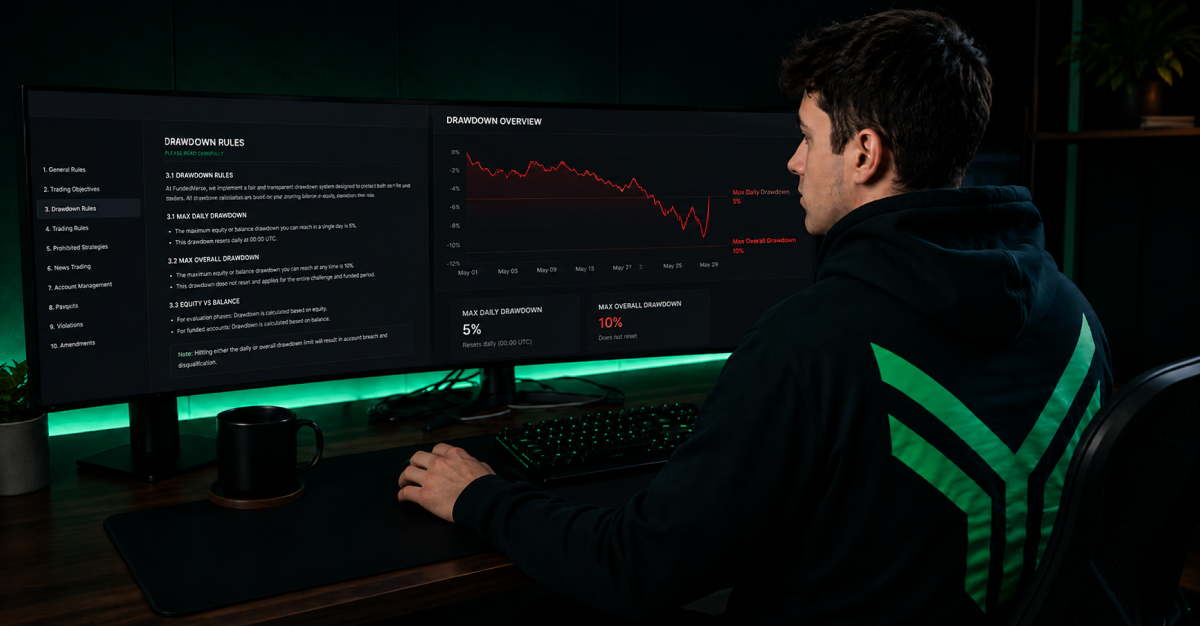
Read the trading rules before the marketing. The drawdown rules here, a 10% total ceiling and a 5% max daily loss, define your whole risk envelope, and you want to know precisely how each is calculated, including whether the daily cap measures off your starting balance or your peak equity, because that single detail changes how a single trading day can end your run. Understand what triggers a hard breach versus a soft warning. Confirm the maximum leverage on the instruments you actually trade, since a number that flatters a forex position can punish an index one.
Ask the questions the references don’t answer. Is there a consistency rule or a consistency score that caps how much of your profit can come from one day or one trade? Many firms run one; verify FundingTraders’ exact stance rather than assuming. Scrutinize any add-ons and what they cost. And be skeptical of the phrase “payout guarantee” wherever you see it across the industry, a guarantee is a marketing word; a public, unedited payout history is evidence, and evidence is what FundingTraders chose to put on the wall this month. And because the tracker stamps each withdrawal with a time, you can run the firm’s bragging math yourself, line up the timestamps and decide whether “fastest in the industry” is earned or aspirational. Read the negative reviews on Trustpilot alongside the glowing ones; the gap between them usually tells the real story.
Above all, remember the part no firm can outsource. The capital may be the firm’s, but the discipline is the trader’s responsibility. Consistent risk management is what turns a funded seat into a paycheck and its absence is what turns it into a fast, expensive lesson. The best trading conditions in the world won’t save a strategy with no edge, and FT Intel, for all its institutional polish, is a confluence tool, not a crystal ball.
Trust Is the Product Now
Strip May down to its frame and the story is simple: a firm that decided its two best arguments were we’ll show you we pay and we’ll help you win, and built a product for each. The Live Payout Tracker and FT Intel attack the two oldest objections in prop trading, will they actually pay, and can a retail trader really get an edge, and they do it with receipts rather than adjectives. That’s what’s new with FundingTraders, and it’s a more interesting answer than another round of bigger accounts.
None of it removes the work. The tracker’s value depends entirely on staying unedited, FT Intel’s value depends on traders using it as a filter rather than a crutch, and your outcome depends on the risk management the firm can’t do for you. Do the homework the firm can’t, read the trading rules, test the customer support, weigh the negative reviews, understand the drawdown rules and the revenue model that’s supposed to keep everyone’s interests aligned. A funded program is a tool. You’re still the one holding it. That’s not a hedge tacked onto the end, it’s the whole arrangement. A firm can hand you capital, three trading platforms, weekly settlement rails, and an intel feed that reads like a desk analyst’s morning notes, and none of it substitutes for the unglamorous daily discipline a funded trader has to bring alone. What May proved is that FundingTraders is at least competing on the parts it can control, and doing it in public.
What to watch into next month: whether the payout wall holds its candor past the launch glow, and whether FT Intel grows past forex pairs into the firm’s full asset menu. If the names keep landing on the wall, the argument makes itself. Your name could be the next row.
Stop watching other people’s payouts and put your own name in the queue. Use FT50 for 50% off your account, clear the target, and let the weekly cadence do the rest.
Disclaimer: Trading involves significant risk and is not suitable for every investor. Past performance is not indicative of future results. The information provided in this article is for educational and informational purposes only and should not be considered financial, investment, or trading advice. All account rules, payout structures, profit splits, and promotional offers described in this article are subject to change at the discretion of FundingTraders. Promo codes may expire or be modified without prior notice. Always trade responsibly and only risk what you can afford to lose.