
The Hormuz Bottleneck: Policy Paralysis in a Supply-Shock Economy.
Last week, it handed the market more information than it could cleanly process in five sessions. CPI printed above expectations, confirming what every trader watching the oil board already suspected: the Hormuz supply shock is bleeding beyond energy futures and into the broader price index. The Federal Reserve now sits in one of the most uncomfortable policy positions in a generation. Rate cuts look irresponsible. Rate hikes would accelerate a labor market already showing real weaknesses. The Fed has no clean lever, and the market knows it. These market insights are critical for anyone trying to navigate the current macro landscape.
The ECB met on March 17 and held rates at 2.00%, exactly as priced. But the commentary carried more weight than the decision itself. European energy vulnerability is no longer a quarterly market update talking point. It is a live margin problem for industrial consumers and businesses across the continent, and it will not fully show up in the hard data for another four to six weeks. The competitive landscape for capital has shifted, and geographies that looked attractive six weeks ago are being repriced session by session. For clients managing cross-border portfolios, understanding this shift is essential to protecting capital.
The Strait of Hormuz remains effectively closed. No confirmed timeline, no credible diplomatic framework, and tanker transit data showing no material improvement. Leading analysts at JPMorgan, Barclays, and Goldman Sachs have all characterized this as the most disruptive peacetime energy event in decades. Their research underscores how the industry is grappling with supply constraints not seen in a generation. This week, the focus shifts from absorbing the shock to understanding what it means for the next 60 to 90 days, and the market intelligence emerging from institutional desks will inform how traders position accordingly.
When the macro environment moves this fast, preparation is the only edge that holds. FundingTraders back traders who are ready to act when the setup confirms, not scrambling to find capital after the fact. Start your challenge today at FundingTraders.com and use code MADNESS for 30% off plus a 100% profit split on everything you earn.
Quick Summary Box
This is not a week to approach casually. The data calendar is dense, the geopolitical backdrop is live, and the macro framework that governed Q1 is being stress-tested in real time.
XAUUSD enters near $5,200, holding above its breakout zone after last week’s dollar-driven reversal from $5,417. The bull case is structurally intact, and the next leg higher is one hot inflation read away.
WTI Crude consolidates between $101 and $109. The directional bias does not change until Hormuz reopens. Every closed session adds to a cumulative supply deficit that will eventually need to be resolved in price.
Equities remain the most exposed asset class. If PMI data this week confirms a slowdown while energy costs stay elevated, the stagflation read on the S&P 500 becomes very difficult to argue against.
The Dollar is the wild card. DXY’s strength last week was safe haven demand overriding rate logic, and that dynamic can reverse quickly on any Hormuz headline shift.
Asset Breakdown: Market Research on Global Markets
XAUUSD (Gold): The Institutional Bid Is Not Going Away
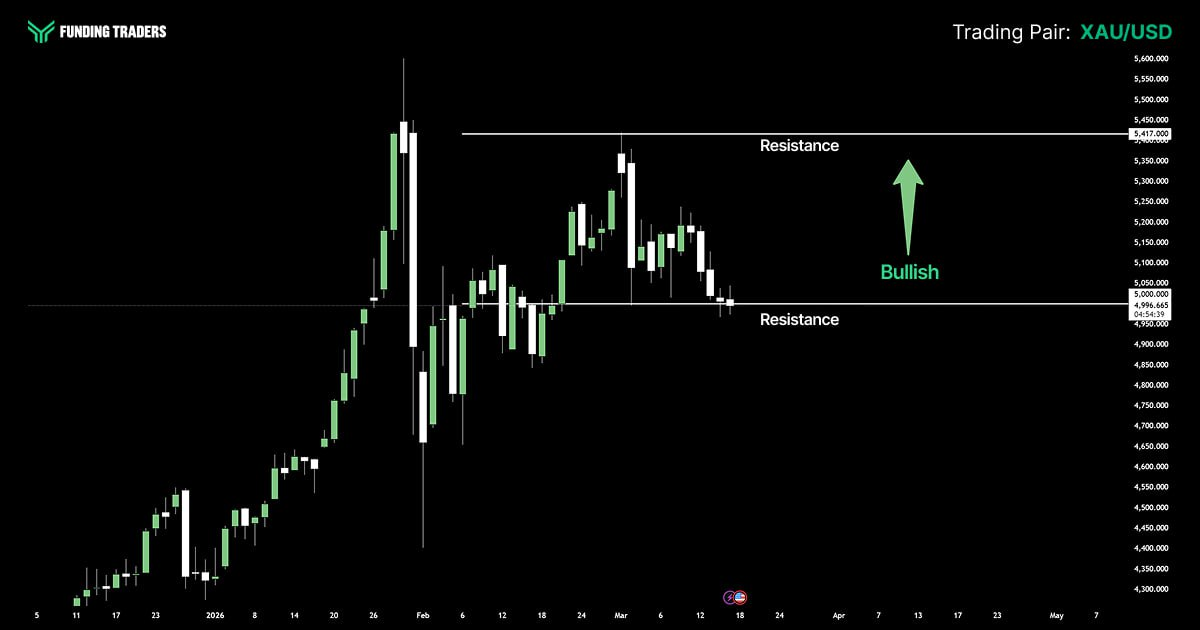
The latest insights on gold are best understood by separating noise from structure. The spike to $5,417 and the subsequent pullback were a short-term dollar event, not a fundamental deterioration in the thesis. The People’s Bank of China extended its buying program for a 16th consecutive month. Goldman Sachs holds a $5,400 target for 2026, and ING Think forecasts a Q4 average of $5,450. These are dedicated, long-horizon buyers whose organization-level mandates do not reverse on a single data print.
The Fed paralysis narrative is gold’s most important macro tailwind right now. An economy shedding jobs while energy-driven inflation pushes headline CPI higher is the exact environment where rate policy becomes genuinely indecisive, and where investors historically rotate into hard assets with real depth and quality. CFTC net longs still have room to grow before reaching historical extremes, which means the speculative community has not yet chased this move in size. That is dry powder. If Fed speakers this week lean more resigned rather than hawkish, it adds meaningful volume to the upside fast.
EUR/USD: Digesting the ECB and Living With Elevated Gas Prices
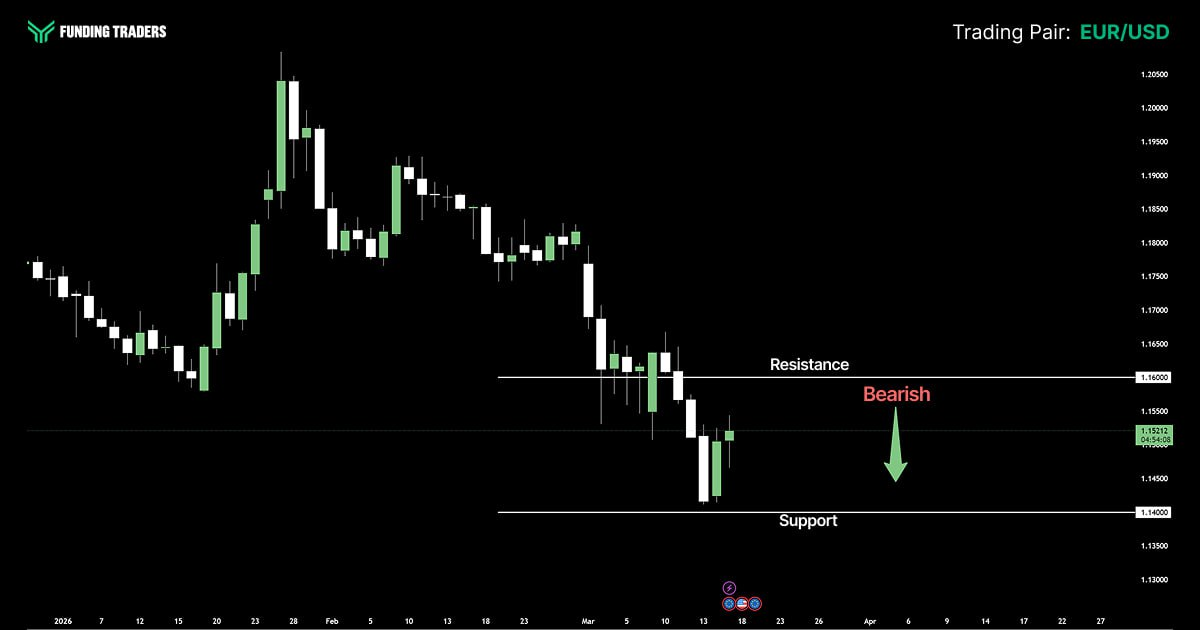
The ECB held, but the forward guidance revealed a committee more concerned about economic growth than it is willing to publicly admit. European PMI data this week will either support or complicate that read. The structural picture for EUR/USD does not improve quickly. Energy costs remain a sustained tax on consumers and businesses across the eurozone, compressing revenues and slowing demand in ways that keep the euro from mounting any durable rally.
EUR/USD closed last week below 1.1600, and the bias stays to the downside absent a credible Hormuz resolution. Clients holding euro-denominated exposure need a clear Q2 framework, not just a week-by-week update. The medium-term story continues to favor dollar strength.
GBP/USD: Three-Month Lows and a Dovish Bank of England
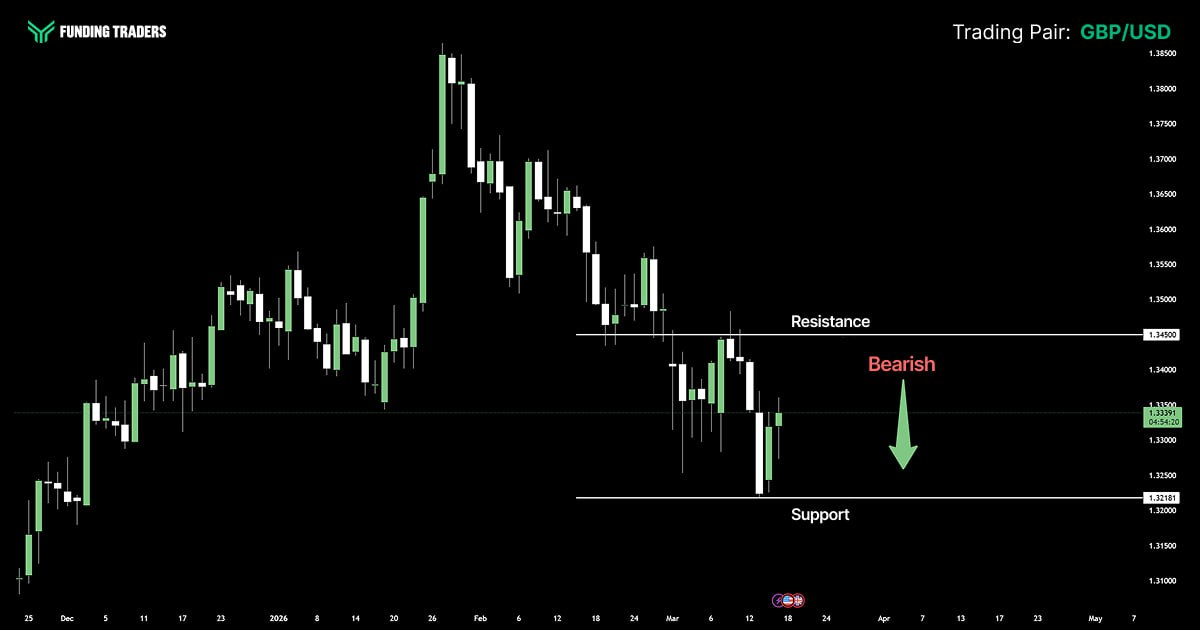
Sterling sits near 1.3250, and the UK economic story is not improving fast enough to challenge the Bank of England’s dovish trajectory. Goldman Sachs forecasts three more cuts this year, bringing the rate to 3.00%, well supported by unemployment sitting at 5.2%. Friday’s GDP print is the most timely read of the week for GBP traders. A weak number validates the BoE’s caution and opens the door to further selling. An upside surprise does not change the structural story but gives better entry levels to traders already positioned directionally.
GBP carries a double discount right now: a weak domestic economy inside a global risk-off environment with a dovish central bank. That makes it one of the more straightforward setups on the board this week, provided the trader waits for confirmed levels rather than positioning ahead of the data blind.
USD/JPY: Yen Still on Edge
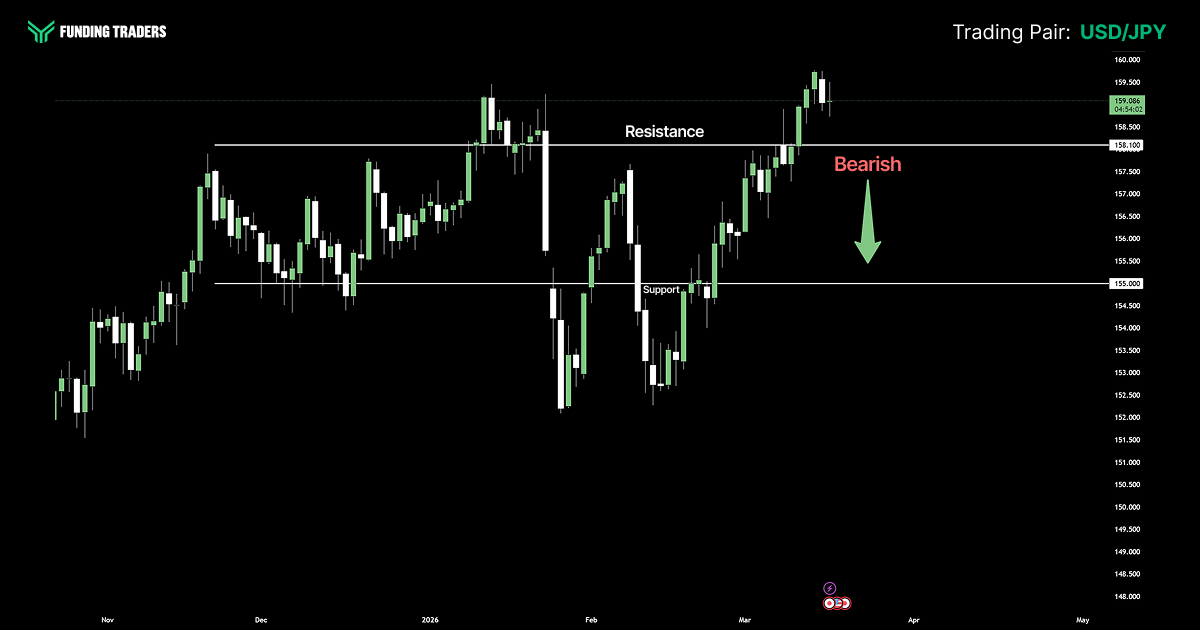
USD/JPY trades near 158.50, and the yen continues to attract institutional safe-haven flows whenever risk appetite deteriorates. The carry trade that has funded long positions in higher-yielding assets for two years is showing structural cracks, and the research coming out of Asian desks reflects genuine concern about the pace of potential unwinding. 155.00 is the key floor to watch. A breakthrough at that level would have knock-on effects across global markets well beyond the forex board. For any organization carrying yen-denominated liabilities, this is a balance sheet event in slow motion, not just a currency trade.
USD/CHF and AUD/USD: Safe Haven vs. Risk Barometer
USD/CHF near 0.8850 and AUD/USD near 0.6900 reveal exactly where institutional capital is sitting. The franc is receiving dedicated flows from investors who want genuine depth, low volatility, and safe-haven quality without European proximity risk. The CHF and gold correlation during risk-off events is one of the most reliable signals across global markets, and both are behaving exactly as expected.
AUD/USD is caught in a complex tug of war between the commodity tailwind from higher oil and metals prices and the structural headwind of global growth concerns. The net direction this week depends on how risk sentiment settles after the US PMI data and Fed commentary. It is a clean barometer of appetite for growth-sensitive assets and worth watching closely as a read on the broader market.
WTI Crude Oil: Market Held Hostage by a Single Headline
WTI consolidates between $101 and $109 with a clear directional bias that does not shift until the Strait reopens. The process for trading this market is straightforward: wait for consolidation above $100, identify confirmed support, and size to accommodate the range rather than fight it. Momentum traders who entered below $90 are managing significant gains and are a source of two-way risk on any given session.
Any Hormuz headline remains a binary event. A credible reopening signal triggers violent safe-haven reversals. Further escalation, particularly any threat to production infrastructure in Iraq or Kuwait, puts the $120 to $130 range that UBS has flagged as a live scenario firmly back on the table. Have a plan for both before the week opens.
These instruments, especially gold, structural setup is one of the clearest macro trades of 2026, and the traders capitalizing on it are doing so with funded accounts, not their own risk. At FundingTraders, qualified traders receive real capital to execute exactly these kinds of high-conviction setups. Join the platform and use code MADNESS at checkout for 30% off your challenge, plus a 100% profit split.
Key Economic Events: March 16–20 (GMT+2)
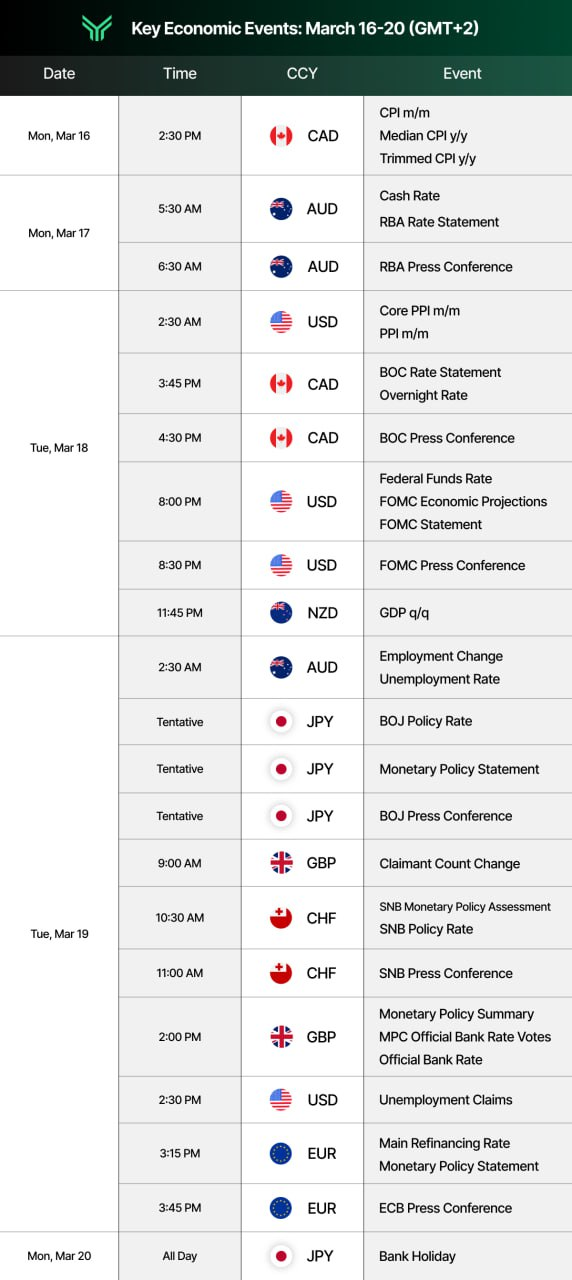
This condensed calendar is adapted from the Forex Factory economic calendar at forexfactory.com, a leading resource professional traders use to track market‑moving macro news and central bank events in real time.
Asset Watchlist: Market Intelligence Snapshot
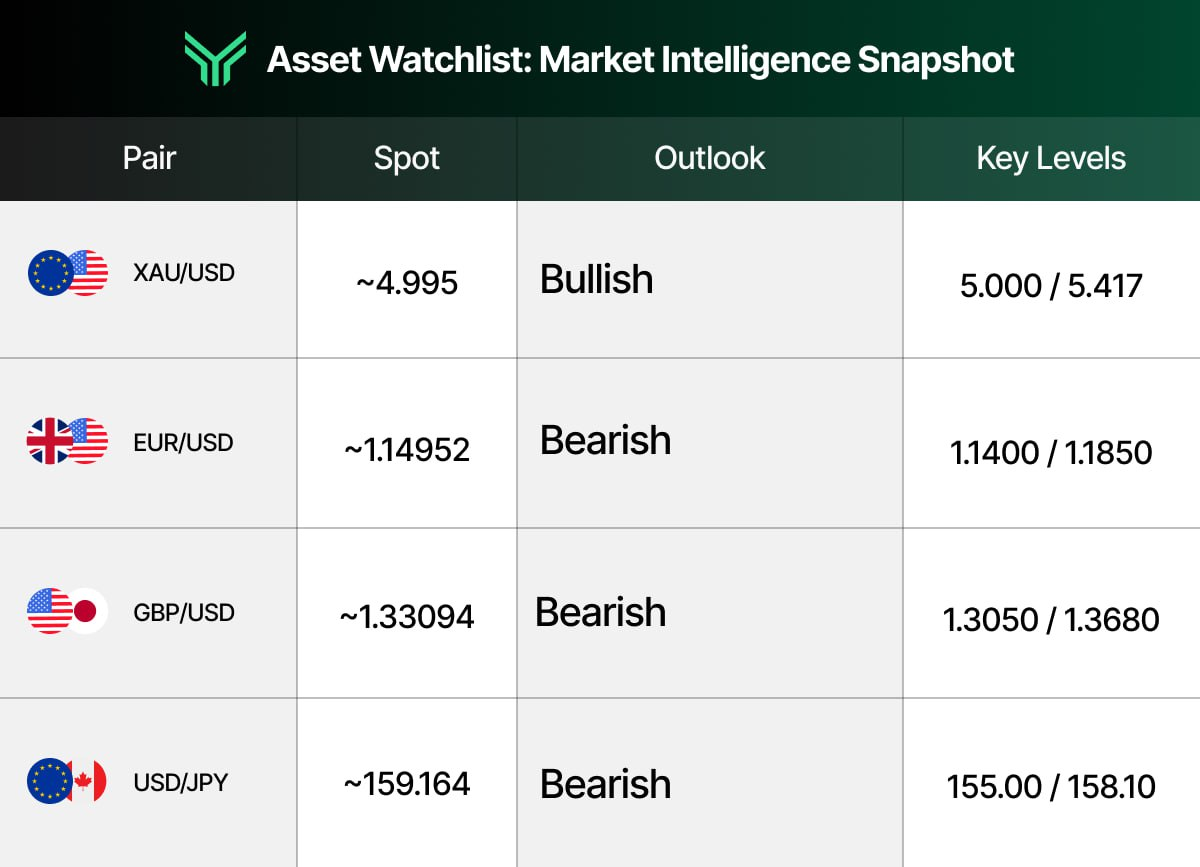
This table delivers market insights at a glance, helping traders quickly analyze key levels and understand current trends.
Actionable Insights for the Week to Drive Growth
The traders who gain the most from a week like this are not the ones who predicted the exact CPI number. They are the ones who arrived Monday with a comprehensive methodology already built, covering every scenario before the market forces a reaction.
Phase one continues as long as WTI holds above $100 and Hormuz stays closed. The stagflation trade remains the dominant framework: long XAUUSD toward $5,300 to $5,400, short EUR/USD on rallies toward 1.1600, and flat or short on risk-sensitive equities. These are well-defined trades built for investors and traders who understand the macro environment in which they are operating.
Phase two begins at one of two triggers. A Hormuz reopening reverses safe-haven trades violently. Further escalation deepens the stagflation playbook and puts oil toward $120 as the base case. Generative AI tools and innovative data services can help traders analyze information faster than ever, and that speed matters in a week where macro events are arriving in clusters. But faster data only drives growth when the underlying framework is sound. Without defined levels and a clear process, speed is just faster noise.
Stay Ahead of the Market
These latest insights are built on the same research framework that has defined FundingTraders throughout 2026. The goal is a comprehensive view of the macro environment paired with actionable intelligence that grounds your decisions in what the data is actually showing.
The world is repricing risk in real time. The investors and organizations who stay ahead of that repricing are the ones who arrive prepared, execute with confidence, and adjust as new information arrives. Explore the full FundingTraders platform, access the Help Center, and connect with a team dedicated to helping traders at every level gain the depth and quality of preparation that competitive markets demand.
That description is exactly the kind of trader FundingTraders is built to back. If that’s you, don’t wait for a quieter week — this market rewards traders who move while the opportunity is live. Use code MADNESS at FundingTraders.com right now: 30% off your challenge, 100% profit split, starting today.
Disclaimer: This content is for informational and educational purposes only and does not constitute financial, investment, or trading advice. Trading forex and other financial instruments involves significant risk and may not be suitable for all investors. Past performance is not indicative of future results. Always conduct your own research and consult with a licensed financial advisor before making any trading decisions. FundingTraders is a proprietary trading firm and is not a broker-dealer or registered investment advisor.