If you only read Prop Firm News for the discount codes, you missed the real story of May 2026: the industry spent the month arguing, in public and at high volume, about where its money actually comes from. FundedVerse launched a whole brand around the question, building a six-part “Vault System” and telling traders the single most important thing to ask any firm is “where, exactly, does my payout come from?” Days earlier, a rival CEO had answered it bluntly, most traders never get paid, and some of the rules pretending to protect them are really there to delay the check. Two operator-economics deep-dives then put numbers on the suspicion. This was the month the conversation moved from price to substance. Here’s what happened, why it matters, and which firms came out of it looking serious.
Quick Summary
May 2026 read less like a sales month and more like an audit. The dominant thread was transparency: who really pays, who really doesn’t, and what the rules are actually for. FundedVerse arrived positioning itself on infrastructure over price; FundedHive’s CEO called the consistency rule “a payout trap” and admitted under 10% of his funded traders stay funded long-term; and two Track360 pieces from Finance Magnates–adjacent operators laid out the uncomfortable math, roughly 60–75% of a typical firm’s revenue comes from challenge fees paid by people who fail. Against that backdrop, the best prop firm to back is the one whose incentives don’t depend on you washing out. That’s the cleanest case for FundingTraders, a Dubai-based proprietary trading firm whose stated revenue model mirrors successful funded accounts rather than profiting from blown evaluations, offering weekly payouts, news trading permitted, and profit split up to 100%. Elsewhere: institutional prop trading firms shrugged off Q1 volatility, AI started reshaping hiring, and Axi rolled into Cape Town with Manchester City and a $1M funding program. A month of grown-up questions, and a few firms that already had answers.
The Month Prop Firm News Stopped Being About Price
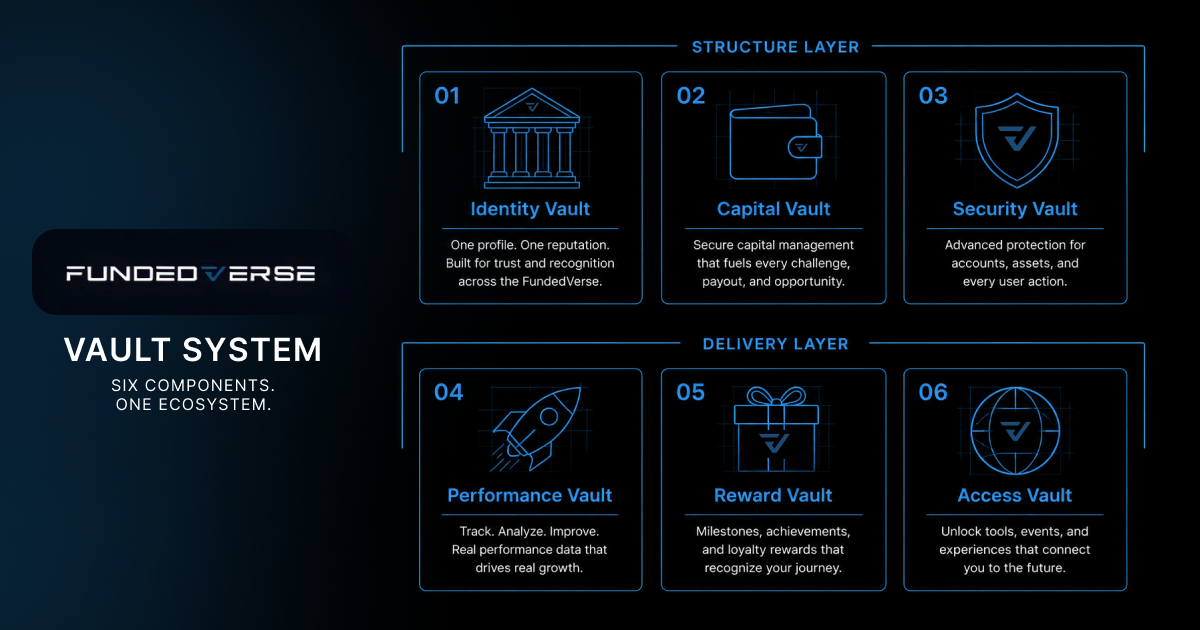
For two years, the marketing was a race to the bottom on cost, cheaper challenges, bigger headline splits, flashier sales. May 2026 broke the pattern. On May 14, FundedVerse launched what it calls The Vault System, a six-component framework, and the pitch wasn’t a coupon. It was a posture: a prop firm is only as serious as the infrastructure behind it. The first three components, a committed capital reserve dedicated to funding payouts, a full-time risk and dealing desk instead of an anonymous algorithm, and a private partner network for top performers, are all answers to one question the firm wants every trader asking: where does the payout actually come from? FundedVerse runs in simulated environments on MT5 and Match-Trader, registered in Saint Lucia with a Cyprus payment agent, and it’s betting that traders are finally ready to evaluate firms on substance rather than on the size of the profit split banner.
Whether FundedVerse delivers is unproven, it’s brand-new, and a framework is a promise, not a track record. But the framing landed because it named something the whole industry has been circling. The serious money in prop trading is now in trust, not discounts. And that reframing set the tone for everything else that happened this month.
FundedHive Calls the Consistency Rule a “Payout Trap” and Reopens the News Trading Debate
If FundedVerse asked the question politely, FundedHive’s Thomas Heinfart answered it with a sledgehammer. In remarks published May 2 via Finance Magnates, the CEO said the one rule he’d erase from the industry is the consistency rule, “in most cases it is not a real risk-management tool. It is a payout trap.” The mechanic, in its usual form, caps how much of your profit can come from a single day, forcing you to keep trading until the curve looks tidy enough to withdraw. Heinfart’s verdict on the firms that built their models this way was just as sharp: “they were not built as risk management businesses. They were built as marketing machines.”
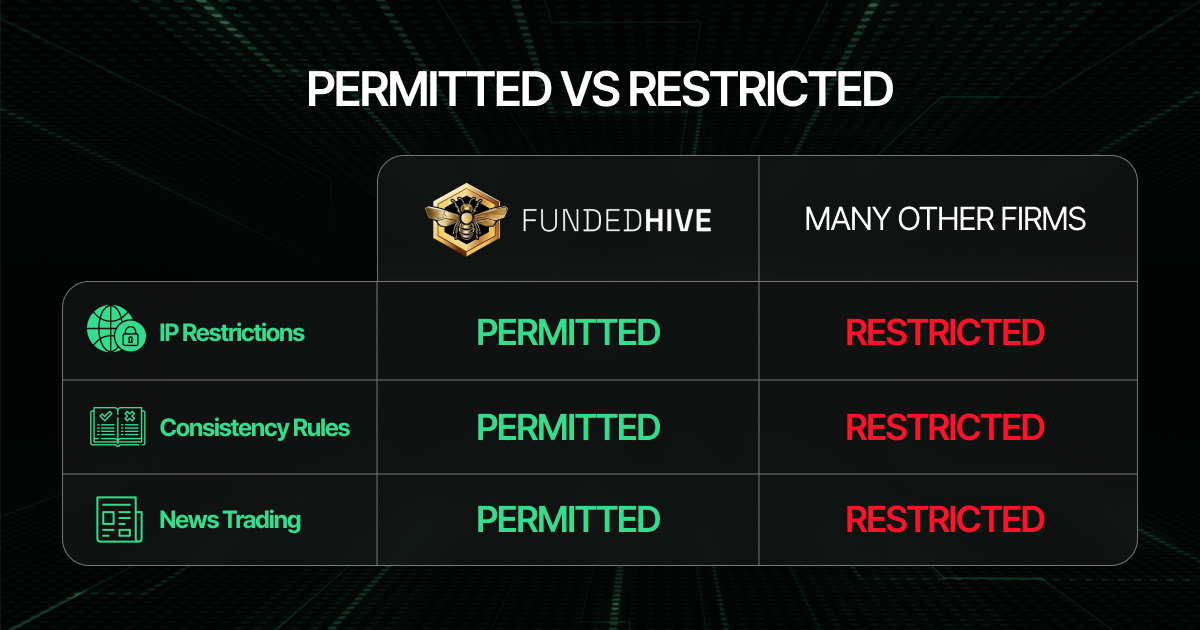
He’s not shouting into a void. MyFundedFX floated a 50% consistency guideline in July 2024 and reversed it inside two weeks under client pushback. A PipFarm survey of around 500 active prop traders, shared with Finance Magnates, found 53% listed consistency rules among the features they most wanted to avoid, second only to trailing drawdown. Yet the mechanic survives in softer forms: FundedNext requires a minimum of two trading days on its Stellar 1-Step, FundingPips applies a three-day minimum on its 1-step path, and Hola Prime builds its funded-stage rules around steady performance. Heinfart’s distinction is the useful one, the problem isn’t that rules exist, it’s “when rules are hidden, vague, changed retroactively, or used manually to avoid paying traders.”
FundedHive’s own answer is to run zero consistency rules, no IP restrictions, and to permit gold and news trading, the firm says payouts execute via smart contract in under 60 seconds, though it concedes those figures are self-reported and not independently audited. That last caveat matters, and it’s exactly why the news trading question keeps mattering too. Strategies built around high impact news events live or die on whether a firm lets you hold through the print. This is one of the quiet places FundingTraders has simply never wavered: event-driven strategies are permitted across all stages, no special window, no asterisk, a standing policy, not a reaction to anyone else’s.
Actual Trading vs the Sales Funnel: What the Numbers Show
The most-quoted figure of the month came from FPFX Technology data cited in the FundedHive interview: only 7% of challenge buyers ever receive a payout. Heinfart’s reaction, “the 7% figure does not surprise us”, was the candor the industry rarely offers. He pegged his own faster one-step and instant funding products at 20–30% withdrawal ratios (self-reported), and when pressed on how many of his traders have what it takes to stay funded across multiple payout cycles, he didn’t dress it up: “single-digit percentage. Probably under 10%.” The Funded Trader’s own client stats, shared earlier this year, suggested just 1–2% of clients ultimately make money.
The takeaway isn’t that the model is rigged, skilled traders with a real edge do get paid, repeatedly. It’s that actual trading skill, not challenge-gaming, is the only thing that survives the funnel. Heinfart’s advice was the same point in plainer words: stop trying to beat the challenge and trade as if you’re already managing real A-book exposure, because the people who get paid are the ones who stay eligible and controlled, not the ones taking the biggest shots. For a trader choosing where to deploy trading capital, the read-through is simple, the fees are real, the odds are filtered, and the firm you pick should be one that wins when you do.
The data’s clear: most firms profit when you fail. FundingTraders profits when you get paid. Start your evaluation with a discount, use code FT50 for 50% off any account size from $5K to $200K. Build on the right side of the math.
FundingTraders: The Proprietary Trading Firm Answering the Question
So here’s the firm quietly answering most of the problems this month surfaced. FundingTraders, founded in 2023 and based in Dubai, is led by CEO Stan G.K., who brings more than 18 years in institutional finance, and the firm’s design reads like a direct response to the best prop firm checklist traders have been building all year. Where the month’s big question was “where does my payout come from,” FundingTraders’ answer is structural: a revenue model that mirrors profitable funded accounts rather than feeding on failed evaluations. That single choice ripples through everything else.
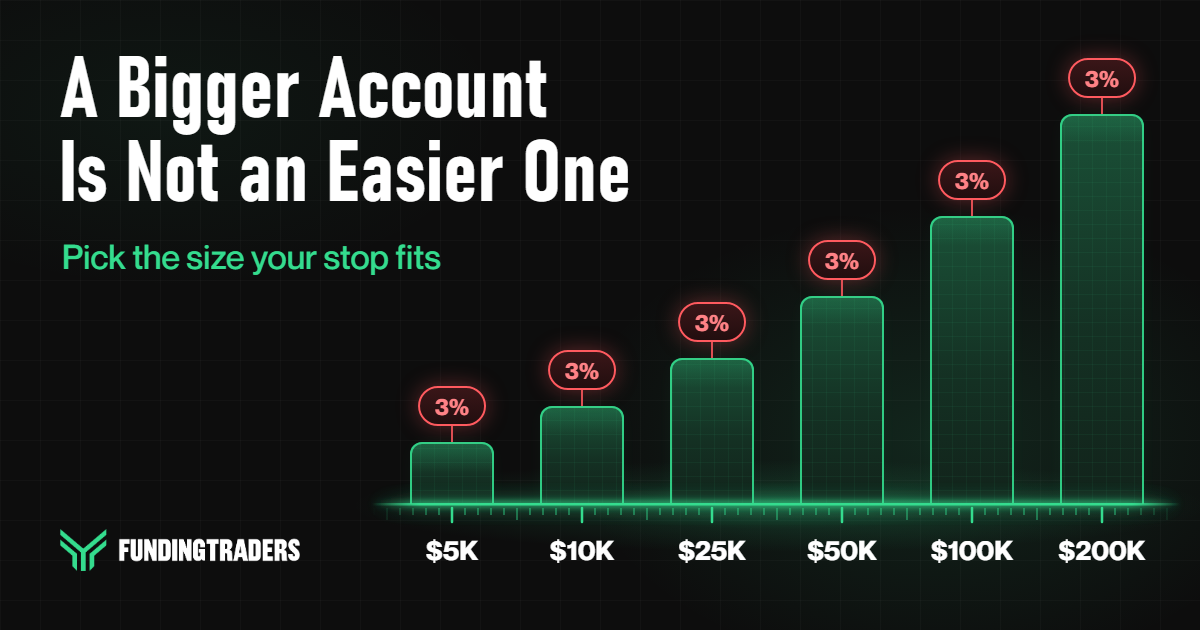
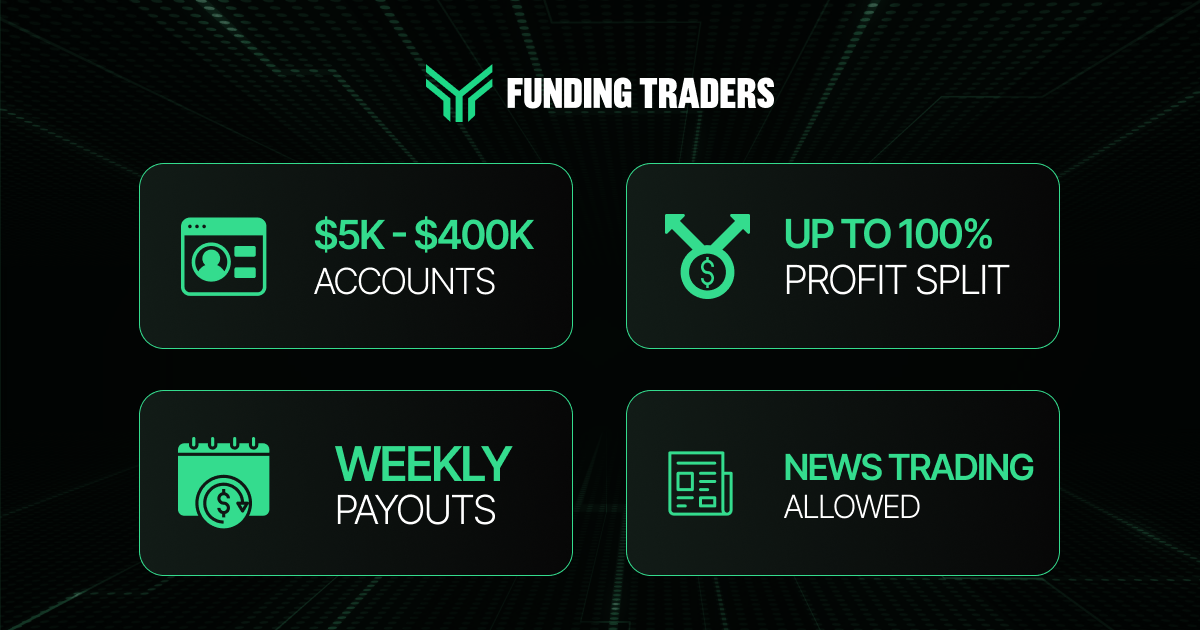
Start with the on-ramp, because it’s the rarest part. Account sizes run from $5K to $200K, with a profit split up to 100%, zero commissions on evaluations, and no time limits, so the clock isn’t a hidden challenge type working against you. The challenge structure offers both a one step challenge and a two step challenge, built on a 10% profit target, a 10% total drawdown ceiling, and a 3-5% daily loss limit, transparent rules, stated up front, the kind Heinfart spent his whole interview asking the industry to adopt.
The trader-friendly mechanics keep going where rivals add friction. Payouts run bi-weekly, every 14 days, via Rise or Crypto, so getting paid doesn’t wait on a monthly cycle. Copy trading between your own setups is allowed, expert advisors run within the firm’s risk limits, and overnight and weekend holds are fine, the structural mismatches that wreck swing traders at other firms. Multiple trading platforms, and the tradable universe spans forex, indices, metals, commodities, and crypto. For traders who prove out, the scaling plan lifts the account by 25% every 2 months, a path to scale that rewards exactly the steady, eligible performance the data says actually gets paid. Add an active community on multiple platforms such as Discord and YouTube, and you have a firm that looks built for the post-reckoning environment rather than the hype cycle that preceded it.
No time limits, news trading permitted, up to 100% split. If you’ve been waiting for a firm whose rules read like the ones traders actually asked for this month, this is it. Apply FT50 at checkout for 50% off ($5K–$200K accounts) and claim your evaluation.
Can Prop Traders Make a Living From Prop Trading?
This is where the romance meets the spreadsheet. The honest answer from The Prop Firm Guide: yes, but fewer than 5% of the traders who try ever go full-time. The ones who do aren’t running two or three accounts, they’re running 10 to 50+ funded accounts across multiple firms, because individual accounts have payout caps, you will lose some (budget for a 20–30% annual failure rate), and diversification across firms is the only real insurance against any single firm changing rules or stalling payments. A realistic full-time operation might mix eight $100K forex accounts with seven $150K futures accounts for $1.85M in nominal capital, targeting roughly 3% monthly and clearing $35K–$45K after an 80% profit split and costs.
The unglamorous prerequisites matter more than the upside. The guide’s checklist before quitting a day job: 6–12 months of living expenses in cash, 12+ months of consistent monthly profitability, 10+ funded accounts already producing income, and reserve capital to replace blown accounts. Skip any of them and the math turns hostile inside six months. For experienced traders building income diversification rather than chasing an escape hatch, prop trading works as a capital-allocation engine, provided you already have an edge. It is not, and has never been, a substitute for learning to trade. The repeat-purchase model makes sure of that.

The Institutional Room: Proprietary Trading Under Pressure
Worth keeping the two worlds straight, because they get blurred constantly. The funded-account firms above are one segment; the institutional proprietary trading firms in Acuiti’s Q2 2026 report are another, market-makers and derivatives shops, not challenge sellers. And that grown-up room had a sturdy quarter. Despite Q1 2026 volatility driven largely by Middle East conflict, 83% of the proprietary trading executives Acuiti surveyed reported strong operational performance, though 54% hit market-data capacity and latency snags and 46% ran into order-management issues under stress. Resilience, with visible seams.
Two signals from that report point at the whole industry’s next phase. AI is starting to reshape workforce dynamics, nearly half of firms have slowed hiring, though only 15% are actively cutting headcount on the back of productivity gains. And the market’s edge is migrating: a third of firms are leaning harder into directional positioning as pure market-making profits thin out, while digital assets and Latin America (Mexico especially) sit on the expansion roadmap. The institutional firm is adapting in real time. The retail-facing prop firms would do well to watch how.
The Question That Isn’t Going Away
Strip away the noise and May 2026 delivered a single, durable lesson for anyone following prop firm news: the firms worth your capital are the ones that can answer “where does my payout come from” without flinching. FundedVerse turned it into a framework, FundedHive turned it into a confession, and the operator-economics pieces turned it into arithmetic. The arithmetic favors traders who pick firms whose incentives are aligned with getting them paid, which is the cleanest argument for a proprietary trading firm like FundingTraders, where the transparent rules, weekly payouts, and a revenue model built on successful funded traders aren’t perks bolted onto a sales funnel but the structure itself.
The homework is the same homework it’s always been, just louder now. Before you hand any firm a challenge fee, check the payout history, read the restriction rules, especially the consistency rules and the news trading policy, confirm the platform’s stability, and understand how the firm makes its money. If most of its revenue comes from people failing, you already know which cohort it’s optimized to keep. If it makes money when you make money, you’re on the same side of the table.
Next month, watch the regulators and watch the imitators, expect more “transparency frameworks” now that FundedVerse proved the angle sells, and expect the audit, not the ad, to become the new flex. The traders who win this next phase won’t be the ones chasing the biggest headline split. They’ll be the ones who read the fine print, kept their risk controlled, and backed a firm that wanted them funded. Pick that firm, do the work, and the money follows.
Done reading the fine print? Put it to work. Pass the FundingTraders evaluation and trade forex, indices, metals, commodities, and crypto thru multiple trading platforms, with weekly payouts and a scaling plan that grows your account 25% every three months. Lock in 50% off with code FT50 (account sizes $5K–$200K) before it changes.
Disclaimer: Trading involves significant risk and is not suitable for every investor. Past performance is not indicative of future results. The information provided in this article is for educational and informational purposes only and should not be considered financial, investment, or trading advice. All account rules, payout structures, profit splits, and promotional offers described in this article are subject to change at the discretion of FundingTraders. Promo codes may expire or be modified without prior notice. Always trade responsibly and only risk what you can afford to lose.
Sources: FundedVerse · Track360 · Finance Magnates · The Prop Firm Guide · Acuiti · PR Newswire · FundingTraders