July’s prop firm news did not read like a month of trading updates. It read like a land grab. Inside four weeks, proprietary trading firms annexed prediction markets, spot crypto, and sports contracts, while a comparison engine launched on July 1 to help futures traders sort the pile-up. PropAccount.com added event contracts on July 6. OddsON went live nine days later as a prop firm built on sports markets alone. DojoTraders opened with four asset classes; Drift Fund stripped leverage out. Almost every announcement expanded what you were allowed to trade. Exactly one touched what the rules cost you. Here is what happened, and what funded traders should carry into August.
Quick Summary
July 2026 was the month the prop industry stopped competing on rules and started competing on inventory. Prop Firm Compare opened a comparison engine on July 1 built around challenge fees, drawdown methodology, consistency requirements, and scaling plans. PropAccount.com added prediction markets on July 6, handing 175-plus operators a fifth asset class. DojoTraders launched July 8 across Forex, Futures, Crypto, and Equities. OddsON arrived July 15 on sports markets alone. Drift Fund shipped spot funded accounts with no leverage on July 28. Orbit Funded closed the month arguing instant funding should carry better risk parameters than an evaluation, not worse. FundingTraders announced nothing, which is the point. Its 2-Step Pro accounts already run a maximum loss limit that is fixed and does not trail, and its Instant Funding payouts had dropped to seven days in late June.
The Tell: Futures Traders Got a Search Engine Before They Got Better Rules

The most revealing story of July landed on day one, and it was not a prop firm at all. Prop Firm Compare launched a comparison engine out of Orlando on July 1, aimed at futures traders choosing where to buy a challenge. Headline account size and advertised profit splits tell you almost nothing, because the rulebooks underneath differ enormously. The engine compares trailing drawdown methodology, payout frequency, activation fees, consistency requirements, contract limits, supported trading platforms, and scaling plans, with filters for scalping, day trading, and swing trading. CEO Kane Simons argued that ranking firms one through ten is useless: the right firm depends on how a trader actually trades. A market only needs a search engine when it has grown too opaque to shop by hand. Traders are not confused about profit targets. They are confused about day forty, when a trailing drawdown eats a winning account from underneath them.
Prediction Markets Move Inside the Prop Firm Stack
On July 6, PropAccount.com added prediction markets as a fully supported asset class alongside FX, Futures, Crypto, and Equities, on one dashboard. Operators launch branded event-contract challenges on the risk engine, KYC, and payment rails already running underneath. The platform already supports more than 175 active prop firms worldwide.
Nine days later came the retail version, and it was stranger. OddsON launched July 15 out of Sheridan, Wyoming, built entirely around sports prediction markets. Traders access a free, simulated $1,000 bankroll, clear a two-stage Qualifier and Verification process with published stake caps and drawdown rules, and earn a funded account with no profit target and unlimited time. Funded participants keep 75% of the profit they generate. Whether the funded-trader playbook, long confined to forex and equities, transfers to sports is open. The direction of travel is not: the evaluation model is being pointed at anything with a price and a chart.
One Roof or No Leverage: Funded Trading Splits Two Ways for Multi Asset Traders
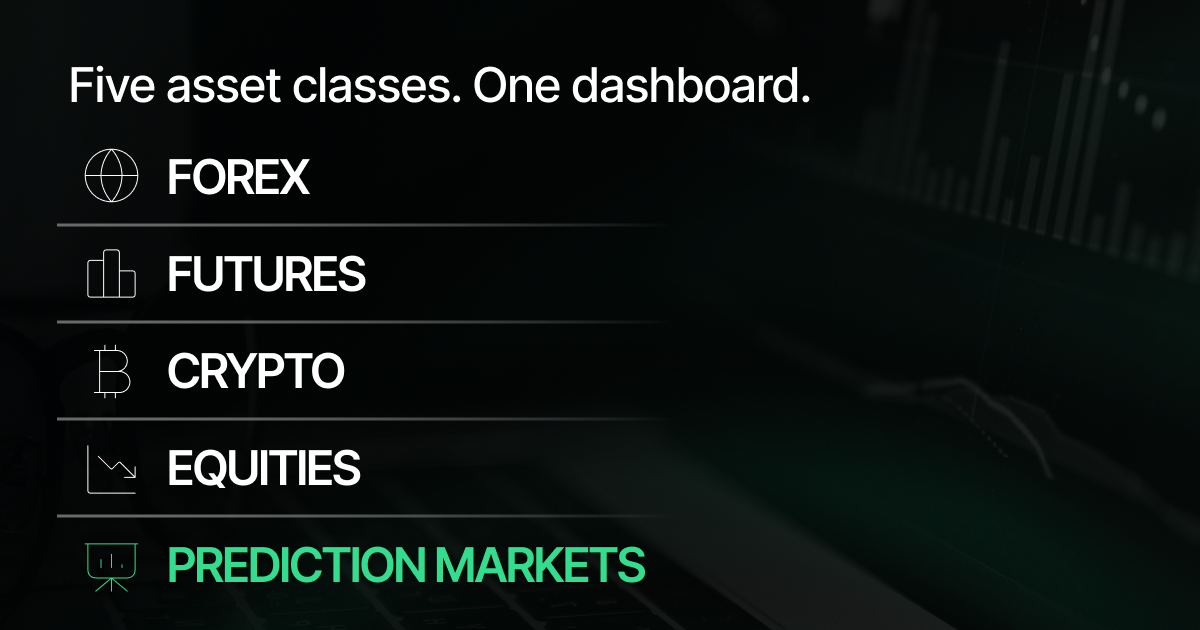
DojoTraders launched July 8 with a diagnosis rather than a discount. Most prop firms specialize in one asset class, so active traders run several dashboards, rulebooks, and payout cadences at once. The firm built one ecosystem instead, giving traders access to Forex, Futures, Crypto, and Equities in one place: funded accounts to $500,000, profit splits to 90%, one evaluation, bi-weekly payouts inside 24 to 48 business hours, six trading platforms. Experienced traders can skip evaluation through Instant Funding; others take 1-Step programs shaped to forex, crypto, or US stocks, while futures traders follow a separate progression. The stated goal is more flexibility.
Then, on July 28, somebody finally subtracted something. Drift Fund launched Spot Funded accounts from Saint Lucia, the first funded product built on real spot exposure with no leverage. CEO Tim Charkee’s point: spot is how most people enter crypto, and the sector skipped past it to leveraged derivatives and cfd markets. Accounts run to $300,000 at a 90% split, payouts process in crypto within 24 hours, and the browser-based terminal needs no downloads. Roughly 267 crypto pairs sit alongside precious metals, select equities, and stock indices, with no forex pairs in the mix. The rules: 10% profit target, 4% daily drawdown, 6% maximum drawdown, five minimum trading days, no time limits. For multi asset traders told for years that leverage was the only route to a funded seat, that is a real alternative. Leverage was never a trader requirement. It was a business model.
Instant Funding Stops Being the Compromise Experienced Traders Pay For
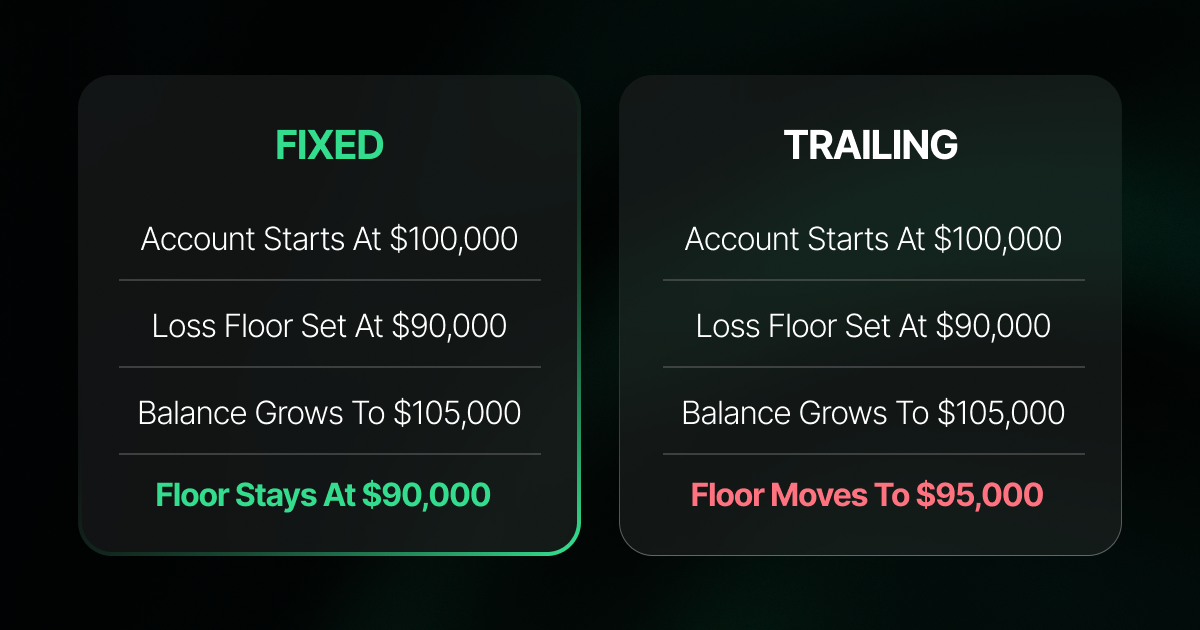
Orbit Funded closed the month on July 30 with the sharpest argument of July, and it had nothing to do with what you can trade. Instant funding programs have historically punished traders for skipping evaluation: lower daily loss limits, smaller drawdowns, trailing models, higher price. Orbit Funded inverted it. Its Instant Accounts carry a 5% daily drawdown and a 10% static maximum drawdown, parameters the firm notes exceed what many other prop firms offer inside conventional evaluations. Some two step challenges run roughly a 3% daily loss limit and a 6% maximum drawdown while still demanding two phases and two profit targets. Orbit Funded runs account sizes ranging across Instant, One Step, and Two Step account types.
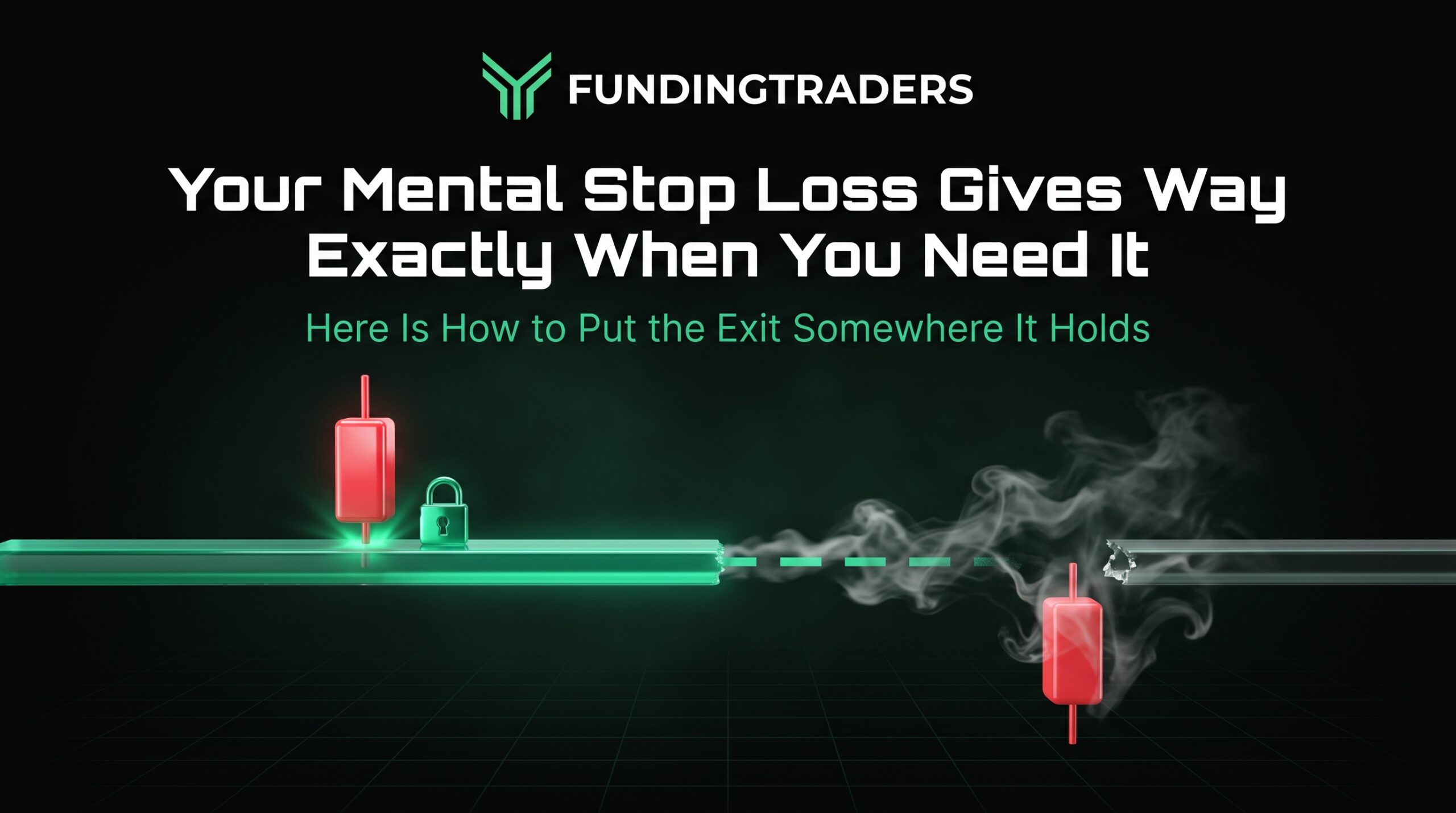
The static detail matters. Under a trailing model the loss threshold follows equity highs, so profits keep moving the reference point. Under a static structure, a $100,000 account with a 10% maximum drawdown has its floor fixed at $90,000 from day one and it stays there as the balance grows, so profit becomes room. Steven, Head of Growth at Orbit Funded, put it plainly: challenges push traders into risks they would not normally take. Remove the qualification phase and focus returns to risk management.
Challenge Fees, Hidden Fees, and the Refund Line Nobody Reads
Strip July down and a pattern appears. Six firms expanded the menu. Almost none addressed the bill. Prop Firm Compare’s criteria list is the receipt: alongside challenge fees it flags activation fees separately. Activation fees are the classic hidden fees of this sector, the charge that lands after you have already passed. Drift Fund’s one-time fee is one answer; Orbit Funded’s pricing is another.
FundingTraders runs a third, and it is the one worth pricing properly: a Refund Bonus returning the evaluation fee itself alongside your second payout, on accounts purchased on or after May 8, 2026. Pay $149, pass, get paid twice, and the $149 comes back. Nobody advertised tight spreads, professional execution, or which liquidity providers sit behind the quotes. Nor whether expert advisors and automated strategies are permitted, under what ceiling, or what scaling opportunities exist for a strong track record. Those live in a rulebook, not a landing page. Advanced traders read it first. Inexperienced traders learn later, when buying power they assumed was theirs turns out to be conditional.
The Firm That Already Ran the Static Drawdown Play
Here is the awkward thing about a land-grab month. If your trading conditions were already settled, you had little to announce. FundingTraders, founded in 2023 and based in Dubai, spent July quiet. CEO Stan G.K. built the firm after over a decade and a half in institutional finance, on a model that mirrors its successful traders rather than profiting from failed evaluations.
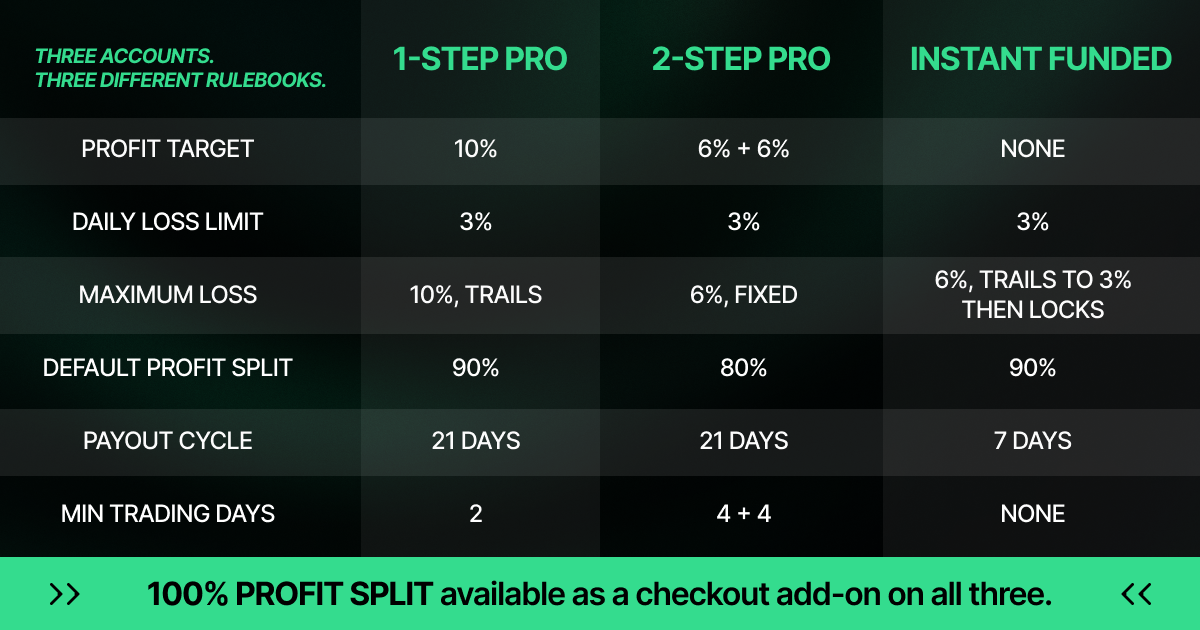
Read Orbit Funded’s static-versus-trailing argument, then read the 2-Step Pro rulebook. PRO6 runs a 6% profit target in each phase, a 3% daily loss limit, and a 6% maximum loss limit that is fixed and does not trail higher when you are in profit. PRO10 runs a 10% then 5% target, a 5% daily loss limit, and a 10% maximum loss, likewise fixed. That is the structure Orbit Funded spent a long press release arguing for, already shipped. Be precise about the rest, because the account types differ. 1-Step Pro runs a single 10% profit target, a 3% daily loss limit, and a 10% maximum loss that does trail with the highest recorded balance, against a minimum trading days requirement of just two. Instant Funding skips evaluation: a 3% daily loss limit, and a 6% maximum loss that trails only until 3% profit is banked, then locks to the initial account size.
On profit split, 1-Step Pro and Instant Funding start at 90% and 2-Step Pro at 80%, with a 100% add-on at checkout across all three. Pro evaluations carry no commission at all: the $3 per lot roundtrip applies in the funded phase only, on everything except indices, and a Zero Fees add-on removes it and enables swap-free trading. Instant Funding runs $6 per lot. Coverage spans forex majors, minors and exotics, stock indices, precious metals, oil, commodities, and crypto, with leverage up to 1:50 on FX majors, tiered down from there. Allowing traders to hold Instant Funding positions through the weekend arrived on June 29, 2026, crypto included.
News Trading and Fast Payouts: Read the Account Type First
Two rules separated the field this month, and neither made a headline. The first is news trading, and it deserves precision. On FundingTraders Pro accounts it is fully permitted through the challenge phase, with no restrictions whatsoever. In the funded phase it stays allowed with a ceiling: no more than 30% of total profits may come from trades inside a ten-minute window around a high-impact release, and Pro accounts may hold through those events provided the position was open five hours or more beforehand, a deliberate accommodation for swing traders. Instant Funding is stricter, prohibiting news trading outright, with a News Holding add-on introduced June 29, 2026, as the exception.
The second is cadence. Drift Fund processes in 24 hours; DojoTraders runs bi-weekly. FundingTraders moved Instant Funding to a seven-day cycle on June 29, 2026, with an On-Demand Payout add-on; Pro accounts default to 21 days, or 14 with an add-on, paid via Rise or Coinbase Commerce inside 24 to 48 hours. Accounts reset to their starting balance while a payout processes, giving funded traders uninterrupted trading activity instead of a dead week. Fast payouts are table stakes now. Payout conditions are where the variance sits.
Where Prop Trading Firms Stand on Profit Split Right Now
A snapshot as August opens. On funding levels, DojoTraders leads the July cohort at $500,000, Drift Fund at $300,000. On profit split, both sit at 90%, OddsON at 75%, and FundingTraders defaults to 90% on two of its three funding options, with 100% as an add-on. On drawdown, Orbit Funded’s 5% daily and 10% static is the most permissive announced in July, though FundingTraders’ 2-Step Pro was already fixed rather than trailing.
No firm wins every column. What changed is that various trading styles now have genuinely different homes, and the gap between a diverse range of options and a good one has widened. Trader flexibility is finally being priced.
The Thing Nobody Launched
July 2026 makes one argument: growth is coming from new inventory, not better terms. Five of six announcements added to the menu. One argued the rules were the product. The prop firm news cycle will keep producing asset classes, and most will be interesting. But a prediction market on a bad rulebook is still a bad rulebook. Before buying in August, check four things: whether the maximum loss trails or stays fixed, what the payout terms require, whether your strategy survives the news rules on that account type, and how the firm makes money.
That last point is why FundingTraders holds up through months like this. Transparent rules and transparent conditions, published per account type rather than averaged into one flattering headline, a clear path through funded trading to a refunded entry fee, and a fixed drawdown on 2-Step Pro the market spent July arguing toward. Watch two things next month: whether prediction-market challenges survive regulators, and whether anyone follows Orbit Funded in treating risk parameters as a selling point. The firms competing on inventory get the headlines. The firms competing on terms get the traders who last.
Disclaimer: Trading involves significant risk and is not suitable for every investor. Past performance is not indicative of future results. The information provided in this article is for educational and informational purposes only and should not be considered financial, investment, or trading advice. All account rules, payout structures, profit splits, and promotional offers described in this article are subject to change at the discretion of FundingTraders. Promo codes may expire or be modified without prior notice. Always trade responsibly and only risk what you can afford to lose.
Sources: PR Newswire (PropAccount.com) · Yahoo Finance / GlobeNewswire (OddsON) · The Manila Times (DojoTraders) · Yahoo Finance / GlobeNewswire (Prop Firm Compare) · PR Newswire (Drift Fund) · The Manila Times (Orbit Funded) · FundingTraders Official