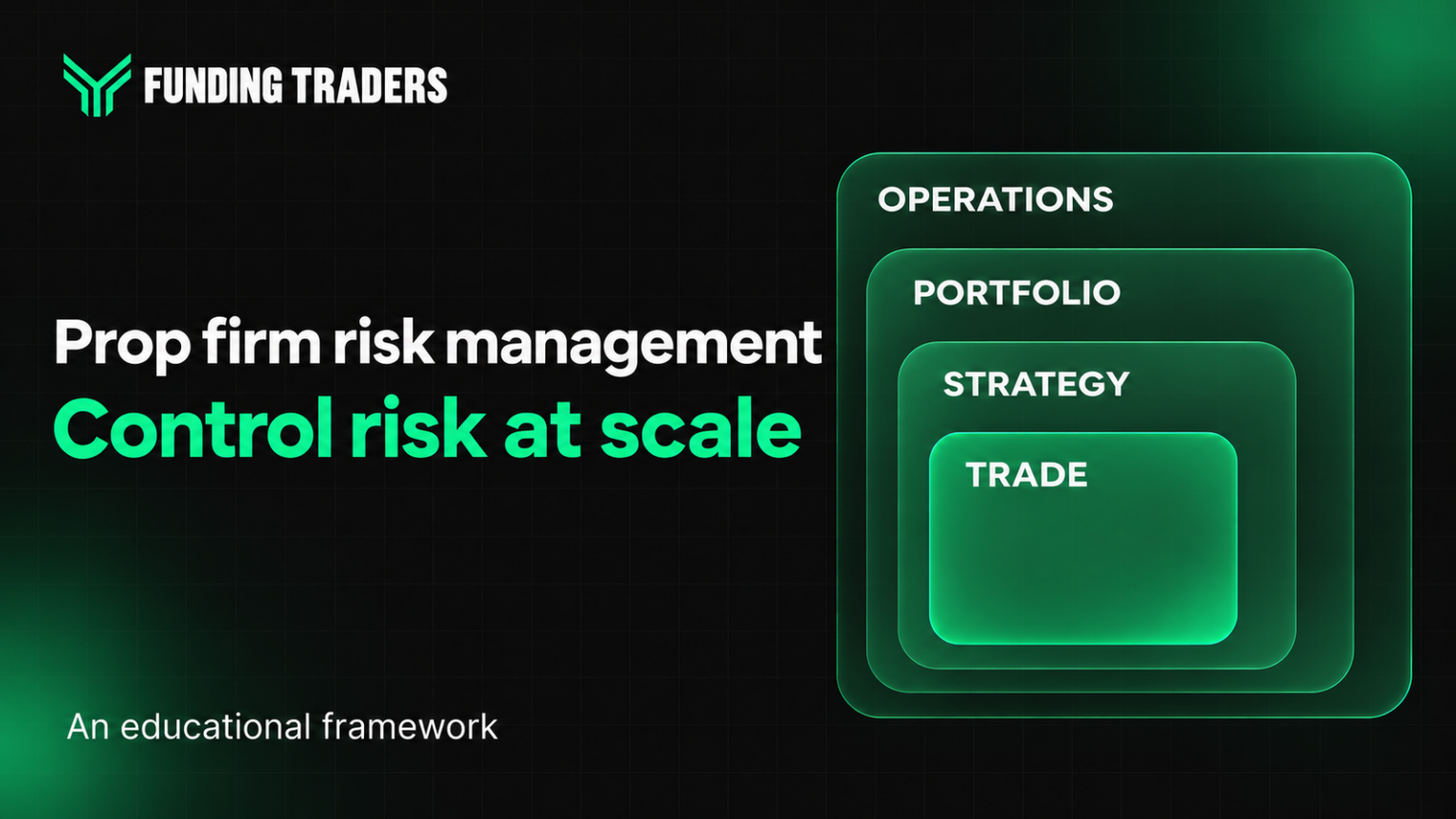
Prop firm risk management connects the risk on one trade with the exposure created by every other position, strategy, and account around it. A sensible stop-loss on each ticket is useful, but it does not tell you whether several trades depend on the same market move.
This guide is for traders who want to understand why firms set overlapping limits and how to build a more disciplined decision process. You will learn to separate trade risk, portfolio concentration, operational controls, and behavioral review.
The firm-level examples are educational frameworks, not descriptions of FundingTraders’ internal trading book. Its participant rules are discussed separately, so a general explanation of professional risk control does not become a claim that your account trades institutional capital.
Prop firm risk management has several layers
At scale, risk is a question of aggregation. Ten individually reasonable positions can still create an unreasonable combined exposure. A control system therefore needs a view beyond the next order.
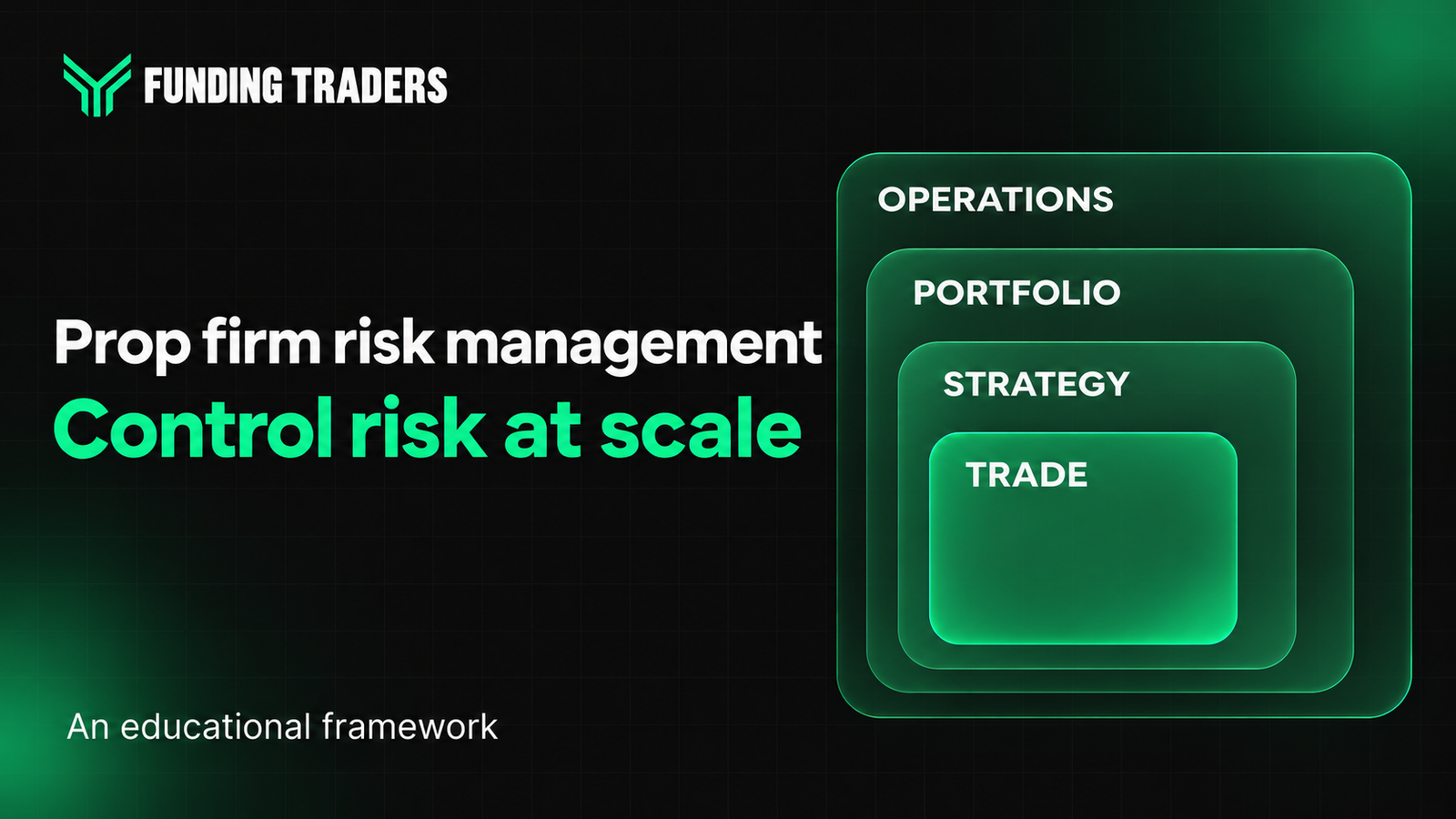
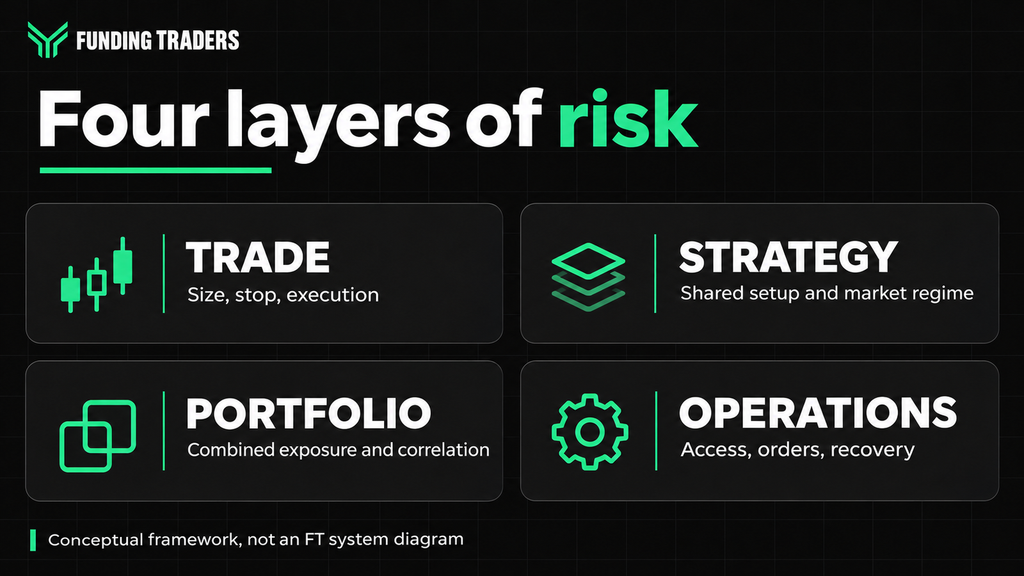
One useful framework separates four layers. These are teaching categories, not a universal industry standard or a diagram of any firm’s private systems.
| Layer | Question to answer | Example control |
|---|---|---|
| Trade | What could this position lose, and how could execution differ from the plan? | Position-size and order checks |
| Strategy | Are several trades relying on the same setup or market conditions? | A budget for the strategy and a review trigger |
| Portfolio | What happens if connected positions move against us together? | Aggregate exposure limits and scenario analysis |
| Operations | What happens if data, orders, access, or connectivity fail? | Permissions, cancellation procedures, and recovery plans |
These layers measure different things. Margin usage measures how much collateral a position requires. Planned stop-loss risk estimates a loss at a selected exit. Gross exposure totals the size of positions before offsets, while net exposure allows specified offsets. None can replace the others.
For example, two opposing positions may have a small net exposure but still incur costs and execution risk. Conversely, a position that uses little margin can have a large potential loss if its exit is distant or ineffective. The label on one metric never tells the whole story.
More symbols do not necessarily mean more diversification
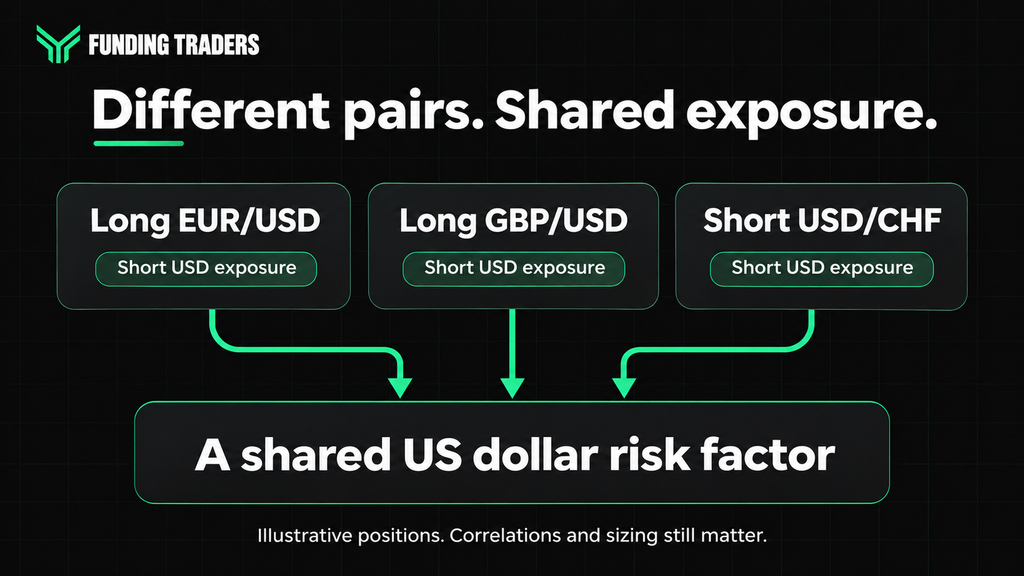
Imagine three traders taking the following positions: long EUR/USD, long GBP/USD, and short USD/CHF. Each ticket contains a short US dollar exposure. A broad dollar rally could hurt all three, even though the traders selected different currency pairs.
This is an illustration of a shared risk factor, not a prediction that the pairs always move together. Other currencies, position sizes, holding periods, and changing relationships affect the result. Counting symbols alone misses those differences.
Suppose each trader plans to risk $250. If all three stops fill at their intended prices, the planned combined loss is $750. It is not $250 merely because each trader stayed inside an individual budget. Gaps, slippage, and costs can increase the realized loss beyond that simplified estimate.
A portfolio review also asks whether strategies fail under the same conditions. Three momentum systems may lose together in a range even if their trades do not look identical. That is why prop firm risk management needs both position-level detail and a view of the ideas behind the positions.
For your own journal, group trades by their common driver as well as their instrument. Then ask what a sharp move in that driver would do to the open positions. Historical correlation can inform this review, but it is not a fixed promise about the next market shock.
Controls work best before an order reaches the market
A loss limit is a boundary. A pre-trade process is how you avoid discovering that boundary too late.
In live-market infrastructure, controls can include order-size checks, price checks, aggregate limits, and ways to block or cancel orders. Cboe’s published US equities documentation provides examples of these controls. Their availability in that setting does not mean every prop program uses the same infrastructure.
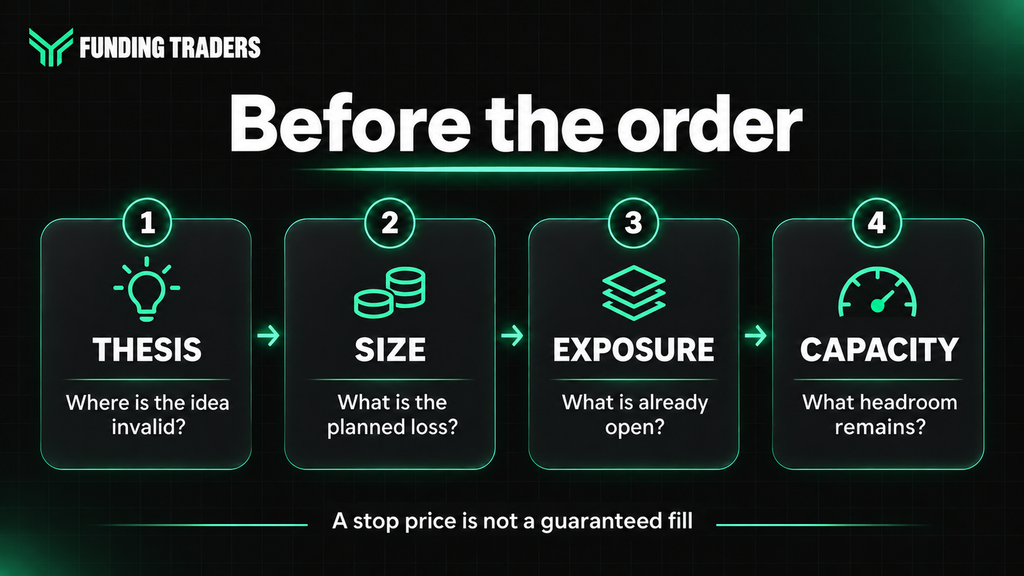
For an individual trader, the equivalent discipline starts with four questions:
- Where is the idea invalid? Define the reason to exit before choosing an attractive position size.
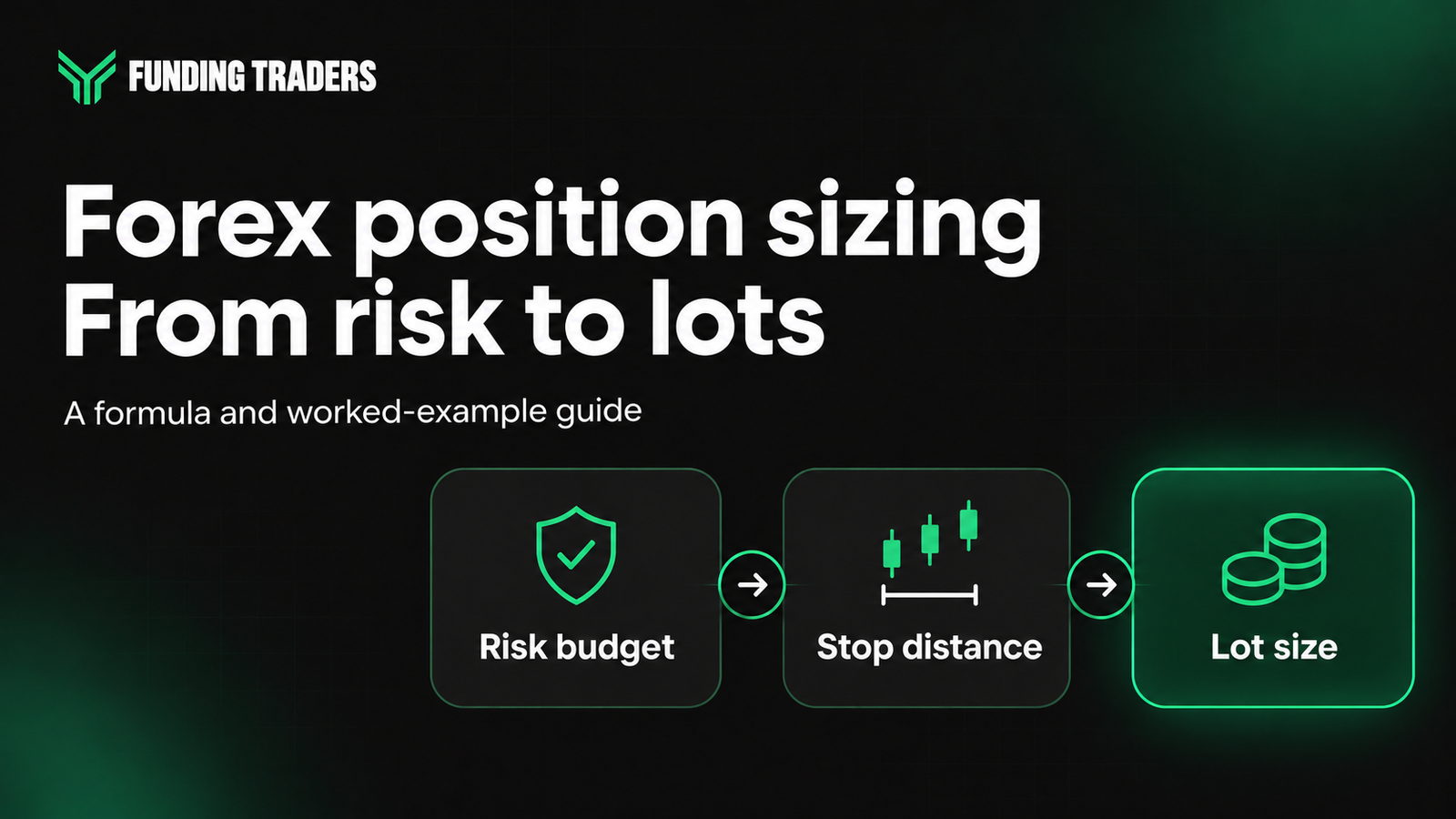
- What is the planned loss? Convert the stop distance and position size into account-currency risk, including relevant costs.
- What is already open? Check related positions, pending orders, and repeated entries into the same idea.
- What headroom remains? Compare the proposed trade with daily, overall, and any other applicable limits.
The answer can be to reduce size, wait, or skip the trade. Moving the stop closer simply to force a larger position into a risk budget changes the trade thesis; it does not make that thesis stronger.
A stop order also needs realistic expectations. In a fast or gapping market, the exit can occur at a different price from the one planned. Leave room for uncertainty instead of treating a stop distance as a fixed maximum possible loss.

Protect room to trade instead of spending the loss limit
A maximum loss rule should not become a daily spending target. Repeatedly trading near the boundary leaves little room for ordinary costs, execution differences, or another position moving against you.
Consider a hypothetical account with $1,000 of remaining headroom before its relevant breach level. Two open trades have $300 of additional planned loss each from their present values to their stops. A proposed trade adds another $300. Together they would use $900 of the remaining headroom if those stops fill as assumed, leaving only $100 before any extra costs or slippage.
That arithmetic is an illustration, not an FT account rule or a suggested risk allocation. It also assumes the breach level does not move and that floating losses already reflected in equity are not counted twice. Actual drawdown calculations can use different reference balances and reset rules.
There is a similar distinction between size and capacity. A larger headline account does not automatically suit a strategy with wider stops or more simultaneous positions. Translate the applicable rules into dollars and consider the combined positions before comparing account labels.
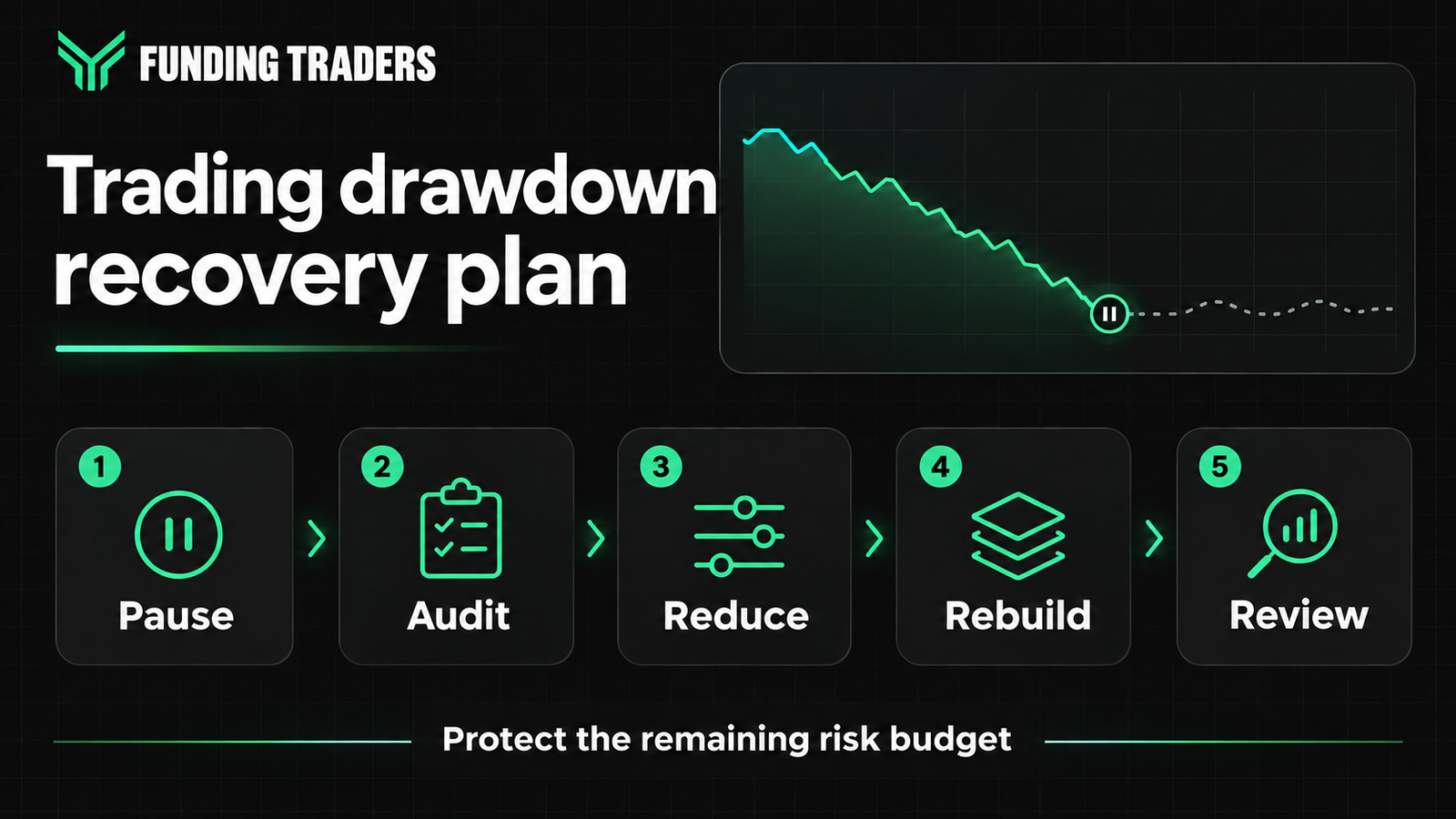
Prop firm risk management also requires a response plan. Decide in advance what triggers a pause, what data you will inspect, and what must change before trading resumes. Increasing size to recover a loss is a new risk decision, not a repair to the old trade.
Review behavior alongside the numbers
Profit and loss describes an outcome. It does not, by itself, explain whether the trader followed a sound process.
A winning trade can come from an oversized position that happened to survive. A losing trade can follow a reasonable plan that simply did not work on that occasion. Treating every win as approval teaches the wrong lesson.
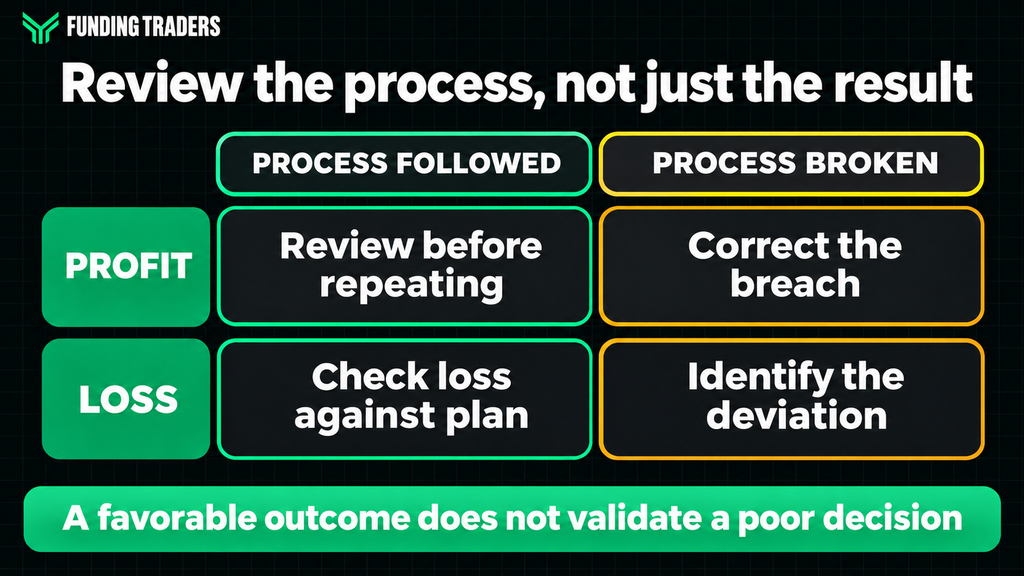
A practical prop firm risk management review separates two questions: did the setup behave as expected, and did the trader execute the plan? Record the intended size, actual size, stop changes, reasons for adding, and timing after a previous loss. These observations are more actionable than calling a losing day a lack of discipline without evidence.
| Outcome | Process followed | Process broken |
|---|---|---|
| Profit | Review the setup and execution before repeating it | Correct the breach; profit does not validate it |
| Loss | Check whether the loss was within the plan | Identify the deviation and change the control |
The matrix does not prove that a strategy has an edge. You still need a meaningful sample and a realistic accounting of costs. Its purpose is narrower: prevent one lucky result from becoming permission to repeat a poor decision.
How this connects to FundingTraders’ published rules
FundingTraders’ Terms of Service state that FT US Inc is not a broker and does not accept deposits. A program fee purchases access under the program’s terms; the displayed account size is not a cash deposit placed in your brokerage account.
The public risk management framework addresses behavior on funded accounts. It describes review of position sizing, stacked entries, repeated pressure on loss limits, and other patterns. Product hard rules continue to apply alongside that framework. The general portfolio examples above should not be read as claims about how FT allocates or hedges its own capital.
FundingTraders’ trade-idea definition is especially relevant when splitting an entry. Positions on the same symbol and in the same direction can be grouped when they overlap or open within two minutes. Several tickets therefore do not necessarily create several independent risk allowances.
The published Clarity Desk guide describes a funded-account dashboard view of rule status and flagged trades. It says a flag is not automatically a strike; strikes are applied on review. This is a description of the documented participant interface, not a claim about undisclosed surveillance technology.
For Instant Funding, read the account-specific rules for the applicable product version. The guide includes daily and overall loss limits, open-risk controls, and a consistency requirement. Do not assume an Instant account is free of consistency rules, or that an add-on removes every other condition.

Questions about risk management at scale
Why are individual stop-losses not enough?
Several positions can lose together because they share a market driver. Stops address individual exits, while aggregate controls address the combined exposure. Neither removes execution risk or prevents all losses.
Does opening more trades diversify risk?
Only if the positions reduce concentration in a meaningful way. Different symbols can still express the same view. Assess direction, size, common drivers, and behavior under stress instead of relying on trade count.
Is a drawdown limit the amount I should risk?
No. It is a boundary defined by the program or trading mandate. A personal operating budget should account for open positions, costs, execution uncertainty, and the room needed to avoid that boundary.
Does a profitable trade prove that its risk was acceptable?
No. Judge the position size, exit plan, and compliance separately from the outcome. A favorable result does not make an excessive or prohibited risk decision sound.
Build a process you can repeat
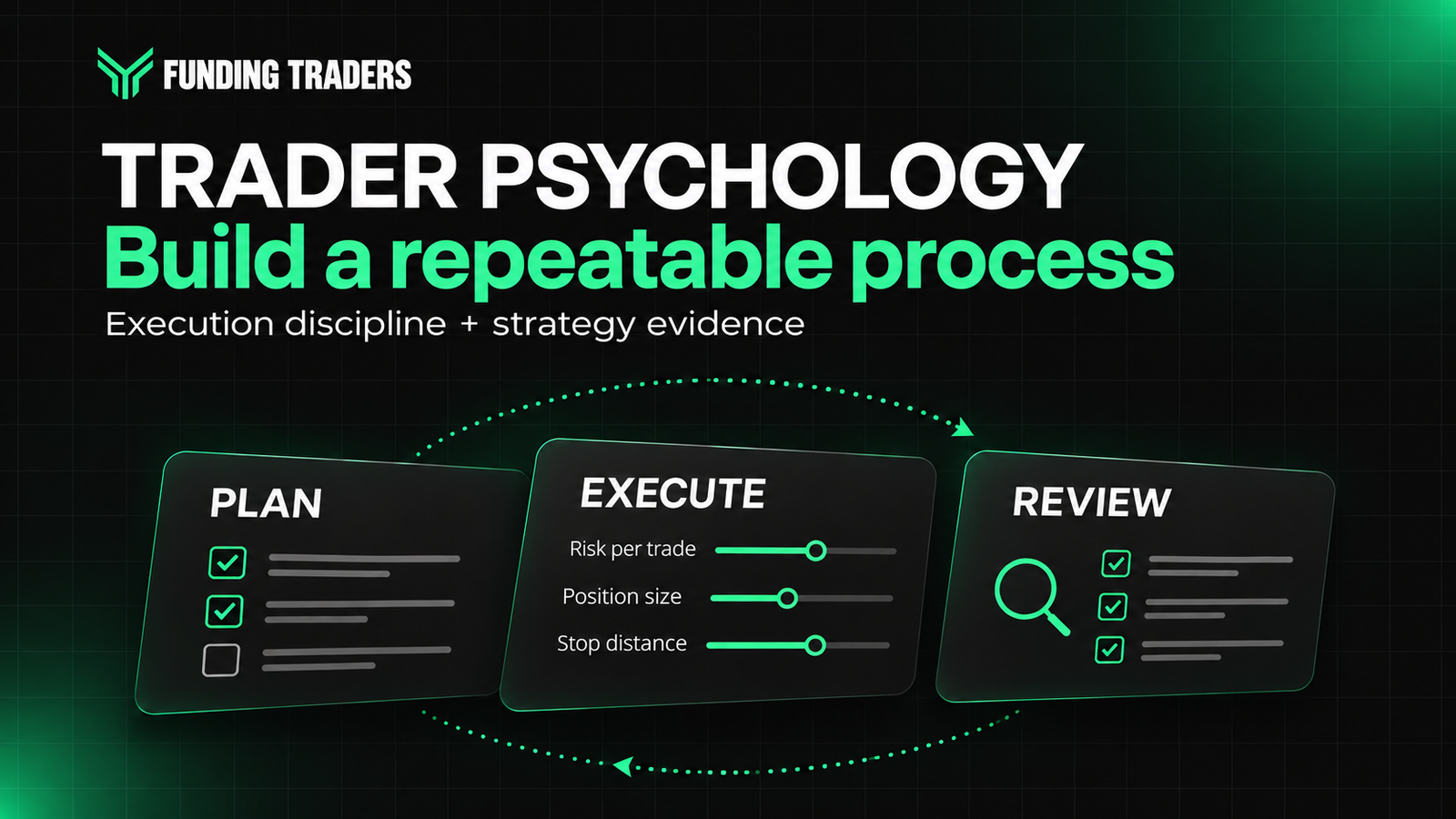
Prop firm risk management starts with a trade plan and expands to everything that can make several decisions fail together. Check the risk of the idea, the combined exposure, the remaining headroom, and the behavior that produced the result.

Disclaimer: Trading involves significant risk and is not suitable for every investor. Past performance is not indicative of future results. The information provided in this article is for educational and informational purposes only and should not be considered financial, investment, or trading advice. All account rules, payout structures, profit splits, and promotional offers described in this article are subject to change at the discretion of FundingTraders. Promo codes may expire or be modified without prior notice. Always trade responsibly and only risk what you can afford to lose.