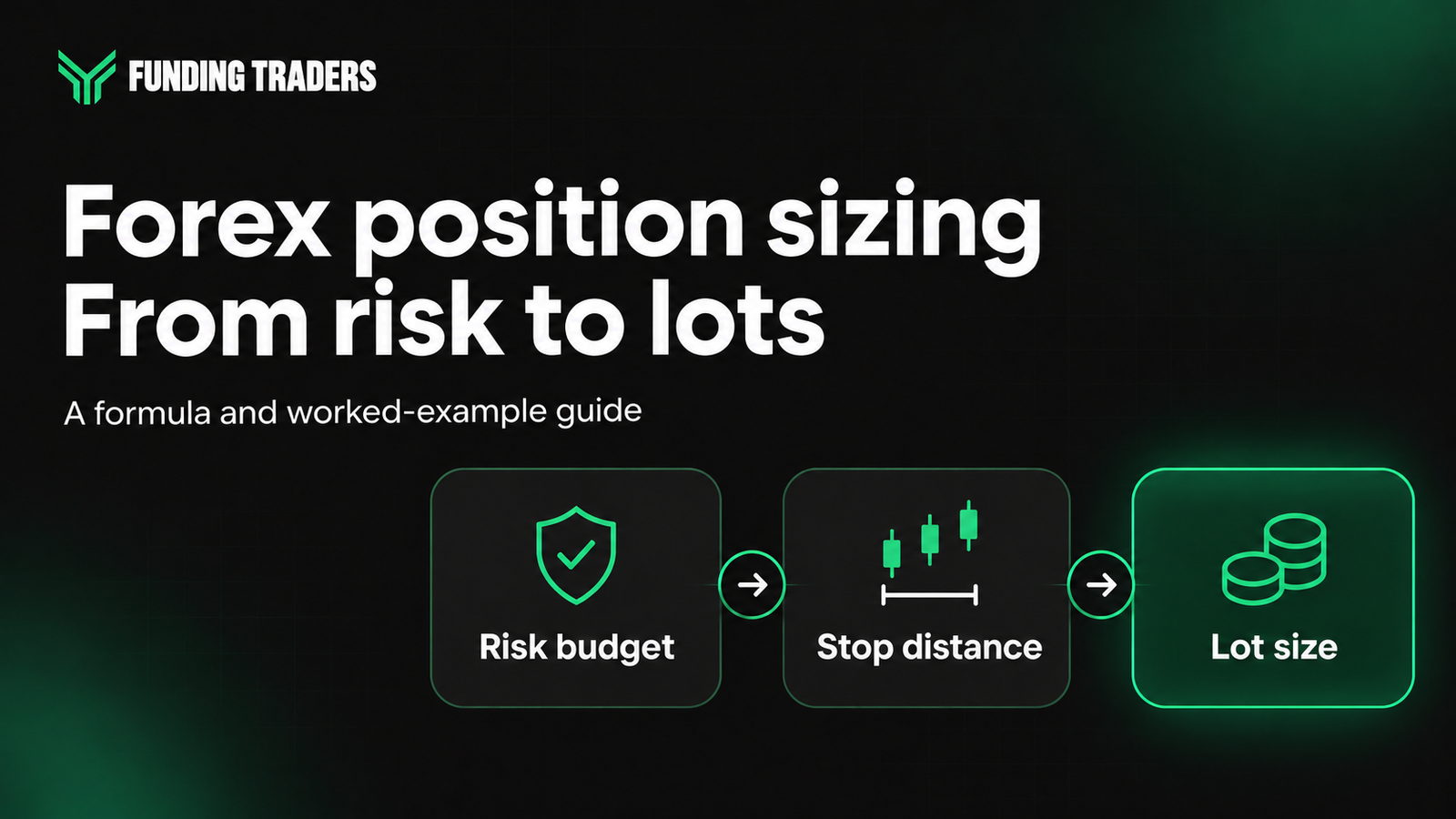
A forex position sizing calculation turns a planned loss budget and a stop distance into the number of units or lots to trade. Getting that arithmetic right matters because the same lot size can create very different exposure when the stop, currency pair or account currency changes.
This guide is for traders who want to check their order size before submitting it, including traders using FundingTraders. You will work through the formula, pip values, costs and the checks that can make a calculated size unsuitable. The examples use stated assumptions, not live quotes. A stop-loss order does not make the estimated loss a guaranteed maximum, and an illustrative risk percentage does not establish that a trade fits your account rules.
The forex position sizing formula
For a conventional FX contract, the starting calculation is:
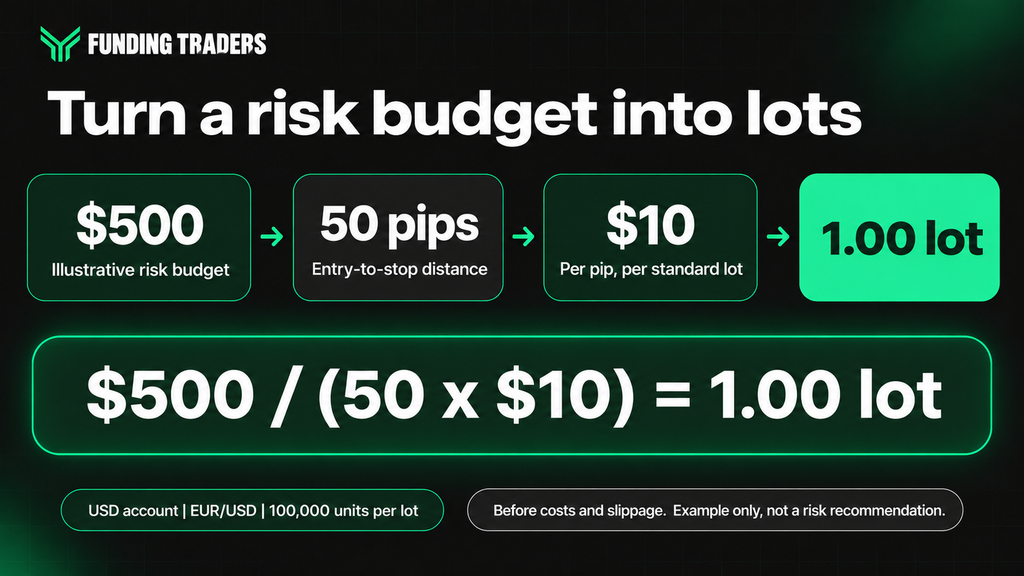
Position size in lots = planned price-loss budget / (stop distance in pips × pip value per lot in account currency).
The denominator estimates the loss on one lot if the position exits at the intended stop price. Dividing the budget by that amount gives the lot size before additional costs and execution adjustments.
For example, assume a USD account, a $500 price-loss budget, a 50-pip EUR/USD stop and a 100,000-unit standard lot worth $10 per pip:
$500 / (50 × $10) = 1.00 lot.
That result describes the example’s price exposure. Commission, financing, spread treatment and adverse execution can change the actual loss. We will add those checks below.
Choose the budget before calculating the volume
Multiplying account equity by a selected percentage can provide a starting figure. For $50,000 of equity, an illustrative 1% equals $500. Neither 1% nor 2% is universally safe, and neither percentage overrides a prop firm’s restrictions.
Balance records the account’s closed results; equity also reflects open-position results. Check both where the account rules require them. A useful budget must also consider remaining daily and overall loss room, any tighter floating-loss limit, existing positions and a reserve for costs and adverse execution. The smallest applicable allowance can require a lower budget or no new trade.
When considering a prop firm account size, distinguish the headline account amount from the loss room you can actually use. They are different numbers.
Start with the limits: review FundingTraders account options, with up to 70% off your next account with code BLACKFRIDAY.

Lots, pips and pipettes: use the right units
In the standard FX convention used here, one lot represents 100,000 units of the base currency, the first currency in the pair. One standard lot of EUR/USD therefore represents 100,000 euros, not a $100,000 cash deposit.
| Lot description | Volume in standard lots | Base-currency units | EUR/USD value per pip in USD |
|---|---|---|---|
| Standard | 1.00 | 100,000 | $10.00 |
| Mini | 0.10 | 10,000 | $1.00 |
| Micro | 0.01 | 1,000 | $0.10 |
These are unit relationships, not account-size recommendations. Your platform’s contract specification determines what one lot means and which volumes it accepts. Do not transfer this FX table to gold, indices or crypto CFDs; their contract sizes, tick sizes and tick values can differ.
A pip is commonly 0.0001 for pairs such as EUR/USD. For yen-quoted pairs such as USD/JPY, it is usually 0.01. A pipette is one tenth of a pip: 0.00001 on EUR/USD or 0.001 on USD/JPY.
For an entry at 1.10000 and a stop at 1.09500, the EUR/USD distance is 0.00500 / 0.0001 = 50 pips, or 500 pipettes. Confusing the last displayed digit with a full pip can produce a tenfold sizing error.
Convert pip value into your account currency
First calculate the pip value in the pair’s quote currency:
Pip value per lot in quote currency = contract units per lot × pip size.
Then convert that amount into the account currency if necessary. Use the appropriate conversion rate and direction, and check the platform’s loss estimate. Bid/ask conversion and a moving exchange rate can affect the realized amount.
USD-quoted pairs in a USD account
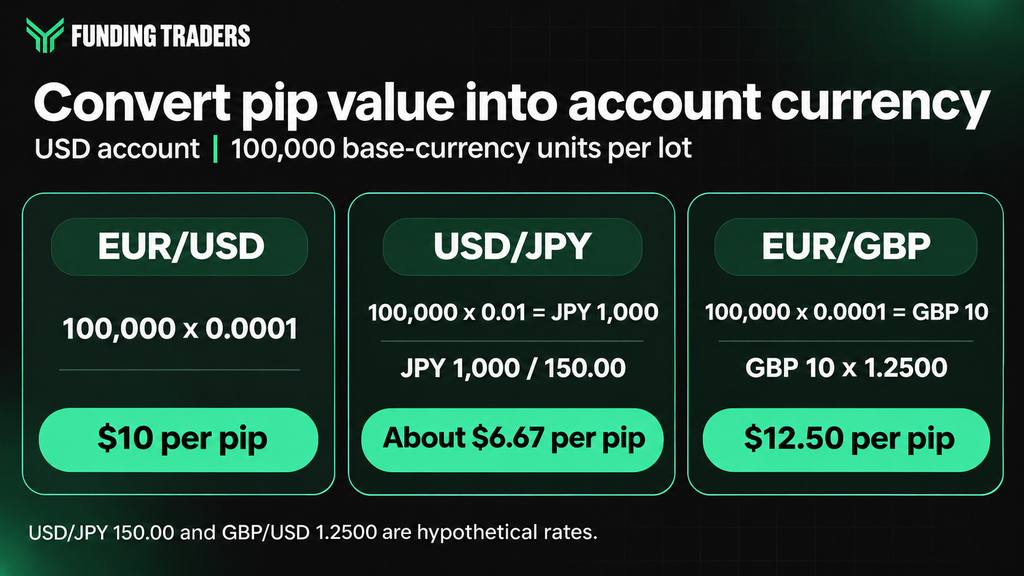
For a 100,000-unit EUR/USD contract, 100,000 × 0.0001 gives $10 per pip per standard lot. The same unit calculation applies to conventional GBP/USD and AUD/USD contracts of that size. A non-USD account still needs a currency conversion; “$10 per pip” is not a universal account-currency value.
USD/JPY at a hypothetical exchange rate
Assume USD/JPY is 150.00 yen per dollar. One standard lot has a pip value of 100,000 × 0.01 = JPY 1,000. In a USD account, JPY 1,000 / 150.00 is approximately $6.67 per pip. This is a hypothetical conversion, not a current quote. Recalculate when the rate changes, and retain full precision until the final volume step.
Crosses such as EUR/GBP
One standard EUR/GBP lot has a pip value of GBP 10. If GBP/USD is hypothetically 1.2500 dollars per pound, GBP 10 × 1.2500 gives $12.50 per pip in a USD account. The cross pair’s pip value must be translated from pounds into dollars before it goes into the sizing formula.
Worked examples: account size and stop distance
The next table assumes USD equity, conventional EUR/USD contracts, an illustrative 1% price-loss budget, a 50-pip stop and $10 per pip per standard lot. Costs and slippage are excluded to isolate the arithmetic.
| Account equity | Illustrative 1% budget | Calculation | Position size |
|---|---|---|---|
| $10,000 | $100 | $100 / (50 × $10) | 0.20 lots |
| $25,000 | $250 | $250 / (50 × $10) | 0.50 lots |
| $50,000 | $500 | $500 / (50 × $10) | 1.00 lot |
| $100,000 | $1,000 | $1,000 / (50 × $10) | 2.00 lots |
These are mathematical examples, not recommended sizes or permitted FundingTraders risk levels. In particular, planning a full 1% price loss would leave no buffer against the separate 1% aggregate floating-loss threshold for the Instant Funding version discussed below.
Change the stop, then recalculate the lots
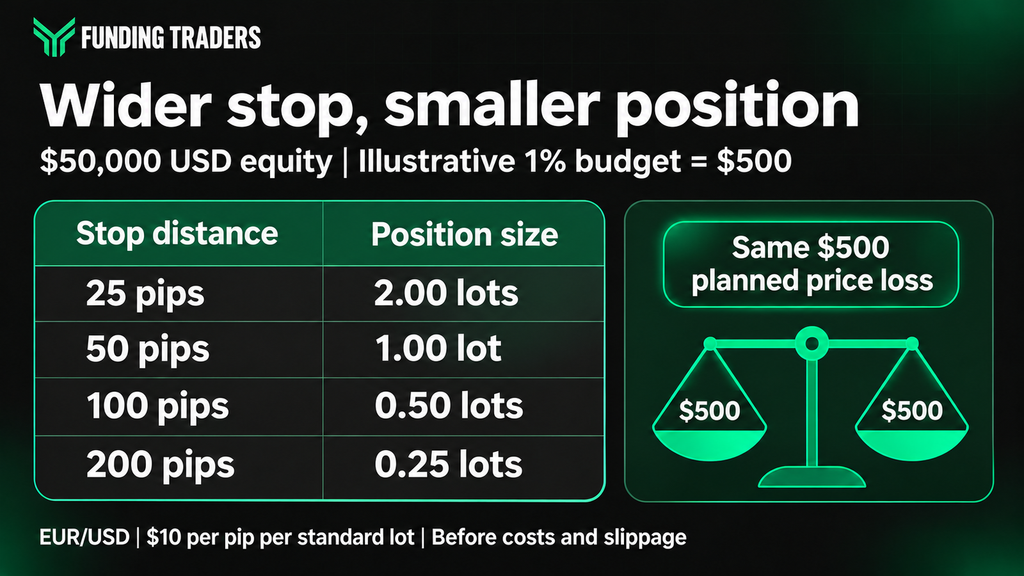
Keep one basis throughout this comparison: $50,000 equity, a $500 illustrative budget, EUR/USD and $10 per pip per standard lot.
| Entry-to-stop distance | Position size | Planned price loss before costs |
|---|---|---|
| 25 pips | 2.00 lots | $500 |
| 50 pips | 1.00 lot | $500 |
| 100 pips | 0.50 lots | $500 |
| 200 pips | 0.25 lots | $500 |
At a fixed 1.00 lot on that same $50,000 account, a 25-pip stop represents $250, or 0.5%, while a 100-pip stop represents $1,000, or 2%, before costs. The wider stop creates four times the price exposure. Recalculating the volume is what holds the planned amount steady.
Choose a stop that reflects the trade’s invalidation point, then assess the affordable size. Moving the stop closer merely to fit a preferred lot size changes the trade setup.
Adjust for costs, execution and trade-size restrictions
The basic forex position sizing formula leaves out anything beyond the entry-to-stop price movement. For a more useful estimate, include the applicable round-trip commission, financing if relevant and an allowance for adverse execution. If spread is already reflected in executable entry and exit prices, do not add the same spread twice.
Consider the same $500 budget and 50-pip EUR/USD stop. Suppose, purely for illustration, round-trip commission is $6 per standard lot and an additional execution allowance is 2 pips, or $20 per lot. These are hypothetical inputs, not a FundingTraders fee quote.
- Estimated loss per lot: (50 × $10) + $6 + (2 × $10) = $526.
- Unrounded volume: $500 / $526 = approximately 0.95057 lots.
- If the permitted volume step is 0.01 lot, round down to 0.95 lots.
- Estimated total: 0.95 × $526 = $499.70.
That allowance does not cap slippage. A gap or thin liquidity can make the fill worse than assumed, so the actual loss can exceed the estimate. Leave room below account limits instead of treating a calculated $499.70 as protection against a $500 breach boundary.
Respect minimum volume and step size
Check the symbol’s minimum, maximum, volume step and any aggregate volume limit. A calculation of 0.037 lots becomes 0.03 when the allowed increment is 0.01. If the calculated size is below the minimum, rounding up would exceed the budget; skip the trade or reassess the setup without increasing the loss allowance just to place an order.
In MT5, open the symbol’s Specification in Market Watch. Verify the contract and tick information for the exact symbol on the account you will use. The same symbol name elsewhere does not establish identical specifications.
Check margin separately
Margin is the amount required to support an open position, not the amount you can afford to lose. In a simple hypothetical FX margin model, one EUR/USD lot represents EUR 100,000. At 1:50 leverage, the initial calculation is EUR 2,000; at a hypothetical EUR/USD rate of 1.1000, that is $2,200. Actual margin can use different settings, rates or tiers.
A trade can fit a loss budget yet fail the free-margin check. Higher leverage can lower required margin for the same position, but it does not lower that position’s pip value. Confirm the order’s margin requirement and leave room for other positions and market movement.
FundingTraders rules can restrict the budget first
FundingTraders is not a broker and does not accept deposits for trading capital. Account size is therefore not a personal cash balance available to risk without constraints.
For Instant Funding accounts purchased on or after October 8, 2026, the linked Instant Funding rules state that aggregate floating loss across all open trades must not reach 1% of the initial account balance, measured from the current balance. This is distinct from the daily and overall loss floors. On a $50,000 initial account, that floating-loss boundary is $500 below the current balance, regardless of how many tickets create the loss.
Use the help article matching your account’s purchase version and the dashboard’s applicable limits. The FundingTraders terms also distinguish planned-risk rules from floating-loss restrictions. A correct forex position sizing calculation does not waive either. Keep a buffer; do not set a stop at the breach boundary.
Different products have different constraints. Review the 2-Step Pro account rules if that is your program, along with the trading-practice restrictions. Use the rules for your product and account status rather than borrowing a percentage from another model.
The account’s loss rules belong in your sizing process before the first order. Explore FundingTraders account options and compare those constraints, with up to 70% off your next account with code BLACKFRIDAY.

Five sizing mistakes to catch before submitting an order
- Reusing yesterday’s volume. A changed stop or pip value changes the planned loss. Recalculate from the new inputs.
- Treating equity as the whole budget. Open losses, drawdown floors and account restrictions can leave much less room than an equity percentage suggests.
- Confusing pipettes with pips. Confirm the price increment rather than counting displayed digits by habit.
- Rounding up or ignoring costs. A neat volume is not a reason to exceed your planned amount. Use the allowed step and check the resulting loss estimate again.
- Ignoring the portfolio. Long EUR/USD and long GBP/USD both include short-USD exposure. Their relationship is not constant, but a shared currency move can hurt both. Budget their combined downside instead of treating each ticket as independent.
When projecting what happens if open trades reach their stops, distinguish losses already reflected in equity from additional losses between today’s prices and those stops. Otherwise, you may double-count existing losses or overlook further exposure. Include pending orders that could activate and positions that may close worse than planned.
A pre-trade forex position sizing checklist
Record these inputs in a trading journal or worksheet:
| Check | What to record |
|---|---|
| Account and rules | Account currency, equity, balance, applicable loss floors and remaining room |
| Existing exposure | Open and pending trades, shared currencies and additional downside |
| Contract | Units per lot, pip or tick size, account-currency value and conversion rate |
| Setup | Intended executable entry, stop price and measured distance |
| Budget and costs | Planned loss amount, commissions, financing and execution reserve |
| Order feasibility | Rounded-down volume, minimum/maximum, margin requirement and buffer |
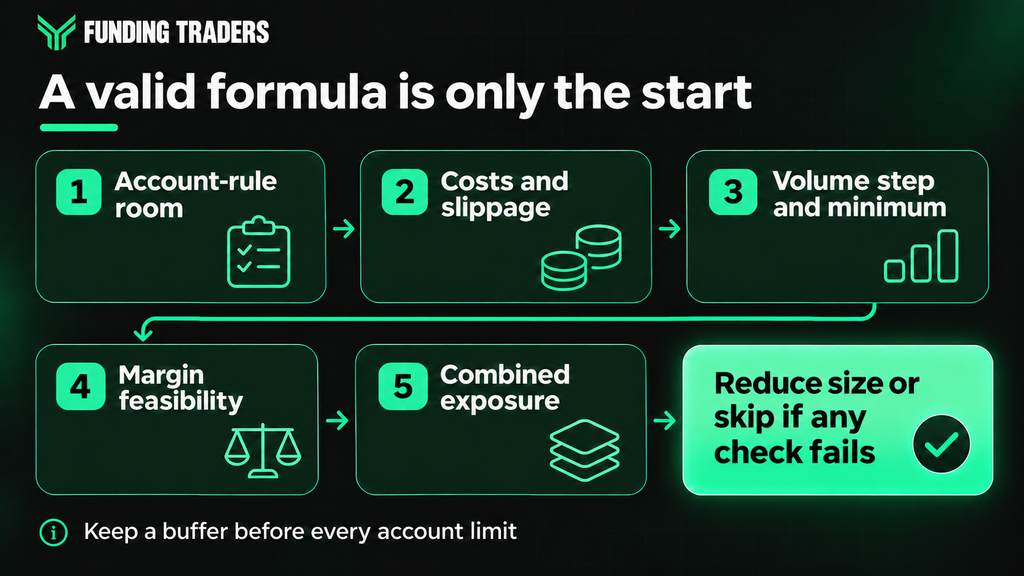
Recheck the estimated loss using the final volume, and compare the combined account scenario with every applicable limit. If any check fails, reduce the position or skip the trade. A completed worksheet is a decision aid, not evidence that the strategy has an edge.
Frequently asked questions
Is risking 1% per trade always appropriate?
No. A percentage is only an input. Your strategy, existing exposure, execution conditions and remaining account-rule room may require a lower amount or no trade. An aggregate floating-loss rule can be tighter than a separate daily or overall limit.
Is one standard lot always worth $10 per pip?
No. That example assumes a 100,000-unit FX contract, a 0.0001 pip, USD as the quote currency and a USD account. Yen pairs, cross-currency pairs and other account currencies require different calculations or conversions.
Does leverage change my stop-loss risk?
For the same contract, volume and price movement, leverage does not change the price loss. It affects how much margin is required. Using lower margin to open a larger position increases exposure because the volume is larger.
Can I use a position sizing calculator instead?
Yes, as a calculation aid. Check its account currency, contract assumptions, pip definition, conversion rate, costs and rounding. Reconcile the result with your platform and account rules. This guide provides the formulas and worked examples, not an interactive calculator.
Can an ordinary stop keep my loss below the planned amount?
It cannot ensure that result. Slippage, gaps, costs and conversion changes can increase the loss. A stop sets an exit instruction, while its execution and the account’s breach rules determine what happens next.
Make the calculation part of the decision
Useful forex position sizing starts with a permitted budget, measures the stop in the correct units and converts pip value into the account currency. It then adjusts for costs, rounds down to an accepted volume and checks margin and combined exposure. Repeat those checks when an input changes.
Ready to compare the account rules behind the numbers? Review FundingTraders options, with up to 70% off your next account with code BLACKFRIDAY. Choose only an account whose constraints fit your process.

Disclaimer: Trading involves significant risk and is not suitable for every investor. Past performance is not indicative of future results. The information provided in this article is for educational and informational purposes only and should not be considered financial, investment, or trading advice. All account rules, payout structures, profit splits, and promotional offers described in this article are subject to change at the discretion of FundingTraders. Promo codes may expire or be modified without prior notice. Always trade responsibly and only risk what you can afford to lose.