Cash is a position when your trading plan calls for patience and the market has not given you a reason to enter. You have checked your levels, watched price approach an area of interest, and prepared for a possible trade. There is still one condition missing. Staying flat is the decision that follows from that information.
It can also be an uncomfortable decision. The chart keeps moving. Other traders are posting entries. After an hour at your desk, placing an order starts to feel like proof that you have done some work.
That pressure can lead you away from the very rules you came to execute. At FundingTraders, we want traders to recognize the difference between a valid opportunity and the urge to participate. Here is how that difference shows up during an ordinary session, and how to make waiting part of a practical trading routine.
What Does “Cash Is a Position” Mean in Trading?
For an active trader, the phrase means that choosing no open market exposure is a legitimate part of a strategy. You do not need to maintain a position simply because the market is open.
In a prop evaluation, “cash” is shorthand for being flat. Being flat avoids the price exposure of an open trade. It does not eliminate every cost or obligation. Evaluation fees still matter, account conditions still apply, and skipping a valid opportunity has an opportunity cost. A pending order can also create exposure if it triggers, even when you have no open positions at the moment.
The useful principle is narrower than “cash always wins”: when an entry fails your criteria, you can decline it without treating that decision as a failure.
Action Bias: When Placing an Order Feels Like Progress
Action bias describes a preference for doing something when waiting is also an available response. In trading, it can look like entering before confirmation, scanning unfamiliar instruments for excitement, or taking another trade because the session feels unfinished.
The easiest warning sign is a change in the question you are asking. You begin with “Does this meet my setup?” and drift toward “What can I trade right now?”
Consider a hypothetical session on EUR/USD. Your plan requires a close beyond a marked range, followed by a retest that holds. Price approaches the boundary several times, but the full sequence has not appeared. The examples below describe possible choices, not predictions or recommended entries.
The Early Entry: A Familiar Pattern Becomes Permission
You recognize the shape and enter before the candle closes. For a moment, price moves your way. That small gain makes the missing confirmation seem unimportant.
Then price moves back into the range and reaches your stop. Later, a qualifying breakout might appear, but you have already spent some of your planned risk on a different trade.
The error is visible before the result. You replaced an entry condition with a feeling about what would happen next. Even if the early trade had won, it would still be a departure from the strategy you intended to follow.
Separate observation from authorization. A pattern can put an instrument on your watchlist. Your full entry criteria determine whether it becomes a trade.
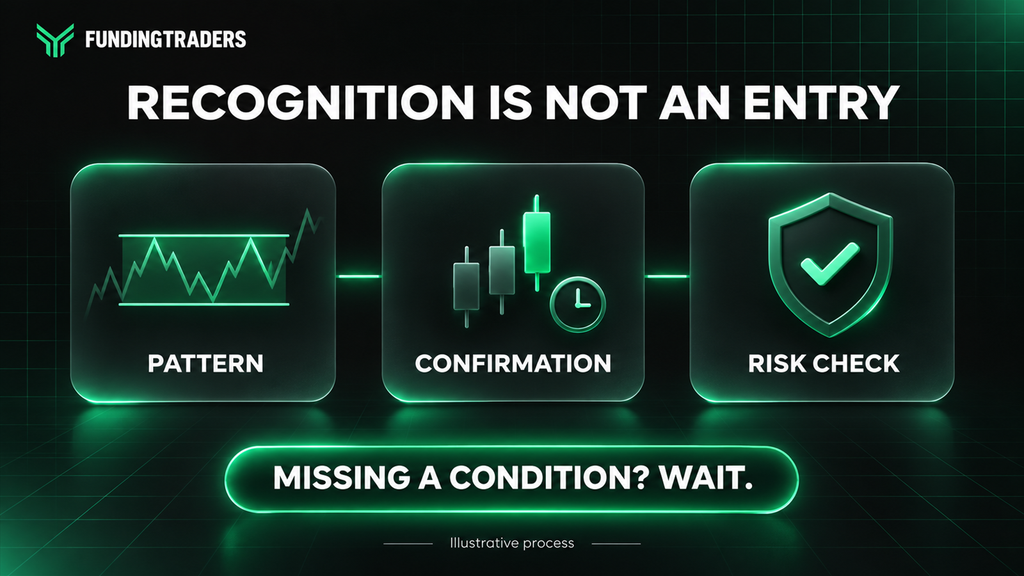
Before the session, write the trigger in language you can check: which candle must close, which level matters, and what would cancel the idea. If “almost” is doing the work of a missing condition, the order is early.
Give the exit the same clarity. Our guide to using a hard stop instead of a mental stop explains why a planned exit needs an execution method, while recognizing that an order does not remove execution risk.

The Quiet Session: Boredom Starts Rewriting the Plan
This time, you wait. Price returns inside the range, so the setup never completes. Another stretch of sideways movement follows.
You open a faster chart. Then another pair. Eventually, you find something that resembles an entry, although it belongs to neither your usual timeframe nor your tested strategy.
This is how overtrading can begin without a dramatic loss or an angry reaction. The first compromise is small: accepting a weaker reason to trade because the original plan has produced nothing.
A profitable impulse trade can make the habit harder to spot. Its result rewards the click, even though the decision process has changed. Judge the entry against the rules that existed beforehand, not just the color of its final P&L.
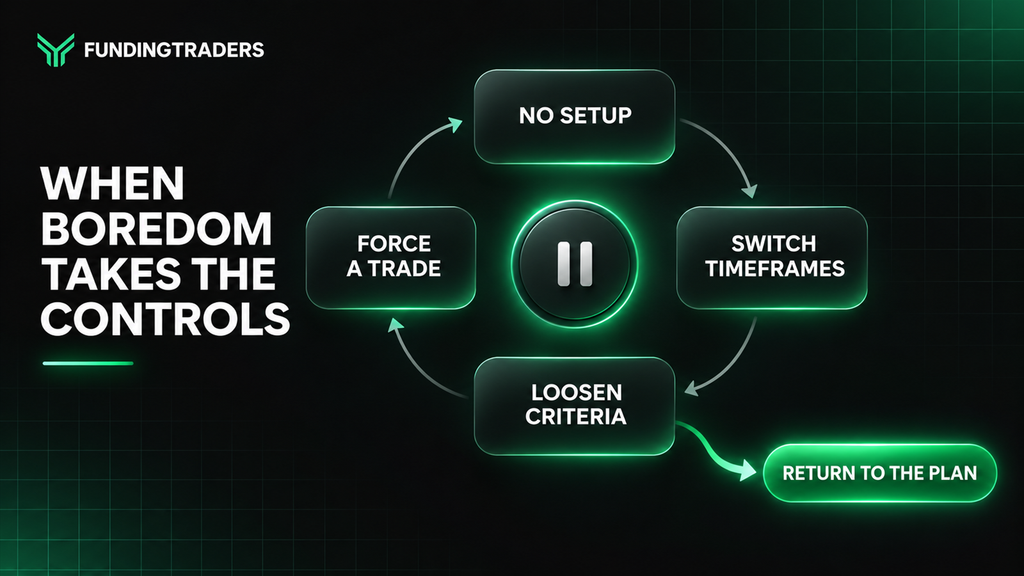
A practical response is to define your watchlist and trading window before opening the platform. Use alerts at relevant levels, and decide what you will do between them. Reviewing a previous session or taking a scheduled break gives the waiting period a purpose.
If your records show that extra trades repeatedly come from boredom, a personal trade limit may help. Set it from your strategy and review data. There is no universal number of trades that makes every trader disciplined.
The Missed Move: Regret Tries to Become a New Entry
You step away while flat and return to find price beyond your planned area. The move looks obvious now. It is tempting to calculate the profit you could have made and enter late to recover something you never actually lost.
Pause before treating that chart as evidence against your rules. A completed move shows information you did not have at the decision point.
Review what actually happened:
- The setup never qualified. Skipping it followed your plan, even if price later traveled in the direction you expected.
- The setup qualified while you were away. Review your alert settings, session schedule, and whether the strategy needs closer monitoring.
- The setup qualified while you watched, but you hesitated. Investigate the hesitation. Avoidance can be a problem even when you describe it as patience.
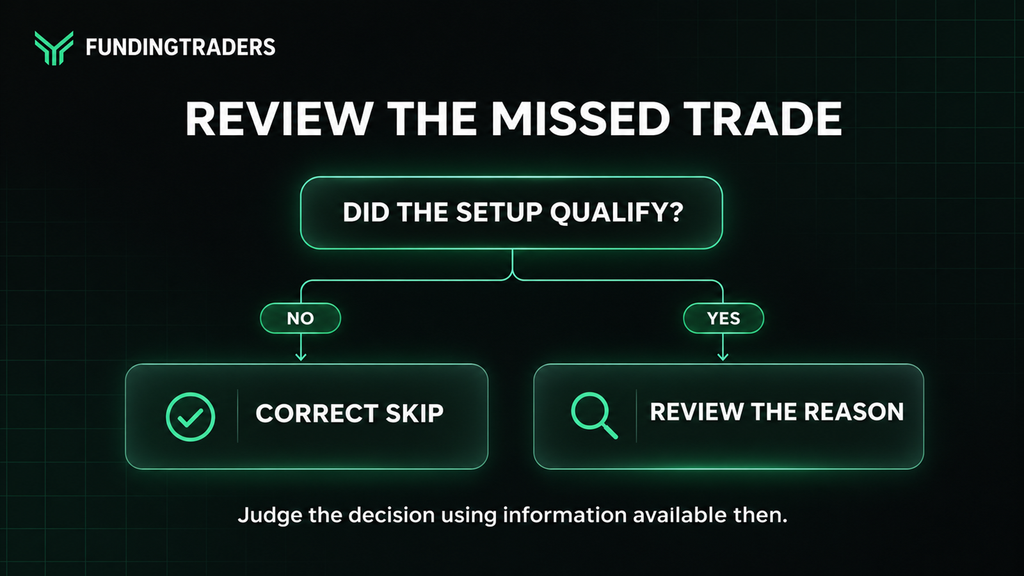
None of those situations makes an unplanned chase necessary. A later entry needs its own valid trigger, stop, position size, and acceptable risk. The earlier move does not supply those details for you.
You can feel disappointed and still leave the order ticket alone. The goal is to stop disappointment from deciding your next trade.
The Session Ends: No Trade Can Be a Valid Result
Your trading window closes with no qualifying setup. Finishing flat is consistent with the plan.
It is not a profit, and it does not prove that tomorrow will be better. It does mean that this session did not add a loss from an entry you had already decided was unsuitable.
Close the session deliberately. Check for unwanted pending orders, record why you stayed out, and note the next conditions worth monitoring. That gives the day a clear endpoint instead of leaving you searching for a last-minute trade to justify the hours spent watching.
Make Waiting Easier Before Willpower Is Tested
“Be more patient” is difficult to execute because it does not specify what to do. A short routine is more useful than repeatedly negotiating with yourself over the same unfinished setup.
Build these decisions into your preparation:
| Decision | Define it before the session |
|---|---|
| What will I watch? | The instruments and timeframes your strategy covers |
| What permits an entry? | The complete setup and observable trigger |
| What cancels the idea? | The price behavior or conditions that invalidate it |
| What risk is acceptable? | Planned stop, position size, costs, and account limits |
| When will I pause or finish? | Your trading window and personal stopping conditions |
Choose breaks that fit the strategy. If you need continuous monitoring, an alert alone may not be enough. If you are already in a position, stepping away also requires a management plan; the advice to take a break while flat is not permission to abandon an open trade.
Our set-and-forget trading guide extends the same preparation principle to decisions after entry.
You do not need to assume that every afternoon session is worse, or that more screen time always causes poor decisions. Compare your own records. Look for the circumstances in which your entries stop matching your plan, then change the routine around those circumstances.

Record the Trades You Decided Against
If your journal contains only executed orders, it leaves out part of your decision-making. A brief record of rejected entries helps you distinguish sound filtering from hesitation.
Use a simple format:
| Journal field | Example entry |
|---|---|
| Instrument and setup | EUR/USD range breakout and retest |
| Missing condition | Retest did not hold |
| Pressure to enter | Frustration after a quiet session |
| Decision | Stayed flat under the existing rule |
| Evidence | Screenshot taken at the decision point |
| Review question | Did I apply the same condition consistently? |
Review these notes alongside the trades you did take. Were your rejected entries missing something specific? Did you reject valid setups mainly after a loss? Did changing timeframes produce trades you would not have accepted during a calmer session?
Be careful with hindsight. A skipped trade that later would have lost is not automatically “money saved,” because its hypothetical fill and management are uncertain. A skipped winner is not automatically a mistake either. Start with whether the decision matched the information and rules available then.
Over time, that record can show where your filter is useful and where it needs testing. Change the plan during a structured review, rather than halfway through a session because one missed move looked attractive.
Staying Flat on a FundingTraders Account
On a FundingTraders prop trading account, patience needs to work within the account’s conditions. Being selective does not suspend those conditions.
Our General Trading Guidelines include an inactivity rule. The initial 30-day period starts at purchase, and placing no trades during that period results in account failure. The guidelines also require at least one trade within each 30-day period. Build account monitoring into your routine before a long break, and choose an account only when its participation requirements fit your availability.
Risk requirements also remain relevant when you resume. Our risk management guidance identifies behaviors such as oversized positions, rapidly compounded exposure, and emotional entries after losses as grounds for review on funded accounts. A quiet session is not a reason to increase size on the next opportunity.
For product-specific entry preparation, read the rules for the account you selected. For example, the 1-Step Pro account rules describe its loss limits and trading objectives. Do not assume that a rule from another product applies to yours.
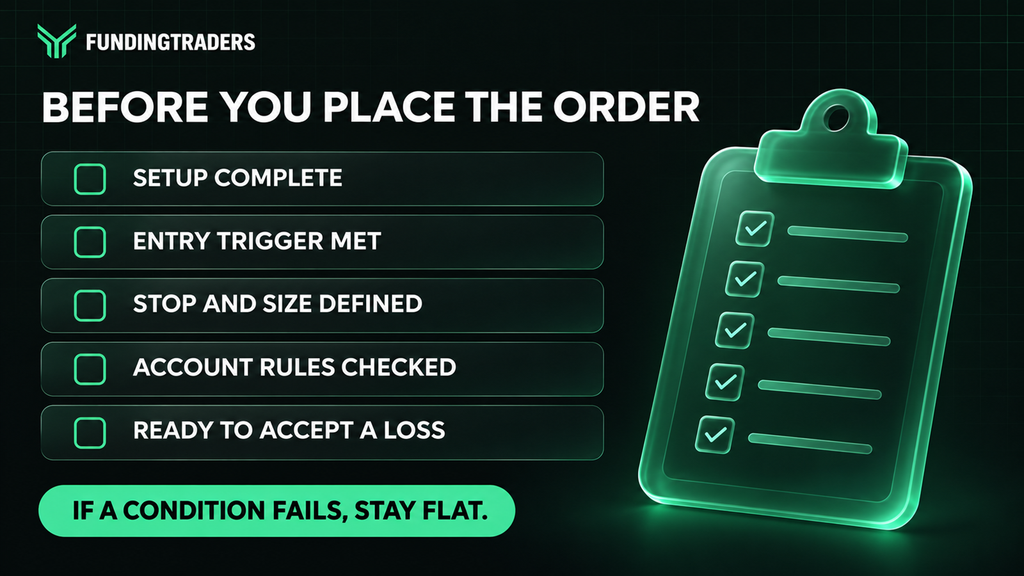
Before submitting an order, check that the setup is complete, the trigger has occurred, the stop and size are defined, and the position fits your account rules. Finally, ask whether you can accept the planned loss without needing an immediate recovery trade.
If a condition fails, keep the order unplaced. If your strategy rarely produces opportunities within an account’s participation requirements, review that fit before purchasing rather than improvising trades to satisfy a deadline.

Frequently Asked Questions
Is a day without trading a wasted day?
No. If you prepared, monitored your planned conditions, and rejected entries that did not qualify, the session served a purpose. Record that work. If valid setups appeared and you repeatedly avoided them, investigate the cause instead of assuming every flat day reflects discipline.
Does trading less make you more profitable?
Not by itself. Removing trades that violate your tested criteria may improve execution, but skipping valid opportunities can also reduce returns. Judge frequency against the strategy, its costs, and your records. Fewer trades is not a substitute for an edge.
How can I tell patience from fear of losing?
Write down the condition that prevented entry. Patience follows an unmet rule. Fear may appear as new objections after every required condition has been satisfied. A journal of both executed and rejected setups makes that distinction easier to examine.
What should I do after missing a strong move?
Check whether the original setup qualified and whether your monitoring routine worked. Enter again only if a fresh opportunity meets your plan. Avoid treating the distance price has already traveled as a reason to chase it.
Can I leave a prop account inactive indefinitely?
No. Account participation requirements still apply while you are flat. FundingTraders has an inactivity rule, described above. Review the applicable guidelines before purchasing or planning an extended break, and do not assume that logging in counts as placing a trade.
Let Your Entry Criteria Decide
Cash is a position when it reflects a clear decision to wait for conditions your strategy requires. It can help you avoid premature entries, boredom trades, and attempts to chase missed moves. It cannot turn an untested strategy into a profitable one or replace the need to act when a valid setup arrives.
For your next session, define the entry trigger, the reasons to stay out, and the point at which you will finish. Apply those conditions consistently, then review the decisions you made on both sides of the order button.
When you are ready to choose an account, compare its rules with that routine. Give the purchase decision the same preparation you expect from your trades.
Disclaimer: Trading involves significant risk and is not suitable for every investor. Past performance is not indicative of future results. The information provided in this article is for educational and informational purposes only and should not be considered financial, investment, or trading advice. All account rules, payout structures, profit splits, and promotional offers described in this article are subject to change at the discretion of FundingTraders. Promo codes may expire or be modified without prior notice. Always trade responsibly and only risk what you can afford to lose.