What is a prop firm, and why are tens of thousands of traders choosing one over traditional self-funded accounts? If you have the trading skills but lack the capital to match your ambition, a proprietary trading firm could change the trajectory of your trading career. A prop firm, short for proprietary trading firm, is a company that provides traders with access to its firm’s capital so they can trade financial markets like forex, stocks, commodities, and indices without putting their own money at risk. In return, the firm and the trader share the profits generated through a profit split arrangement. This prop trading model has exploded in popularity because it removes the single biggest barrier most retail traders face: limited capital. Instead of slowly growing a small personal account, you can trade accounts worth $50,000, $100,000, or even $400,000, and keep the majority of the earnings. In this guide, we break down exactly how prop firms work, what the evaluation process looks like, the benefits and risks you should know, and how to choose the right prop firm for your goals.
Quick Summary Box
Here’s what you need to know about prop firms before going any further. A prop firm is a proprietary trading company that funds skilled traders with the firm’s money so they can trade financial markets without risking their own savings. Most prop firms require traders to pass a challenge or evaluation phase where they must hit specific profit targets while staying within strict drawdown limits and risk management rules. Once a trader passes, they receive a funded account and begin earning real payouts through a profit sharing arrangement, with profit split ratios typically ranging from 70% to 100% in the trader’s favor. The key benefits include access to significant capital, reduced personal financial risk, professional trading platforms, and structured risk management that builds long-term discipline. Prop firms are best suited for traders who already have a proven trading strategy and are ready to scale, though new traders with strong discipline can also find success with the right firm and preparation.
How Does a Prop Firm Work?
Understanding how prop firm work structures operate is essential before you invest in any evaluation. Let’s break down each layer of the business.
The Business Model Behind Prop Trading
At the core, prop trading firms exist to identify talented traders and give them access to capital they wouldn’t otherwise have. The firm provides the money; the trader provides the skill. When trades are profitable, the profits generated are divided according to a profit split agreement, commonly 80% to 90% in the trader’s favor, though some firms now offer up to 100% on certain account types.
How do prop firms actually make money? There are two primary revenue streams. First, evaluation fees, the one-time charge traders pay to enter a challenge or evaluation phase. Industry data suggests roughly 70% of prop firm revenue comes from these fees, since only about 5–15% of traders pass. Second, the firm’s cut of the profit sharing arrangement with funded traders. This creates a model where the most successful prop trading firms profit most when their traders succeed, aligning incentives on both sides.
Unlike hedge funds, which pool external investor capital, or commercial banks and financial institutions that trade with depositor funds, modern prop firms trade only their own capital (or simulated equivalents) and do not manage client funds. This distinction matters for regulatory purposes and for understanding why prop firms can offer such accessible entry points.
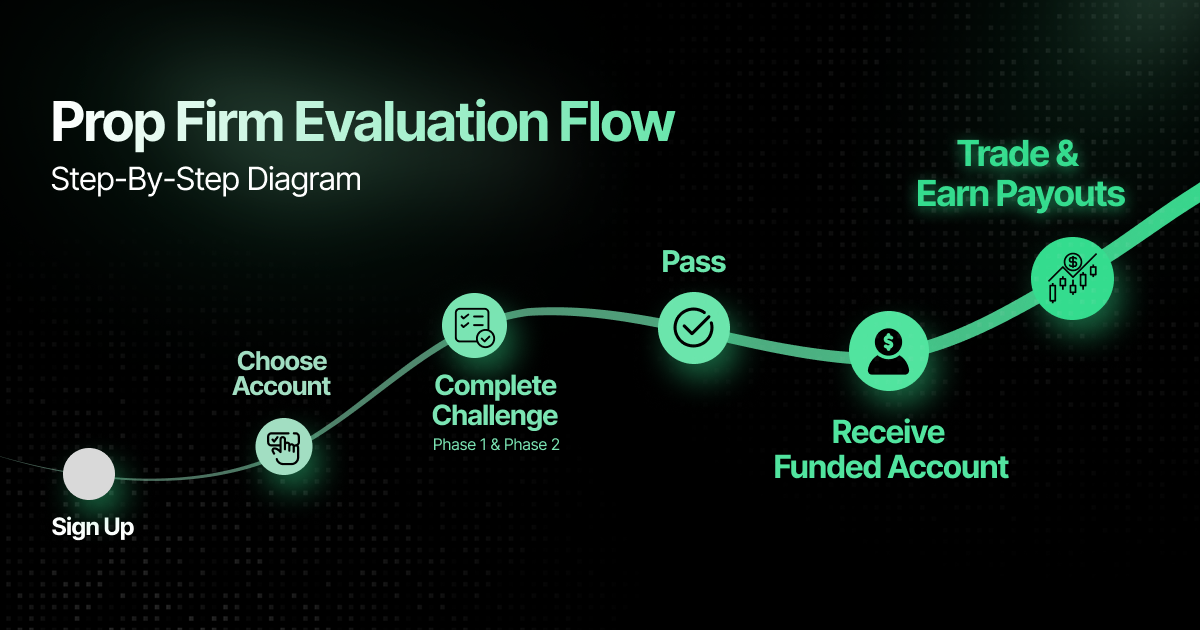
The Evaluation and Challenge Process
Most prop firms require traders to pass a structured evaluation before granting access to a funded account. This is where the firm tests whether you can generate consistent profits while following strict risk management protocols.
Here’s how it typically works. You select an account size, say $50,000 or $100,000, and pay a one-time evaluation fee. You then trade a simulated account under the firm’s rules. In a two-step evaluation, you need to hit a profit target of around 8–10% in Phase 1 and 5% in Phase 2. In a one-step model, there’s a single profit target to clear. Instant funding options skip the evaluation entirely, though fees tend to be higher and rules slightly stricter.
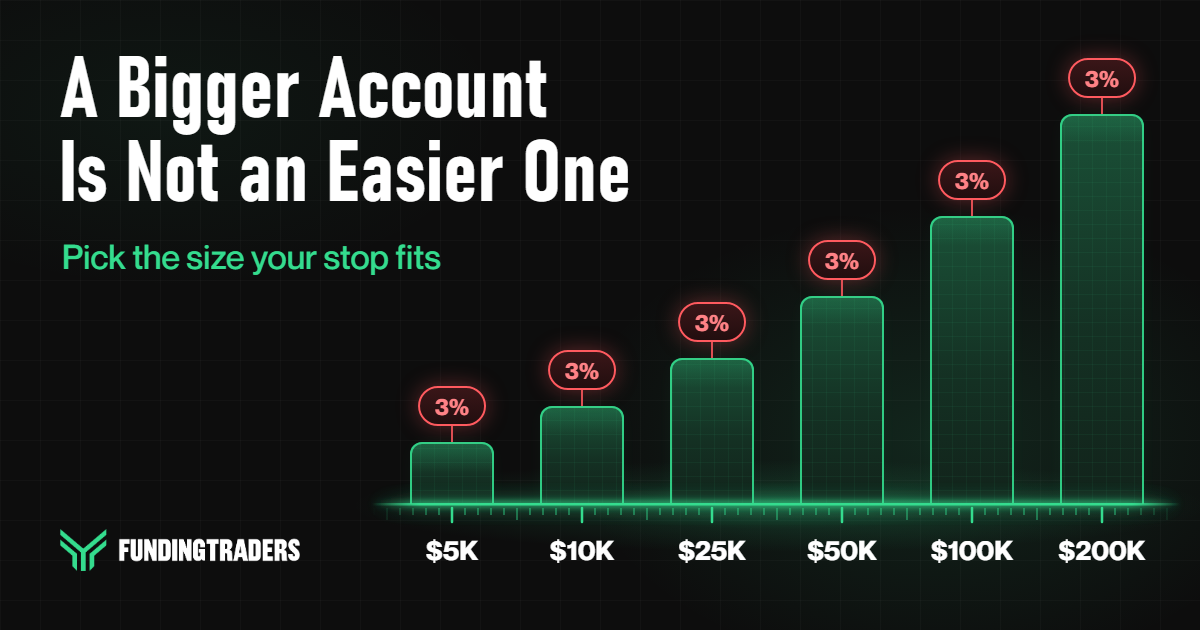
Throughout the evaluation, you must stay within drawdown limits, both daily (typically 3–5%) and overall (6–10%). You also need to meet minimum trading day requirements, usually 4–10 days, to prove that your results reflect consistency rather than a single lucky session. High impact news events may come with additional restrictions depending on the firm.
The evaluation is designed to test discipline, not just profitability. Prop firms require traders to demonstrate that they can manage risk effectively while pursuing returns, because once you’re funded, it’s the firm’s capital on the line.
Ready to see what a real evaluation looks like? FundingTraders offers 1-Step, 2-Step, and Instant Funded challenges with account sizes up to $400,000, and with code FT50, you’ll get 50% off any account size. Start your challenge at FundingTraders.
What Happens After You Pass
Once you clear the evaluation, you receive your funded account credentials. Now you’re trading with the firm’s capital, and the profits you make are real. Your profit split kicks in, at firms like FundingTraders, that’s 80% to 100% depending on the account type and your trading performance.
Successful traders can also access scaling programs. Demonstrate consistent trading performance over time, and the firm increases your capital allocation. Some traders start with a $25,000 funded account and scale to $200,000 or more. The profit target for scaling is usually lower than the initial challenge, encouraging sustainable, long-term performance over aggressive risk-taking.
Payouts at most prop firms are processed on a regular schedule, biweekly or monthly. The speed varies widely across the industry; some firms take a week, others guarantee it within 48 hours. This is one area where choosing the right prop firm makes a material difference to your cash flow.
Types of Prop Firms
The prop trading landscape isn’t one-size-fits-all. Here are the main types you’ll encounter:
Traditional vs. online prop firms. Traditional proprietary trading firms, think Jane Street or Citadel, hire traders as employees with salaries, give them access to institutional capital, and trade using sophisticated quantitative strategies. These firms have acceptance rates below 1%. Modern online prop firms, which is what most people mean today, operate entirely remotely. They’re open to any trader willing to pay an evaluation fee and prove their skill through trading challenges.
Forex prop firms specialize in currency trading and tend to offer the widest instrument selection, the lowest entry fees, and the most flexible hours. They are popular among day traders and scalpers active in the forex market. Prop firms focused on futures have grown rapidly and now rival forex in search volume globally. Stock and crypto-focused firms round out the market.
One-phase vs. two-phase vs. instant funding. One-step evaluations have a single profit target and faster time to funding. Two-step models split the target across two phases, testing consistency more rigorously. Instant funding options bypass the evaluation entirely, you pay a premium fee and start trading a funded account immediately, though drawdown limits tend to be tighter.
Benefits and Risks of Trading With a Prop Firm
Why Traders Choose Prop Firms
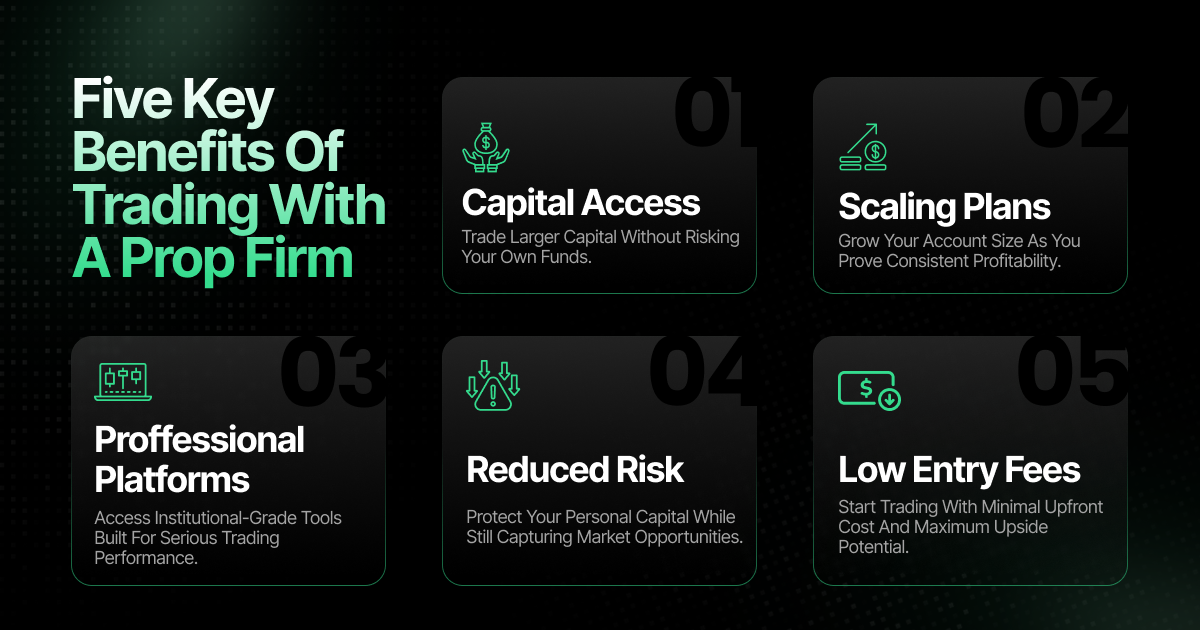
Prop firms offer a set of advantages that are difficult to replicate with a personal trading account:
Trade with significant capital without personal financial risk. This is the biggest draw. Your maximum loss is the evaluation fee, not your life savings. The firm’s capital absorbs market losses, while you keep the majority of the upside through the profit split. This dramatically reduces your personal financial risk and overall risk exposure.
Access professional trading conditions. Prop firms provide traders with advanced trading platforms like MetaTrader 4, MetaTrader 5, cTrader, and DXtrade, along with real-time data feeds, analytics tools, and sometimes educational resources that most retail traders couldn’t afford independently. These trading platforms mirror live market conditions precisely.
Structured risk management builds discipline. The strict drawdown limits and risk management rules that prop firms enforce aren’t just there to protect the firm, they force you to develop the discipline that separates consistently profitable traders from gamblers. This structure encourages traders to manage risk properly and refine their trading strategy over time.
Scaling opportunities. As you prove consistency, prop firms offer paths to larger capital allocations. A successful prop trader can scale from a $10,000 account to six figures without investing a single additional dollar of their own.
Low barrier to entry. Evaluation fees start as low as $35–$99 at some firms, compared to the tens of thousands needed to self-fund a meaningful trading account. This opens doors for skilled traders worldwide who have the talent but not the bankroll.
Risks and Things to Watch
Honesty about the downsides is what separates useful advice from marketing. Here’s what to keep in mind:
Not all prop firms are legitimate. The industry is largely unregulated, and some firms operate with poor transparency, delayed payouts, or rules designed to make passing nearly impossible. Reputable prop firms publish their rules clearly, process payouts on time, and have verifiable track records. Always research a firm’s reputation before paying any fee.
Strict rules lead to high failure rates. With only 5–15% of traders passing evaluations industry-wide, the odds are challenging. A single breach of the daily drawdown limits can end your evaluation instantly, regardless of your overall performance. This is why having a well-tested trading strategy and strong risk management habits before entering a challenge is critical.
Evaluation fees are non-refundable at most firms. While some prop firms refund the fee after a certain number of successful payouts, the initial cost is sunk if you fail. Traders risk real money on the evaluation even though they don’t risk it on the markets.
Payout structures vary, read the fine print. Profit split percentages, payout schedules, consistency score requirements, and the distinction between simulated and live capital all differ from firm to firm. Don’t assume, verify.
Who Should Consider a Prop Firm?
The prop trading model isn’t for everyone, but it’s an excellent fit for specific trader profiles.
Skilled but undercapitalized traders are the sweet spot. If you’ve developed a profitable trading strategy through demo trading or small live accounts and can demonstrate consistent results, a prop firm lets you scale those returns dramatically. Imagine trading your proven strategy on a $100,000 account instead of a $2,000 one, the same 5% monthly return goes from $100 to $5,000.
Part-time traders and career changers also benefit. Whether you’re working a day job and trading the London or New York sessions, or you’re transitioning from another career, prop firms give you a structured path to build trading experience and income without quitting your job or draining savings. Both swing trading and intraday approaches can work within the typical rules.
Experienced traders looking to diversify their capital sources find value too. Even if you already trade a personal account, adding a funded account from a prop firm gives you more capital to deploy your edge across multiple asset classes and trading instruments without increasing your personal financial risk.
Who might not be a good fit? Complete beginners who haven’t yet developed a trading strategy or don’t understand basic risk management will likely struggle. The evaluation isn’t a learning environment, it’s a testing ground. If you’re still learning to read charts, understand lot sizing, or manage risk, invest your time in education first. Traders who treat the markets like a casino will burn through evaluation fees quickly.
How do you know if you’re ready? If you can demonstrate at least three months of consistent results on a demo account, hitting reasonable profit target levels while staying within typical drawdown limits, you’re likely prepared to take on a challenge.
How to Choose the Right Prop Firm
With thousands of prop trading firms operating globally, picking the right prop firm matters enormously. Here are the criteria that should guide your decision:
Profit split. Look for firms offering 80% or higher. The best prop firm options in 2026 offer 80–100% profit split ratios. Be wary of firms advertising high splits with hidden deductions.
Drawdown rules. Understand both the daily loss limit and the maximum drawdown limits. Your trading style needs to match these constraints, aggressive scalpers may need more room than conservative swing trading strategies.
Payout speed. How quickly can you access your earnings? Some firms take 5–7 business days; others guarantee payouts within 48 hours. If cash flow matters to you, this is a differentiating factor.
Platform options. Confirm the firm supports the trading platforms you rely on, MetaTrader 4/5, cTrader, or proprietary platforms. Also check whether the firm supports forex trading, futures, indices, or multiple asset classes depending on your focus.
Reputation and transparency. Check independent reviews, community forums, and social media. Reputable prop firms have active communities, responsive support, and published payout records. Not all prop firms operate with integrity, do your homework.
Educational resources and support. Some firms provide educational resources, trading communities, mentorship, and economic calendars that help traders improve. For new traders especially, this support can accelerate your development.
Scaling plan. A clear scaling pathway signals that the firm is invested in long-term trader success, not just collecting evaluation fees. Look for firms that increase your account size based on consistent trading performance.
Why FundingTraders Stands Out
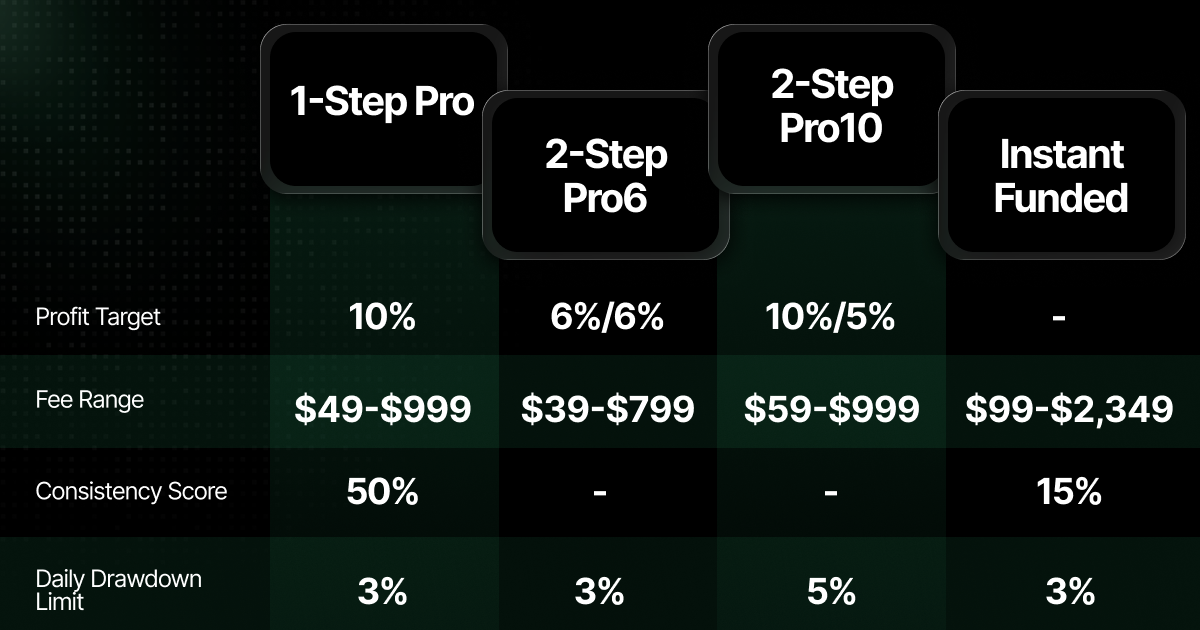
After reviewing the competitive landscape, FundingTraders checks every box above, and adds a few advantages that set it apart. With over 53,000 accounts funded, the firm offers Instant Funded, 1-Step, and 2-Step challenge types with account sizes ranging from $5,000 to $400,000. The profit split goes up to 100%, and the 48-hour payout guarantee means you’re never waiting long for your money.
FundingTraders also offers an account reset feature, if you fail a phase, you can reset at a fraction of the original cost and keep going, rather than paying full price to start over. With instant support response times under one minute, a clean and transparent rule set, and access to trade across forex, commodities, and indices, FundingTraders has positioned itself as a best prop firm choice for both new traders and experienced traders who want reliable payouts and professional conditions.
Ready to see how a properly structured prop firm operates? FundingTraders offers accounts from $5K to $400K with up to 100% profit splits and a 48-hour payout guarantee. Use code FT50 for 50% off all account sizes at FundingTraders.com.
Frequently Asked Questions About Prop Firms
How much does it cost to join a prop firm?
Evaluation fees vary based on account size and challenge type. At FundingTraders, fees start as low as $35 for a $5,000 2-Step account and go up to around $2,349 for a $400,000 Instant Funded account (before discounts). Many prop firms offer promotional codes that reduce entry costs significantly.
Can you make a living trading with a prop firm?
Yes, but it requires consistency and discipline. A successful prop trader with a $100,000 funded account earning 5% monthly at an 80% profit split would take home $4,000 per month. Scaling to larger accounts increases this potential. That said, prop trading is not guaranteed income, your earnings depend entirely on your trading performance.
What happens if you fail a prop firm challenge?
If you breach the drawdown limits or fail to reach the profit target, the evaluation ends. At most firms, the fee is non-refundable, though some offer discounted resets. FundingTraders specifically offers a reset feature, you can restart Phase 1 at 50% of the original fee or Phase 2 at 150%, rather than purchasing a brand-new challenge.
Are prop firms legit?
Many are, but not all. The industry lacks comprehensive regulation, so due diligence is essential. Look for firms with verified payout records, transparent rules, responsive support, and active communities. Reputable prop firms like FundingTraders publish payout certificates and maintain a track record of over 53,000 funded accounts.
What’s the difference between a prop firm and a hedge fund?
Hedge funds pool external investor capital and trade on behalf of clients. Prop firms trade the firm’s capital (or simulated equivalents) and fund traders who pass evaluations. Traders at prop firms don’t manage other people’s money, they trade the firm’s money and receive a profit split on the results.
Do prop firms use real money?
Most modern prop firms operate with simulated capital during both evaluations and funded phases. Your trades execute at real market prices, but the capital itself is virtual. The payouts you receive, however, are real money paid from the firm’s revenue and reserves. Some larger, older firms do route live orders for funded traders.
What trading styles work best with prop firms?
Most prop firms accommodate a range of approaches, day trading, swing trading, scalping, and position trading. Your trading style should align with the firm’s rules. For instance, if a firm restricts overnight holding, swing trading may not be viable on that platform. Choose a firm whose rules suit your natural trading style.
How do prop firms handle risk management?
Prop firms typically enforce strict risk management rules including daily loss limits, maximum drawdown limits, position sizing caps, and sometimes restrictions on trading during high impact news events. These rules protect the firm’s capital and also train you to manage risk more effectively, a skill that benefits your entire trading career.
Ready to Trade With a Prop Firm?
Understanding what is a prop firm is the first step. Acting on that knowledge is what separates traders who dream about bigger accounts from those who actually trade them. Prop firms have fundamentally changed how retail traders access capital, removing the need to save for years or risk everything you have on a single account. Whether you’re a forex trader, a futures specialist, or someone exploring prop trading for the first time, the opportunity to trade the firm’s capital, keep the majority of profits, and build a real trading career has never been more accessible.
FundingTraders makes getting started simple: choose your account type, prove your skills, and start earning. With account sizes up to $400,000, profit split ratios up to 100%, a 48-hour payout guarantee, and educational resources to support your growth, it’s a platform built for traders who are serious about results.
Take the first step today. Use code FT50 for 50% off all account sizes and join over 53,000 funded traders at FundingTraders.com.
Disclaimer: Trading involves significant risk and is not suitable for every investor. Past performance is not indicative of future results. The information provided in this article is for educational and informational purposes only and should not be considered financial, investment, or trading advice. All account rules, payout structures, profit splits, and promotional offers described in this article are subject to change at the discretion of FundingTraders. Promo codes may expire or be modified without prior notice. Always trade responsibly and only risk what you can afford to lose.