Overtrading often begins before any order exists: a good setup hasn’t arrived yet, and there’s an hour to fill.
It’s hour four, and GBP/JPY has spent the morning squeezing into a tighter and tighter shape. Your plan names the candle it’s waiting for, and that candle hasn’t printed. Nothing is open and nothing has gone wrong, which is exactly why the urge to do something is loud.
This guide stays in the hours before a trade, where the pull to act is called action bias and the quickest outlet for it is the click. Instead of a list of tips, it replays one chart four ways, with a single idea running through every version: cash is a position, one you can hold well or badly like any other.
The Urge Behind Overtrading: Action Bias and the Flat Chart
Action bias is the preference for doing something over doing nothing, even when doing nothing has the better odds. A well-known example comes from soccer. A widely cited study of 286 penalty kicks in elite competition found that goalkeepers stayed in the center of the goal on only about 6% of kicks. From there they stopped roughly a third of the kicks they faced, against about one in seven or eight when they dove to either side.
The authors’ reading was about norms and regret: goalkeepers are expected to dive, so a goal let in while standing still feels worse, to the goalkeeper, than one let in mid-dive. A trader’s version of the dive is the click, and the one who feels worse is you, an hour from now, wondering why you let that move go by.
A flat screen sets the same trap. The wedge tightens, the plan stays silent, and the order ticket is one click away, which is the cheapest way on the screen to turn restlessness into activity. Overtrading is what that looks like in practice, and it often turns up on quiet days, when there’s no better setup available, only more time to fill.
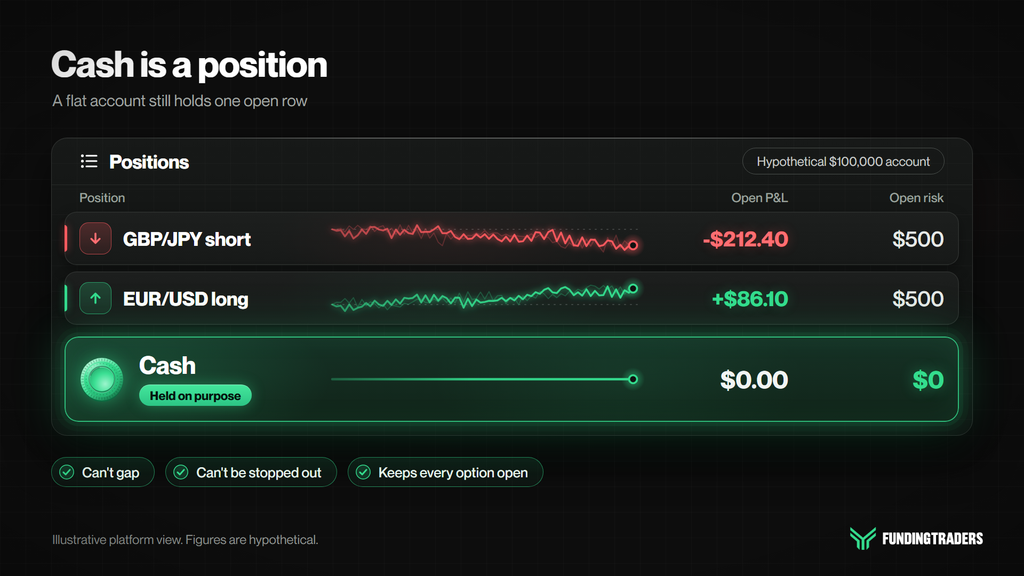
While you’re flat, you still hold something: cash, a balance with nothing open. Cash is a position in the sense that matters, because it makes no claim about where price goes: no move can hurt it, and every other choice stays open until the plan speaks.
Yet it rarely feels like one. A platform lists every trade and says nothing about the balance left when no trade is open, so on a flat day the positions tab is blank and nothing in it moves. Attention drifts toward whatever does, and on a quiet day that’s usually the next candle.
The same blank list can be read two ways. One reading says the hour was wasted. The other says cash is a position that has already been decided, with the next decision waiting on the plan rather than the screen. Which reading you bring to an empty hour tends to decide whether it stays empty.
One Chart, Four Endings
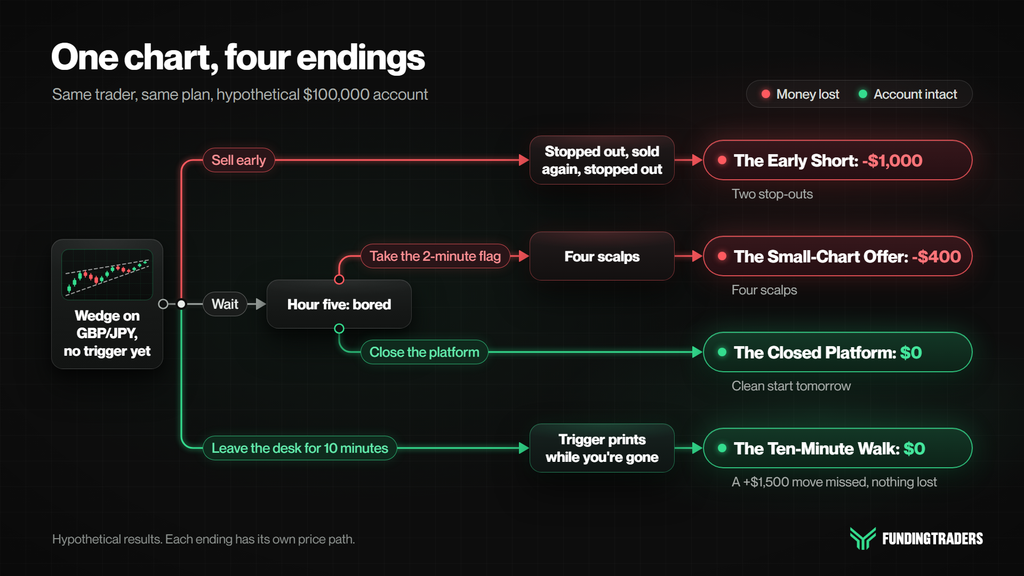
Here’s one session, replayed four times. Read it as a branching story: the setup, the account and the plan stay fixed, and what you do next shapes the ending. Each replay gets its own price path, because markets don’t repeat themselves to be fair to us.
The Setup: One Wedge, One Plan, No Trigger Yet
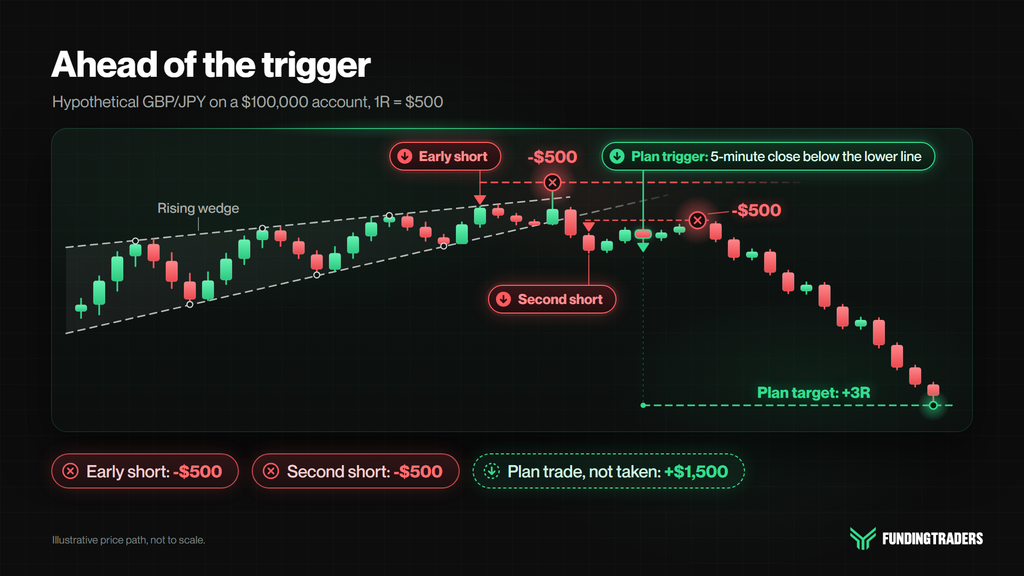
Your plan risks $500 a trade, which is 0.5% of a hypothetical $100,000 evaluation. Call $500 one R: the loss you’ve agreed to if the stop is hit. On the 15-minute chart, GBP/JPY has spent three hours squeezing into a rising wedge: higher lows, higher highs and a range that shrinks with every swing.
Your plan, written last night, is short and specific. Sell only after a 5-minute candle closes below the wedge’s lower line. Put the stop above the wedge’s top. Aim for 3R, or $1,500. No candle has closed below the line yet.
You’ve traded this shape before, and the lean is obvious: the break is coming, and it’s down. The chart can’t tell you the minute, though, and that’s what the written trigger is for. Overtrading tends to live between the lean and the minute. Until the trigger prints, the plan’s answer is simple: cash is a position you already hold.
The cursor hovers over the sell button, and you have three options:
- Sell now, ahead of the trigger.
- Wait for the candle to close below the lower line.
- Leave the desk for ten minutes.
Option 1 leads to Ending 1 and option 3 to Ending 3. Option 2 takes the longest road, with a second fork at hour five.
Ending 1: The Early Short
You sell near the top of the wedge, ahead of the candle your plan is waiting for. For a few minutes it pays: a few hundred dollars of open profit, and a trade that pays this early has a way of making the trigger feel optional.
Then a spike clears the top of the wedge and takes out your stop, and price drops through the lower line anyway. The ticket reads minus $500. The break you called does arrive, just after you’re out of the trade, and a loss that comes with a vindicated read is harder to file as an honest mistake.
Two minutes later you sell again, risking another $500, into the drop, to win the first $500 back. The first bounce shakes that trade out too: minus $500. The morning is down $1,000, or 2R, and price is still falling.
Now compare it with the plan’s day. A 5-minute candle closed below the lower line a few minutes into that drop, so the plan’s own trade, sold there with its stop above the wedge, rode through the bounce and on to the 3R target: plus $1,500. Your morning finished $1,000 down and the plan’s finished $1,500 up. Between the two sits $2,500 and a few minutes of patience.
FundingTraders’ Toxic Trading Practices article defines this precisely. Lose 0.5% of the account or more on a trade, open another position within five minutes, on any symbol, and the second one counts as a revenge trade. A full stop-out here is exactly 0.5%, so the second short falls inside the window. Our guide to chasing losses picks up the story from there.
The read held up. What failed was the sequence: the sale came before the trigger, which is overtrading in its smallest form, one trade placed before the plan asked for it. A pattern tells you where to look, and only the trigger says when. Knowing a train is coming doesn’t make the track a good place to wait.
An early entry and an early exit share a root: acting before the plan says to. Our guide to the disposition effect covers the exit side, where a winner is closed before it reaches its target because waiting feels worse than leaving.
Write the trigger on the ticket before you look at the chart. Until that candle closes, cash is a position the plan has already chosen to hold.

The Long Wait
Rewind to the fork and take option 2. You hold off, which is what the plan says to do. Twenty minutes in, a candle dips below the lower line and is back inside it by the close, a wick where the plan wanted a close. So the answer stays no. The range keeps shrinking, price hugs the inside of the lower line, and an hour goes by without a candle that qualifies.
By hour five the order history is empty and the restlessness has found other outlets: a re-read of the plan, a lap through the economic calendar, a third look at the watchlist. Eventually the 2-minute chart of the same pair is on screen, and a small flag has formed on it. The flag fits neither your setup nor your timeframe, and what makes it tempting is that it’s the only thing in view that looks like a decision.
Five hours in, the day’s P&L still reads exactly $0.00. Cash is a position that has been held all morning, and holding it is the plan doing what it was written to do. It’s also the part that’s hardest to sit through.
You have two choices: take the flag on the small chart (Ending 2) or close the platform (Ending 4).
Ending 2: The Small-Chart Offer
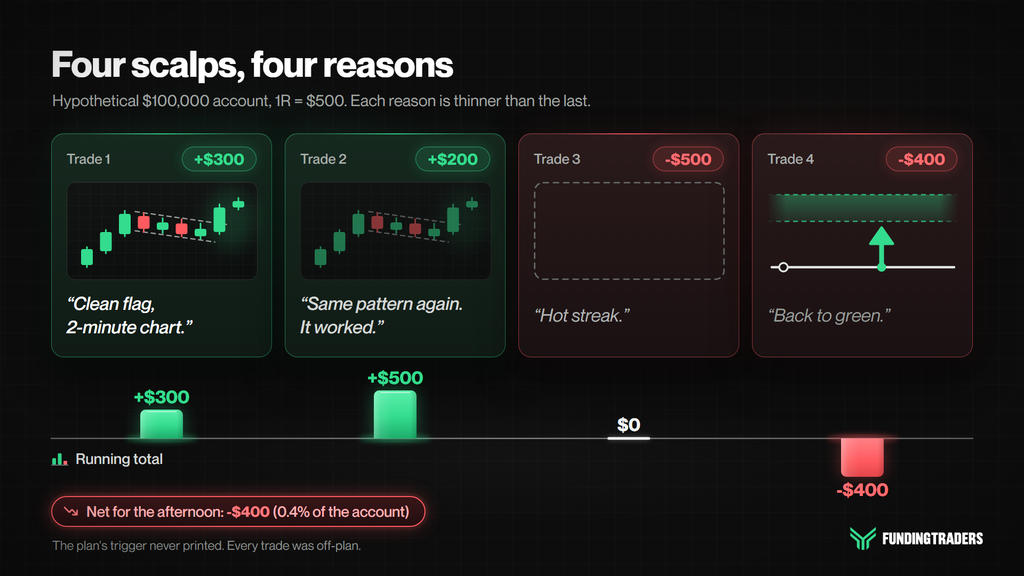
Overtrading from boredom looks harmless one trade at a time. The flag pays $300 in four minutes, and the restlessness goes with it. A second small trade adds $200, and at plus $500 the only question left is where the next one is.
Trade three is a setup you’d have skipped an hour earlier. It loses $500, which wipes out the $500 you were up. Trade four is meant to put the day back to green, and it loses $400. The afternoon closes at minus $400, or 0.4% of the account. Each loss was small enough to shrug at, and each one was off-plan.
Look at the reasons you gave yourself along the way. “Clean flag, 2-minute chart.” “Same pattern again. It worked.” “Hot streak.” “Back to green.” The first reason is almost technical. By the last one the chart has dropped out of the sentence entirely. Each reason asks a little less of the chart than the one before, and the early wins are what let the slide pass for skill.
Some people will go surprisingly far to escape an idle mind. In a widely cited experiment, volunteers sat alone with their thoughts for fifteen minutes and could press a button to give themselves a mild electric shock. Many did, even though they had said beforehand that they would pay to avoid being shocked, and researchers still debate how much of that was boredom and how much was curiosity. A trading platform offers a gentler version of that button, and pressing it for want of anything better to do is overtrading.
Overtrading through quick scalps carries a second cost on FundingTraders accounts. The General Trading Guidelines treat an average holding time under two minutes, weighted by position size, as unrealistic trading, flag the account for review and say it can be terminated for it. A habit of in-and-out trades can drag that average toward the line.
A flat balance doesn’t flash, so a patient morning leaves nothing to point at, while every scalp gives you a number to watch. Cap your trades at what your plan actually produces. Count the qualified setups on an average day, then set the limit just above that number; a plan that finds two or three can live with a ceiling of three, which here would have meant stopping flat instead of $400 down. Once the day’s setups are spent, the day is over and the account stays where it is.
Ending 3: The Ten-Minute Walk
Rewind to the fork and take option 3. You leave the desk for ten minutes and take nothing with you that shows a price. While you’re gone, a 5-minute candle closes below the lower line, price retests it from underneath and the move runs to 3R, the $1,500 your plan would have taken. Nothing was ordered, so nothing moved in your account.
What you do when you sit back down shapes the next trade. The missed move takes nothing from your balance; the arithmetic afterwards can cost a lot. Once the $1,500 is worked out, the tempting fix is to loosen the plan so it would have caught the move, with an earlier trigger or none at all. That revision is how a miss can become Ending 1, and how overtrading gets going. For many traders the sting is less about the $1,500, which was never in the account, than about the story of the one that got away.
Read the same ten minutes from the plan’s side: nothing had triggered when you left, so there was nothing to act on, and the balance is where you left it: cash is a position that only moves when you do. It’s also fair to say the walk cost you a valid trade, which is why it deserves a safeguard: set a price alert on the trigger line first. Then the walk costs nothing, and the plan’s trade is still there if the setup qualifies.
An uncomfortable stretch you got through also leaves a precedent. The next time the urge behind overtrading shows up, you’ve already done this once and nothing broke, which many traders find steadier ground than any single result.
None of this turns “cash is a position” into a vow. A qualified setup is still a trade, and if the trigger prints while you’re watching, you take it.

Ending 4: The Closed Platform
Back at the hour-five fork, take the other door. The platform goes dark and the day ends at $0.00. Tomorrow’s first chart arrives with nothing to recover and nothing to explain, which is a calmer way to read it than a morning that opens with a stop-out still to answer for.
Not trading was a decision, and you made it on purpose: cash is a position you chose. It’s also a skill with a small audience, because so much trading education is about entries and so little of it covers the pass: watching the wick that almost qualified and letting it go. That pass is what kept the morning flat.
A flat account frees attention too. An open trade keeps part of your mind busy with price and the exit, and a fresh result can keep it busy after the trade has closed. With nothing open, nothing is running in the background, and the next chart tends to get a cleaner read.
One more habit belongs here: journal the trades you didn’t take. A line or two is enough. Write down the setup you skipped, the rule that said no, what price did next and what you did instead. After a few weeks the log can show which passes saved you, which ones cost you and where overtrading came closest, and it turns “I did nothing today” into something you can review.
Look back over the morning: the wick that closed back inside and the small 2-minute flag were both offers, and neither was the plan’s trade. A setup that qualifies is whatever survives that filter, and when one arrives you take it without apology.
Why Overtrading Gets Worse Late in the Session
Look at the long wait again and count the small calls in it: whether the wick counts, whether to re-read the plan, whether the 2-minute flag deserves a glance. None of them was the decision that mattered, and each took a little attention. By mid-afternoon on a busy day there can be dozens, and that load is what overtrading feeds on.
There’s an old idea that each act of self-control makes the next one a little harder. Psychologists still argue about how literally to take it: large preregistered attempts to repeat the standard lab test found little or no effect. Treat it as a rule of thumb, not a law of nature. Even so, it describes something many traders recognize, a late-session trade that gets less scrutiny than the first one of the day.
Three things make the load heavier. Touching a live position hands each passing impulse a fresh chance, which is why a hands-off routine like set-and-forget trading keeps coming up. Every alert, headline and chat-room tip adds one more candidate to turn down. And a platform that accepts a click at any moment doesn’t ask whether you should.
The cheapest defense against overtrading is to settle these questions before the session opens, when nothing on the screen is moving:
- A cap on trades, so the day knows when it’s over.
- A daily stop of your own, set inside your product’s daily loss limit, so a bad day ends by your rule and not by a breach.
- Every order placed with its stop and target attached.
- Only the charts your plan actually uses.
- The same checklist for the last trade of the day as for the first.
Seen this way, cash is a position that keeps the balance intact and the next decision uncluttered.
Why a Quiet Day Can Feel Like a Bad One
A quiet day can finish with a healthier account than a busy one and still feel worse. If effort is measured in orders, a flat day looks like time off, and that feeling can push people toward overtrading harder than any chart does.
A fairer score for a quiet day is whether the plan’s work got done: watch the wedge, hold to the rules, pass on the flag. The work is recognizing a setup that qualifies, and when none does, the day was still well spent. Cash is a position on those days too.
Waiting has limits, and FundingTraders’ rules draw them clearly. The 2-Step Pro help article sets a minimum of four trading days in each challenge phase and two in the funded phase. A trading day counts only when at least one trade is placed, and each required day has to show genuine trading activity, so a token trade to check the box is a poor plan. Every challenge and funded account also needs at least one trade in each 30-day period, counted from the day the account is bought, or it fails for inactivity, as the General Trading Guidelines set out.
So a flat day is fine and a flat 30 days isn’t. Cash is a position, but the days with a qualified setup are the ones that supply the trades.
Frequently Asked Questions
Is overtrading just trading too often?
Overtrading isn’t simply trading often. It means taking trades your written plan didn’t call for, whether that’s a handful of extra scalps or a position sized well above the plan. Six trades can be fine for a plan that produces six setups and overtrading for one that produces two. The test is whether each trade traces back to a setup you wrote down in advance, not the number on the screen.
Why does a flat chart make you want to click?
Action bias is one reason: the tendency to prefer doing something over doing nothing even when doing nothing has the better odds. A flat chart offers movement without instructions, and a click turns that discomfort into activity. Boredom can add to the pull, and overtrading can follow. Knowing the urge is predictable helps you plan for it, with a trade cap, a price alert or a closed platform, instead of relying on resistance alone.
Does cash really count as a position?
As a decision, yes: cash is a position whenever you hold it on purpose. In account terms an account with nothing open holds only its balance, but staying flat is still a choice with a definite state: nothing at stake on the next move and the next decision still yours. Give it a reason and an exit like any other position. The reason is that nothing has qualified, and the exit is your trigger.
How many trades a day is too many?
There’s no universal number. Count the setups your plan produces on a normal day and set the cap just above that figure. If the plan usually finds two or three, a limit of three leaves little room for overtrading. The cap exists to end the day, not to pace it, so once it’s reached you’re done for the day.
Can I stay flat for days on a FundingTraders account?
Yes, with two limits. On a 2-Step Pro evaluation, a trading day counts toward the minimum only when at least one trade is placed, and each required day must show genuine trading activity. Every challenge and funded account also needs at least one trade in each 30-day period or it fails for inactivity. Check the help article for your product and its add-ons, since minimum trading days differ.
Give the Urge Another Job
The next time a wedge tightens and the plan stays quiet, the only choice that belongs to you is what you hold until it speaks. Overtrading takes root when a quiet screen makes cash feel like doing nothing.
Give the urge another job. Set a price alert on the trigger, write the trade cap on the ticket, log the setups you skip and close the platform when the day is done. Cash is a position with duties of its own: a reason (nothing has qualified) and an exit (the trigger). For the longer view, what sets disciplined traders apart from gamblers is a good next read.
Before tomorrow’s open, write the trigger, the trade cap and the price alert level where you’ll see them before the first order. Then let the chart come to you.

Disclaimer: Trading involves significant risk and is not suitable for every investor. Past performance is not indicative of future results. The information provided in this article is for educational and informational purposes only and should not be considered financial, investment, or trading advice. All account rules, payout structures, profit splits, and promotional offers described in this article are subject to change at the discretion of FundingTraders. Promo codes may expire or be modified without prior notice. Always trade responsibly and only risk what you can afford to lose.