A mental stop loss is the most comfortable promise in trading. “If gold drops to my level, I’m out.” Picked while the chart is calm, that line feels like the mark of a trader who reads the market too well to need a platform babysitting every position.
Then price arrives, and the close button suddenly feels heavier than the buy button ever did. A number you picked with a clear head an hour earlier now looks open to debate, and the one debating it is you, with money draining out of the position. One small delay becomes two, and soon the exit is less a level than a mood.
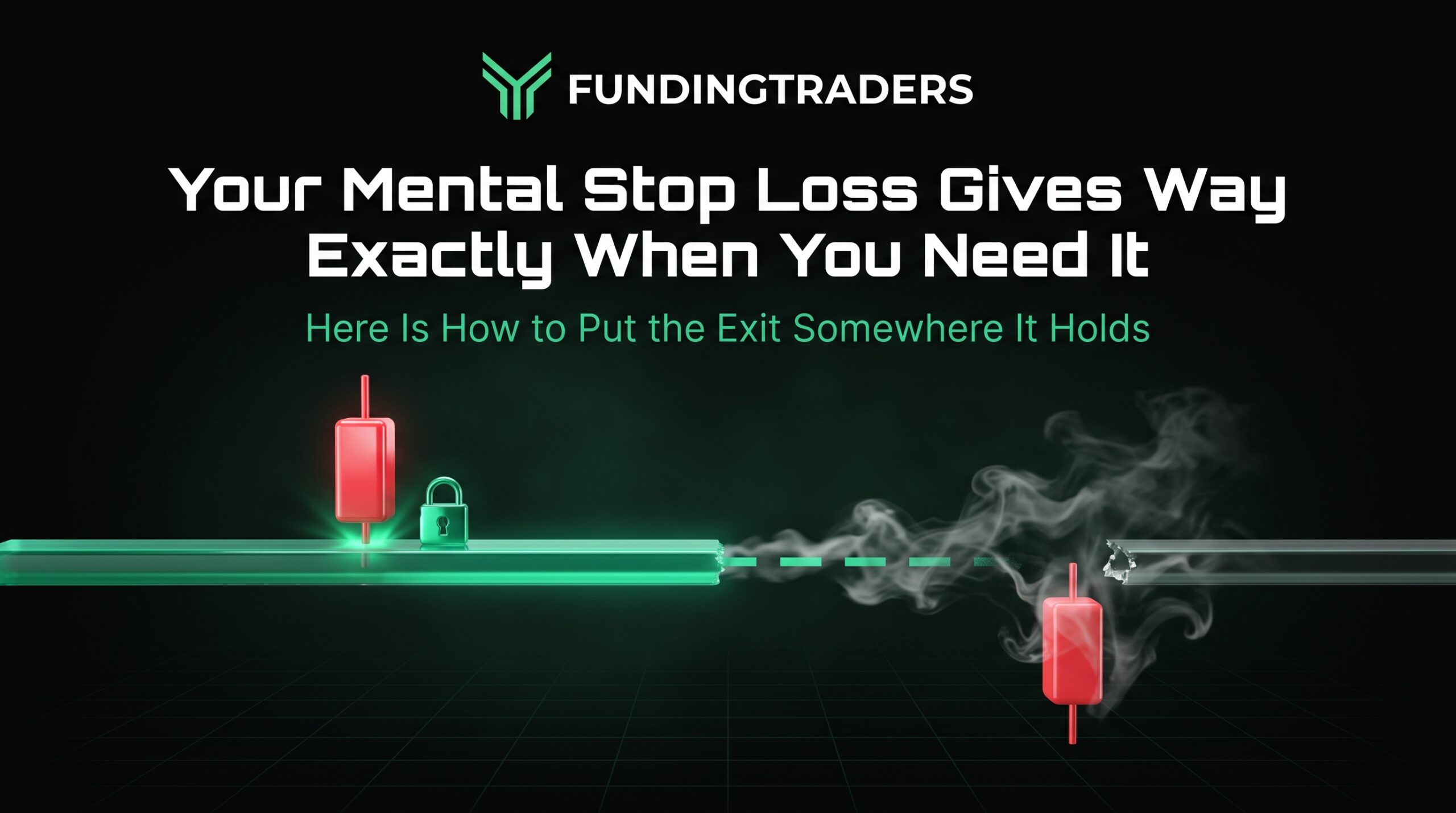
In short: an exit that lives only in your head doesn’t count as a stop. If no order sits on the server, ready to fill without asking your permission, your downside has no floor.
The Case for a Mental Stop Loss, and Where It Breaks
The habit usually rests on three beliefs. Flexibility: markets are messy, and a fixed order can’t read context. Judgment: you’re the one watching the tape, so why hand the final call to a line of code? Fear of stop runs: you’ve watched price stab through your level, close you out, then rip the way you called it.
Two of those beliefs are partly right. Context matters, and price does trade through obvious levels where stop orders cluster.
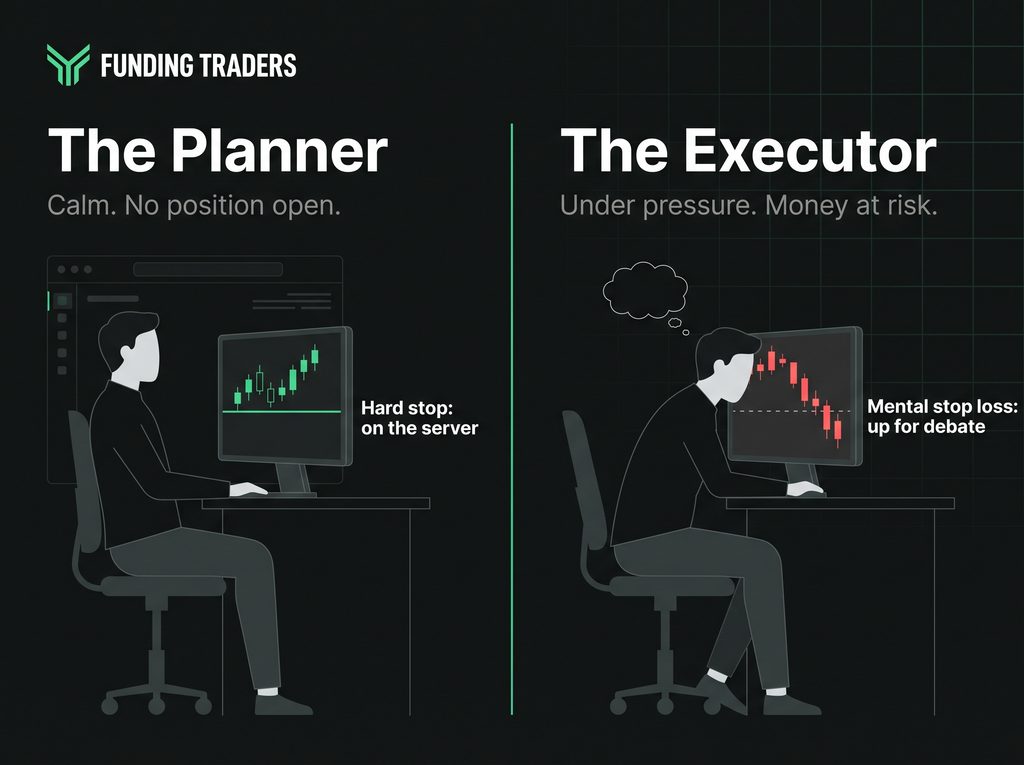
The flaw is assuming the trader who plans the exit and the trader who has to take it are the same person. They aren’t. The planner works before entry: no position open, nothing at stake, time to think. The executor turns up later, with real money underwater, a quicker pulse and a powerful wish not to be wrong.
A mental stop loss hands the trade’s most important decision to the executor, the side of you least equipped to make it. The planner did all the analysis. The executor gets the veto.
How the Exit Slips Away: A Gold Trade, Step by Step
Here is that veto in action, with hypothetical, illustrative figures (not a real trade or any specific account’s rules).
You’re trading a $50,000 challenge account, and you buy 0.5 lots of gold (XAU/USD). In this example, one lot is 100 ounces (a common contract size; check your platform’s symbol specification), so every $1.00 move in gold is worth $50 to you. Your plan says the idea is wrong if gold falls $5.00 below your entry: a planned loss of $250, or 0.5% of the account. Your target sits $10.00 above entry, worth $500. You skip the stop loss order. You’ll handle the exit yourself.
- Gold dips $1.20 below entry. You’re down $60. Normal chop.
- It slides to $3.10 below. You’re down $155, and you start watching every tick.
- It reaches $4.60 below. You’re down $230, only $20 from your line. Excuse one, wait for the candle close: “The 15-minute bar closes in eight minutes. Real traders judge a level on the close, not on a wick.”
- The bar closes $5.90 below entry. You’re down $295, already past the plan. Excuse two, the dollar looks stretched: “The dollar has climbed all morning. Once it cools, gold bounces. I’ll shift my line to the session low,” which sits $8.00 below entry, a $400 loss.
- Gold breaks the session low and trades $9.50 below. You’re down $475. Excuse three, wait for a bounce: “Selling here books almost twice what I planned to lose. I’ll get out on the bounce, smaller.”
- No bounce comes. Gold sits $12.40 below. You’re down $620. Excuse four, call it a swing: “Gold trends up over the long run. This was never really a quick trade.” The position just got a promotion it never earned.
- Another leg lower finally breaks your nerve. You close $15.00 below entry. You’re down $750.
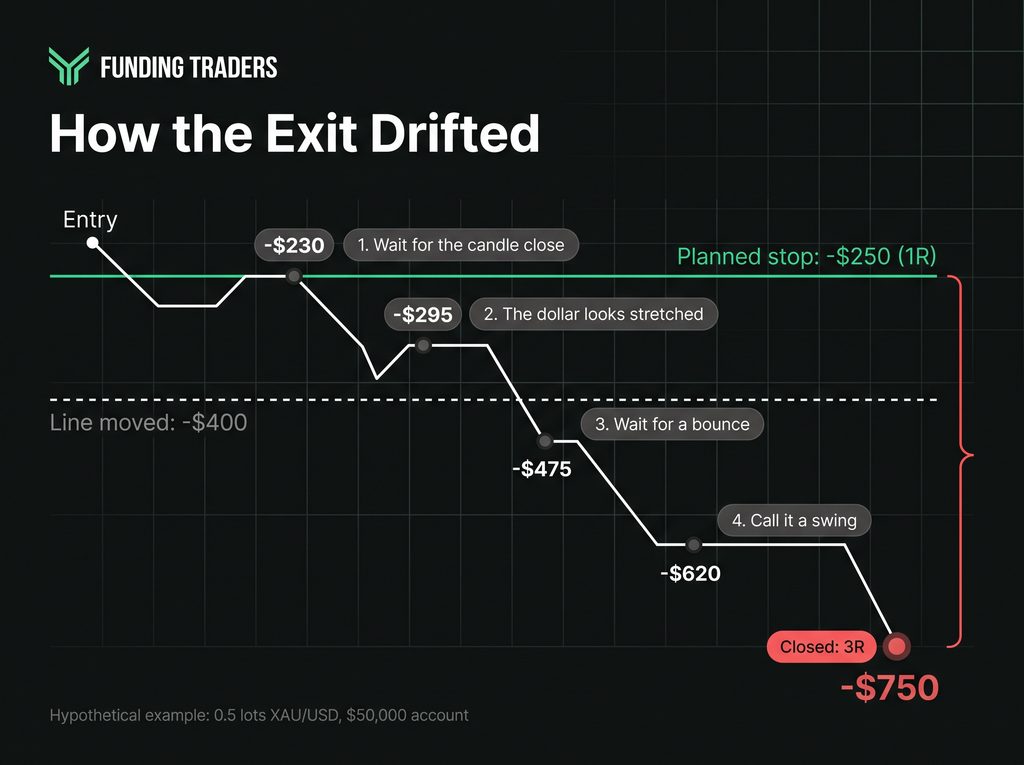
Add it up. You planned to lose $250, or 1R. You lost $750: 3R, 1.5% of the account, three times what your plan allowed. Yet you never once decided to lose $750.
Read the list again: no single row looks like a disaster. The damage sits in the gaps between them ($295, then $475, then $620, then $750), each one accepted only because the row before it had already been accepted. That is how a mental stop loss really fails.
The Stress Response Behind the Excuses
Blaming weak willpower misreads what happened in the gold trade. As price nears your exit, your body tends to read the coming loss as danger. Heart rate often climbs, attention tends to narrow onto one number, and the urge to end the discomfort gets loud. Under acute stress, the prefrontal cortex, which handles planning and impulse control, tends to work less effectively. The mental tools you need to follow a plan are among those stress can weaken.
Research in behavioral finance has also found that losses tend to feel larger than gains of the same size. Closing the trade turns a paper loss into a real one, and that is the moment that stings. Holding postpones it, so your mind builds a case for waiting.
The four excuses in the gold trade (the candle close, the stretched dollar, the hoped-for bounce, the sudden swing trade) each sounded like analysis, and each arrived after the fact to justify skipping the uncomfortable click.
One question cuts through the case: if you were flat at this moment, would you buy gold right here, with the exit where your plan puts it? If the honest answer is no, the reasons on your screen are defending the position, not the account.
The Drift’s 4 Real Costs
The $500 overshoot is the cost you can see on the statement. Four others never show up there.
1. Your risk triples without your consent. Position sizing only works if the exit is fixed. Dollar risk equals lots × ounces per lot × stop distance: 0.5 × 100 × $5.00 = $250. Once the exit drifted to $15.00, the same 0.5 lots carried $750 of risk. FundingTraders’ risk guidance notes that experts typically recommend risking no more than 1.5% of an account per trade idea. The plan used a third of that; the drift used all of it. Careful position sizing and prop trading risk management means little once the stop distance becomes whatever your nerves allow.
2. Your reward-to-risk flips. Say a strategy wins half the time, with winners at 2R and losers at 1R. Over 10 hypothetical trades, 5 wins × 2R = 10R against 5 losses × 1R = 5R, a net of +5R. Let two of the five losers drift to 3R and losses become 9R, a net of +1R. Let a third drift and the net is -1R, with an average loss of 2.2R against a 2R average win. Same entries, same analysis, a different exit habit, and the edge is gone.
3. Your plan loses its authority. A trading plan only means something if you follow it when following it hurts. Overrule it three times and it turns into a suggestion, and suggestions give way everywhere, not just at the exit: entries get looser and position sizes start to creep.
4. Your next trade inherits the damage. Watching a loser grow leaves little attention for anything else, and the eventual close rarely feels like an ending. It feels like a debt, the exact mood in which overtrading and revenge entries start to look like a plan. On a funded account, FundingTraders’ Revenge rule flags that move: a new position on any symbol within 5 minutes of a losing trade of 0.5% of account size. On $50,000 that threshold is $250, so even the planned stop-out qualifies; the drifted $750 loss just makes the urge to jump back in far stronger.
On a prop account, all of this hits a hard boundary: the daily loss limit. On funded accounts, the Risk team watches for traders repeatedly pressing those limits, so guarding daily room is central to managing risk on a funded account. Assume a 3% daily loss limit (illustrative only; limits vary by product, so check your own account’s rules): $1,500 of room on a $50,000 account. At your planned $250 per loss, six straight losers reach that limit. At the drifted $750, two do.
Daily room is what a drifting exit burns fastest. In a 1-Step Pro or 2-Step Pro evaluation, the Daily Drawdown Shield in the Spooky Week Ultimate Bundle gives you one backstop if you hit the daily loss limit. It saves the account, not the money, so it never replaces a stop loss. Use code SPOOKY at express checkout to buy 1 account and get 3 identical accounts, 4 for the price of 1. All FundingTraders evaluations and funded accounts take place in a simulated environment.
Why a Hard Stop Works When Willpower Doesn’t
A hard stop means a stop loss order that sits on the server from the moment you enter and fills without consulting you. It works because the decision gets made at the one moment nothing is at stake: before entry.
Once the order is live, the executor never gets a vote. Replay the gold trade with the order attached: at $5.00 below entry it fills, and the loss is about $250, with no candle-close debate. In a fast market or on a gap, a triggered stop can fill beyond its level, sometimes noticeably, but unlike a mental stop loss, that slippage does not keep growing while you hesitate.
Experienced pilots run a checklist because they know which mistakes a busy cockpit invites, not because they are bad at flying. A stop loss order is the same kind of tool, set by the planner for the moment the executor will be busy.
FundingTraders’ general trading guidelines do not require a stop loss order on every trade, but they highly recommend always using one as best practice, especially in fast markets.
On funded accounts, the Risk Management Group rules go further: trading without a stop loss is a risk hygiene pattern (at least 50% of closed trades with no stop at exit, or a majority of a period’s profits from unprotected trades, from a minimum of 10 closed trades in a payout period) that can trigger a strike on its own. If protective controls are applied, one of them is a stop loss on every trade.
Evaluation history is reviewed too: if behavioral violations are present when you reach the target, the funded account may start at Warned, Tier 1 or Tier 2 with protective controls.
Every trade you close by hand with no order in place ends with no stop at exit. Funded traders can follow this in the Clarity Desk, whose “SL at close” figure shows the share of closed trades that had a stop loss in place at exit, plus a count of unprotected trades. That metric looks for a stop at exit, so attaching one the moment you enter is a best-practice recommendation rather than a Risk Management Group requirement.
When the Wick Takes You Out
The most common pushback comes from traders who have been burned by a wick: put a real order in, and price will dip just far enough to fill it before turning around.
It happens. Stop orders tend to bunch up in predictable places: just under a round number, a hair below the previous day’s low, right beneath a clean swing point. Those clusters are pools of liquidity, and price often trades through them in fast moves before the bigger picture takes over.
Pulling the stop because it sometimes gets run is like taking the battery out of a smoke alarm because it chirps when you sear a steak: fewer false alarms, and silence on the night it matters.
The fix is better placement, not no placement:
- Anchor the stop to structure. Put it beyond the level that would prove your idea wrong, not on the most obvious line on the chart. Structure-based entries like the break and retest give you a natural invalidation point.
- Add a buffer. Leave room beyond that level for the spread and ordinary noise, so a routine wick doesn’t take you out.
- Size down to afford it. A wider stop at the same size means more dollars at risk, so shrink the position until the dollar risk matches your plan. If structure plus a buffer calls for $7.50 of room on the gold trade instead of $5.00, 0.33 lots keeps the risk near $248, inside the original $250. Our swing trading strategies for prop challenges cover setting clear entry and exit rules for multi-day trades.
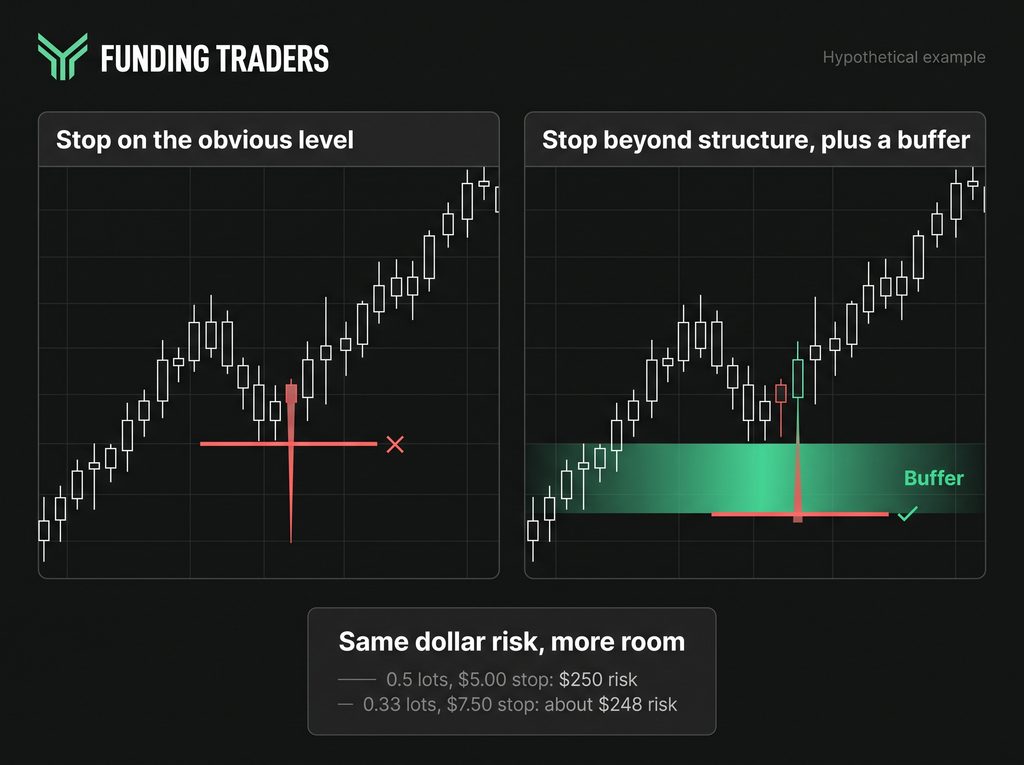
In the gold trade, price kept falling, so the wider stop would also have filled, for about $248. Good placement doesn’t dodge every loss; it keeps each one the size you chose. Of the $750 the trader actually lost, the market accounted for $250. The four excuses added the other $500. A stop that keeps getting tagged has an address problem, not an existence problem: move it and resize the trade, but leave it on the server.
Want somewhere to practice stops that sit beyond structure, with a position size that pays for the room? Use code SPOOKY at FundingTraders checkout to buy 1 account and get 3 identical accounts, and leave the crowded levels to the ghosts.
Four Habits That Retire the Mental Stop Loss
Four habits make the change stick; the first does most of the work.
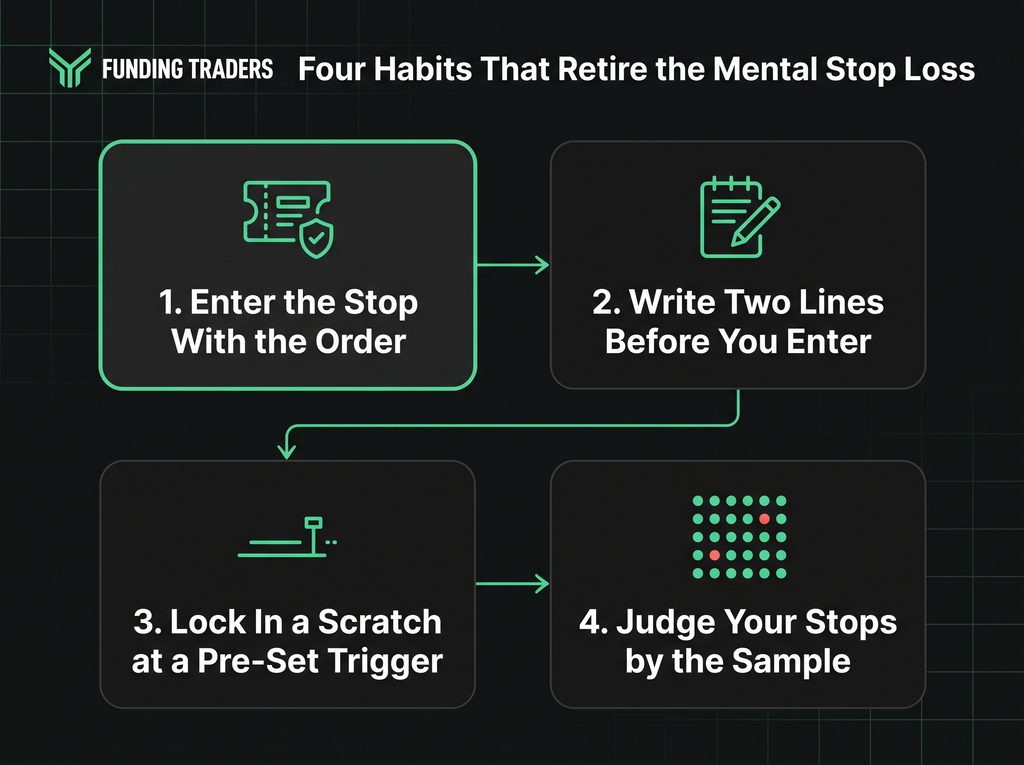
Step 1: Enter the Stop With the Order
The stop loss order is part of the entry, attached on the order ticket before your position exists, not added once the position is already open. Size from it: $250 of risk divided by $5.00 of room, at $100 per $1.00 move per lot, gives 0.5 lots. A simple test: if the stop price field on the order ticket is blank, the buy button stays unclicked. No level, no position. Our set and forget trading guide walks through leaving live orders alone.
Step 2: Write Two Lines Before You Enter
Before you enter, write two lines: what would make the idea wrong (for the gold trade, a break of the pullback low), and a promise that this order may only ever be edited to lower risk. If you catch yourself hovering over the stop mid-trade, log the urge in your journal instead. After a few dozen trades, that log shows you, in your own handwriting, how often the extra room would have cost you.
Step 3: Lock In a Scratch at a Pre-Set Trigger
If a fixed stop seems too rigid at first, add one rule you can follow mechanically: once the trade reaches a pre-set trigger, such as +1.5R or a fresh higher low forming above your entry, the stop moves to breakeven. From there, the realistic worst case is close to a scratch, though gaps and fast markets can still fill you beyond it, and the itch to micromanage fades.
Pick a trigger that lets the trade breathe first. A stop dragged to entry after the first sliver of profit sits right where routine pullbacks tend to reach. Treat the rule as training wheels for leaving your stop alone, and keep the initial stop where structure puts it.
Step 4: Judge Your Stops by the Sample
Some stop-outs will be followed by the exact reversal you expected: out at $5.00 below entry, then gold turns and runs through your target without you. That trade still went right on the one thing you control, the size of the loss.
Keep a simple two-column tally across your next 50 trades: stop-outs that reversed afterward, and stop-outs that kept going against you. Every entry in the second column is a loss the stop kept from growing, and the tally shows whether those outweigh the reversals you missed. That kind of probabilistic thinking is a big part of what separates consistent traders from gamblers.
Attach the stop, ghost the urge to touch it, and let the sample do the judging: grab 4 accounts for the price of 1 (buy 1, get 3 identical) with code SPOOKY at the FundingTraders express checkout.
Frequently Asked Questions
What is a mental stop loss?
A mental stop loss is an exit level a trader decides on but never sends to the platform as an order, planning to close by hand if price gets there. Its weakness is timing: the decision must be carried out under stress, exactly when traders are most likely to delay, move the level or wait for a bounce.
Is a mental stop loss ever a reasonable choice?
For most traders, rarely. Its one real advantage, flexibility, is the same feature that lets the exit drift under pressure, and on a prop account with a daily loss limit that drift gets expensive quickly. A price alert does not fix it, because an alert still needs you to act. Keep discretion for your entries and a stop loss order for your exits.
Does FundingTraders require a stop loss on every trade?
No. FundingTraders’ general trading guidelines do not require one, because many traders automate risk management with EAs or bots, but they highly recommend always using a stop loss order. On funded accounts, the Risk Management Group treats trading without a stop loss as a risk hygiene pattern: if at least 50% of closed trades have no stop at exit, or most of a period’s profit comes from unprotected trades (from a minimum of 10 closed trades), it can trigger a strike. If protective controls are applied, they include a stop loss on every trade.
Can I move my stop loss once I’m in the trade?
Only in the direction that reduces risk, such as moving it to breakeven at a trigger you set before entry. Widening a stop to give a loser more room is the mental stop loss habit returning through a side door, and it is how a planned $250 loss on a $50,000 account can quietly become a $750 one.
Give the Exit to the Server, Not to Your Nerves
A mental stop loss is a promise the relaxed, pre-trade you makes and the pressured, in-trade you breaks. What it gives you is a plan with no enforcement, and unenforced plans fade fast once the trade turns against you.
Consistent traders tend to treat the exit like a seatbelt: something you fasten before the car moves, not something you reach for during the skid. Their stop loss order goes in with the entry, sized to the plan, placed beyond structure, and left alone.
So fasten it first. Let the planner make the call before entry, and let the platform carry it out.
Disclaimer: Trading involves significant risk and is not suitable for every investor. Past performance is not indicative of future results. The information provided in this article is for educational and informational purposes only and should not be considered financial, investment, or trading advice. All account rules, payout structures, profit splits, and promotional offers described in this article are subject to change at the discretion of FundingTraders. Promo codes may expire or be modified without prior notice. Always trade responsibly and only risk what you can afford to lose.