On a $100,000 prop account with a 5% daily loss limit, macro events come down to a single figure: how far your equity sits above the day’s line, which is $95,000 on a day that opens at $100,000. A central bank keynote can close that distance in minutes, and the limit keeps measuring it while the speech is still going.
The calendar is crowded with macro events: rate decisions and the press conferences after them, inflation reports, jobs data, central bank speeches and the yearly Jackson Hole keynote. On each of those days the daily line is set at the open, by the same formula as any other day.
The line stays where it is. Your plan decides how fast you get to it.
In short: the daily limit doesn’t care how good your forecast is, only how much of the day’s room your plan puts at risk. Below you’ll find a worked example on a $100,000 account, a side-by-side table of FundingTraders’ loss limits and news trading rules, and a six-step plan for your next round of macro events.
Jackson Hole and the Other Macro Events on Your Calendar
The keynote at Jackson Hole can change where markets think rates are headed, and when it does, currencies, stock indices and gold can reprice within minutes. The symposium, run every year by the Kansas City Fed, is not one of the Federal Reserve’s eight scheduled policy meetings, but it usually falls between two of them, so the Fed chair’s remarks there are read for signals about the next rate decision.
The first move can be a head fake: price spikes one way, then swings back. In a fast market, spreads can widen and orders can be filled away from the price you asked for.
The other macro events on your calendar can do the same. Before any of them, a prop trader needs three answers on paper: how much daily room is left, whether the account’s news trading rules apply, and what happens to profit from trades inside a news window. Those answers set how much of the volatility the account can take, which makes each release a rulebook question as well as a market one.
Trader A, Trader B and the $95,000 Line
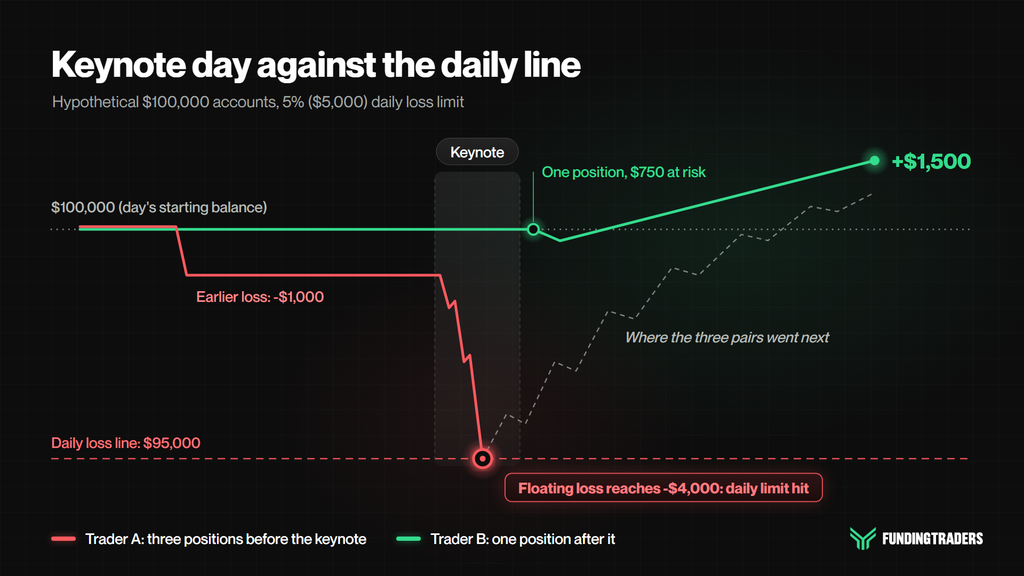
Start with the rule. Take a hypothetical $100,000 account with a 5% daily loss limit ($5,000), measured on equity or balance from the day’s starting balance, the way FundingTraders’ 2-Step Pro10 measures it. The day opens at $100,000, so the daily line sits at $95,000. Floating losses count toward that line in real time, whether or not a stop has been hit.
The two traders in this example share that rulebook and a single forecast: the keynote will lean toward easier policy, and the US dollar should weaken.
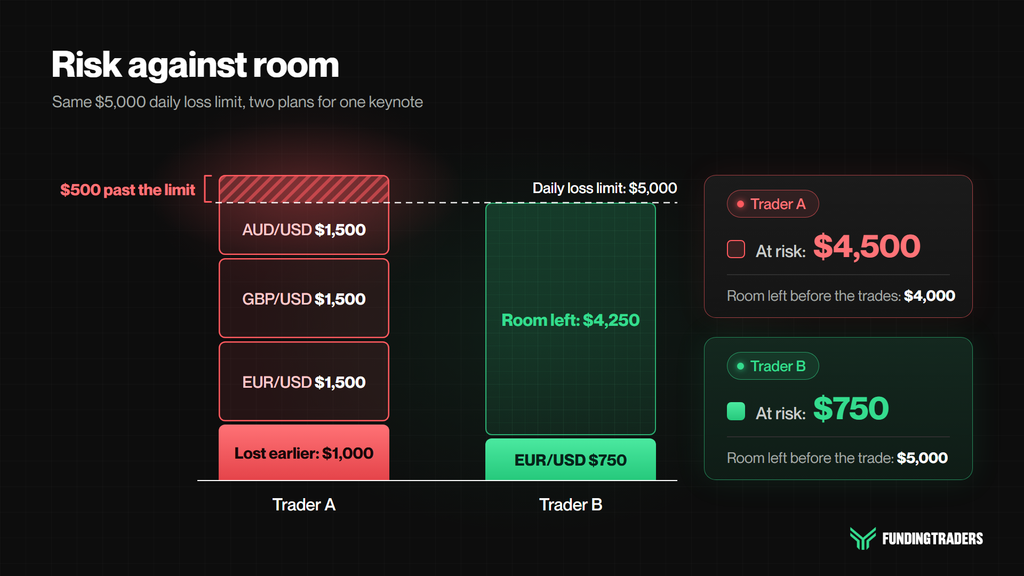
Trader A: Three Positions and $4,000 of Room
An earlier trade cost Trader A $1,000, leaving equity at $99,000 and $4,000 of daily room. A few minutes before the speech, they go long EUR/USD, GBP/USD and AUD/USD, all three against the dollar. Each stop sits where a hit would cost $1,500, or 1.5% per position. Combined, that is $4,500 at risk against $4,000 of room.
The first reaction lifts the dollar, and all three pairs fall together. Their combined floating loss reaches $4,000 while every stop is still untouched. Equity touches $95,000, the daily limit is reached, and the evaluation ends. Around twenty minutes later the dollar turns down and keeps sliding for the rest of the session. By the close, all three pairs are trading above Trader A’s entry prices. The forecast was correct, and the account is gone.
Trader B: One Position and $5,000 of Room
Trader B has made no trade that day, so equity is $100,000 and the full $5,000 is available. Holding nothing into the keynote is Trader B’s own call, not a requirement. Once the speech is over and the first reaction has run its course, they buy EUR/USD with a stop beyond the extreme of that opening spike, risking $750 (0.75%). Price climbs. Trader B takes profit at +$1,500, twice the risk, and finishes the day at $101,500. The most they ever had at stake was $750 of $5,000 of room.
What separated them was how much of the day’s room each plan used and when it entered. Trader A’s plan could reach the line on an ordinary first reaction; Trader B’s used 15% of the room and waited for the spike to print.
Not one of Trader A’s stops was hit. The daily line was.
Now turn it on yourself. Take the last round of macro events you traded, add up the risk on every stop you had open at the release, and compare that total with the daily room you had left. If the total was bigger, you were trading Trader A’s plan, whether or not the market punished it that time.

Event Days Close the Distance Faster
Trader A’s $4,000 of daily room was gone a few minutes into the keynote. A daily limit that includes floating losses is checked against equity every moment a trade is open, so during macro events the speed of a move matters as much as its size: a keynote can pack hours of price movement into a handful of candles, often in both directions.
The limits exist to cap how much damage a day can do, and they don’t loosen for the calendar; the busiest days are when that cap matters most. FundingTraders’ General Trading Guidelines come at the same idea from the sizing side. Position sizing must be consistent, and the guidelines spell out what happens otherwise: “Sudden or inconsistent increases in position size, particularly around economic news, will trigger review.” Nobody is asking you to give up news trading. The expectation is that your event-day risk looks like your everyday risk.
So the work of fitting a keynote inside the rules falls to you, and it starts with two sections of your account’s rulebook: loss limits and news trading. Read both before the next batch of macro events arrives: together they show where your daily line sits, which trades count as news trades and how news profit affects payouts.
Four Rules That Matter Most During Macro Events
Reread all four the morning of any of the macro events you plan to trade.
Floating Losses Reach the Daily Line Before Any Stop Does
On 2-Step Pro, current equity or balance must not reach 5% (PRO10) or 3% (PRO6) of the account size below the day’s starting balance. 1-Step Pro and Instant Funding both use 3%; the table further down shows where each one measures from. Instant Funding also has a tighter line for open trades: floating PnL across all open trades must not drop to minus 1% of the initial account balance, measured from your current balance. A stack sized like Trader A’s would reach that 1% line long before any 3% daily limit.
Every version counts open positions at their floating value. A stop protects the position it is attached to; the daily limit adds up every open position plus whatever the day has already lost, and checks that total continuously. Trader A’s three stops stayed untouched, yet the account reached its line because the line was looking at the sum. During macro events, watch equity against the line, not the stops.
Correlated Positions Count as One Bet
Trader A’s three pairs, EUR/USD, GBP/USD and AUD/USD, all hinged on one outcome, whether the dollar fell after the speech, so in market terms they were a single bet. Whatever per-trade cap an account carries, the daily loss limit is the rule that adds every open position to what the day has already lost and checks that total every moment.
On a quiet day, pairs drift at different speeds and one loss is partly cushioned by another gain. When macro events jolt the dollar, every dollar pair moves with it. Before the release, the sum that matters is a simple one. Add your total exposure to one outcome to what the day has already lost, then compare it with the daily limit. Trader A’s total was $5,500 against a $5,000 limit before the keynote started. Trader B’s single position put $750 at risk, leaving $4,250 of room even if the stop was hit. Our guide to prop trading risk management strategies covers consistent position sizing and diversification in more depth.
Three tickets that need the same outcome are still one bet.
What Banked Profit Does to Each Loss Limit
On 2-Step Pro, the maximum loss is 6% (PRO6) or 10% (PRO10) of the account size, and it “is fixed and does not trail higher when you’re in profit.” On a $100,000 PRO10 account the floor sits at $90,000 and stays there. Bank $4,000 and your equity is $14,000 clear of it instead of $10,000. Profit buys real distance from the maximum loss.
It buys nothing on the daily limit, which is a percentage of the account size: $5,000 every day on this account, measured from wherever the day started. A trader sitting on $4,000 of profit still has exactly $5,000 before the daily line, the same as on day one. Treating earlier gains as a reason to size up for macro events mixes up the two rules.
1-Step Pro and Instant Funding use trailing floors instead; the table below shows how each one moves. Before macro events, note two distances, equity to the maximum loss floor and equity to today’s daily line, and size the event from the smaller one.
Growth and Payouts Reward Repeatable Months
FundingTraders’ scaling plan says “your account can grow by 25% every two consecutive profitable months.” Its conditions include at least 8% total profit across the two months, with both months profitable. One of its stated aims: “Reward real consistency, not short-term luck.” One big keynote does not count for much on that scale. Two steady months do.
Payouts on funded Pro accounts point the same way. No more than 30% of total profits can come from trades influenced by high-impact news. Go over that share and payout processing is delayed until additional trades bring the percentage back under the limit. A big win on a trade classified as a news trade can therefore hold up a payout instead of speeding it along, which is one more reason to keep news trading sized like the rest of your month. Our guide to funded account risk management covers per-trade risk limits and building a risk-focused plan for a funded account.
One caveat covers all four rules: Trader B’s $750 could still have been lost. Had the dollar kept climbing after the speech, the stop would have been hit, leaving Trader B $4,250 above the daily line with the account still open. Trader B’s worst case used 15% of the day’s room. Trader A’s worst case was bigger than the room itself, so an ordinary first reaction ended the evaluation, and the dollar’s later slide came too late to count.
FundingTraders’ News Trading Rules by Account
Trader A broke no news trading rule. Their account ended on the daily loss limit, the same one that applies on a sleepy afternoon. News trading is fully permitted during the challenge phase on 2-Step Pro and 1-Step Pro, with no restrictions in place. On a funded Pro account, news trading picks up one cap, the 30% rule, and the daily and maximum loss rules apply the whole time. Here is how the main rules line up:
| Rule | 2-Step Pro | 1-Step Pro | Instant Funding |
|---|---|---|---|
| Daily loss limit | 3% (PRO6) or 5% (PRO10) of account size, on equity or balance, from the day’s starting balance | 3% of account size, on equity or balance, from the day’s starting equity | 3% of account size from the higher of the day’s starting balance or equity, real time, floating losses included |
| Maximum loss | 6% (PRO6) or 10% (PRO10) of account size, fixed, does not trail | 10% of the account size below the highest recorded balance, trails | 6% of the account size below the highest recorded balance, trails until 3% profit, then locks at the initial account size |
| News trading in the challenge phase | Fully permitted, no restrictions | Fully permitted, no restrictions | No challenge phase (Instant Funding has no profit target) |
| News trading on a funded account | Allowed; no more than 30% of total profits from high-impact news trades | Allowed; same 30% cap | Depends on the account and its add-ons; see the Instant Funding help article |
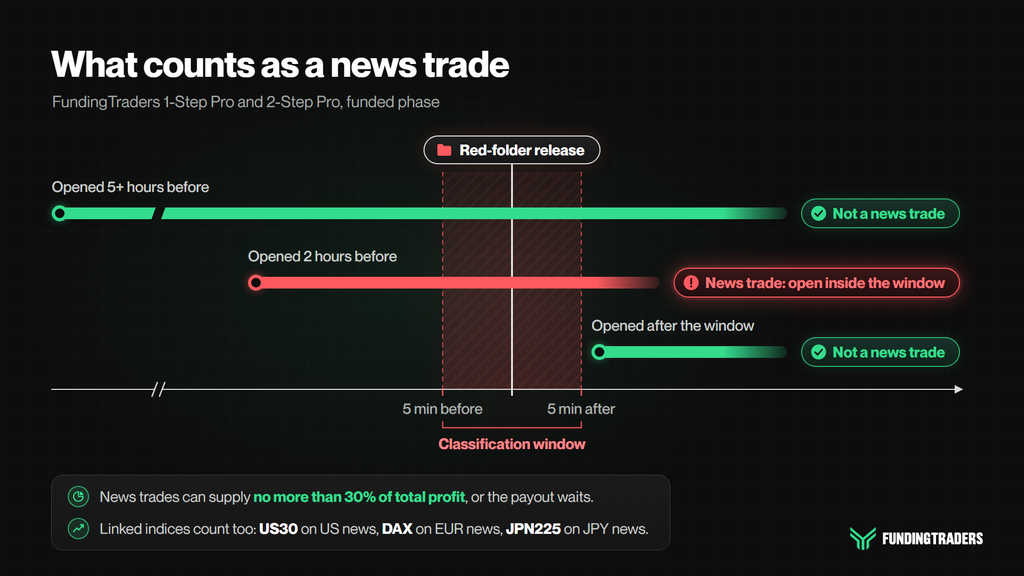
On a funded Pro account, the 30% news trading cap hinges on one definition. A trade is a news trade if it is “opened, held, or closed” within 5 minutes before or 5 minutes after a Red Folder (high-impact) release affecting that asset. “Held” is the word to notice: a position opened a couple of hours before the release and still open when it lands counts as a news trade, even if you never touch it during those ten minutes.
The window reaches beyond the obvious pair. Every currency pair linked to the release is covered, along with indices tied to that currency’s economic news. US30 is flagged during high-impact US news, the DAX during EUR news and JPN225 during JPY news. A US inflation print can turn a US30 position into a news trade, even with no dollar pair open.
There is one exception for traders who hold through. The help center pairs it with the 30% cap: a trade opened 5 hours or more before a high-impact release is not treated as news trading, and news-influenced profits must still stay below 30% of total PnL. That suits a swing style, which our guide to choosing a prop firm for swing traders covers. For a wider look at how firms handle news events, see prop firms that allow news trading.
Sizing rules sit on top of the news trading rules. The General Trading Guidelines warn that persistently going all in, or risking a significant percentage of the account on one trade, “especially increasing size during news events, will raise red flags.” Stacking three positions minutes before the release, as Trader A did, can look like the sudden size increase the guidelines say will trigger review.
Two more numbers sit alongside them. FundingTraders caps risk at 2% of the account per trade idea on its Pro accounts, and Toxic Trading Practices, which FundingTraders applies to funded accounts and to your evaluation history when you reach the profit target, adds Outsized Risk: “Planned stop-loss risk on a trade idea above 2% of account size.” Its rule of thumb is to keep risk per trade idea around 1% of account balance.

A Six-Step Plan for the Next Round of Macro Events
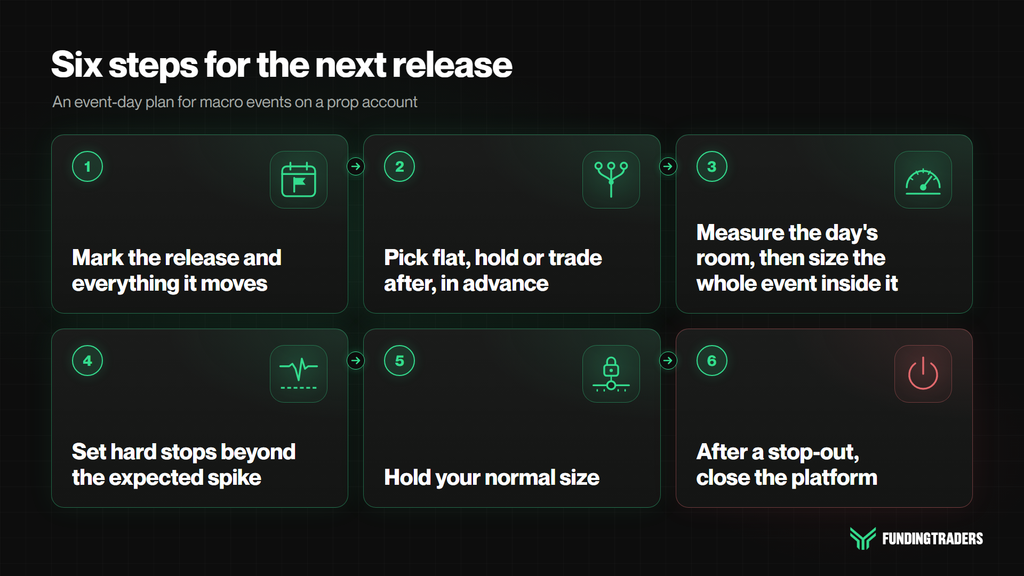
Start with four questions for any rulebook. Do floating losses count toward the daily limit? Yes, on all three FundingTraders accounts above. Is there a news window? On funded Pro accounts, 5 minutes either side; for Instant Funding, check the help article linked in the table. Is the maximum loss static or trailing? Static on 2-Step Pro, trailing on 1-Step Pro, and on Instant Funding trailing until 3% profit, then locked at the initial account size. Can news profit delay a payout? Yes, past the 30% cap on funded Pro accounts. Then the plan for your next macro events:
- Mark the release and everything it moves. Note the time of each high-impact release and every pair and index it touches; on a funded Pro account, a high-impact US release flags US30 as well as the dollar pairs.
- Pick flat, hold or trade after, in advance. Decide the night before which posture each of the week’s macro events gets: no exposure into the release, a position held through it, or entries only after the first reaction. On a funded Pro account, a held trade stays out of the news-trade count only if it was open 5 hours or more when the release lands. On Instant Funding, news holding depends on the account and its add-ons.
- Measure the day’s room, then size the whole event inside it. Take the gap between equity and the daily line, subtract a safety margin, and fit every event-related position into what remains, counted as one bet. Trader B used 15% of the room; Trader A planned to use more than all of it. If you added the Daily Drawdown Shield at checkout (“Breach your daily loss limit during evaluation and your account survives instead of dying. One use.”), treat it as a one-time backstop, not permission to size up.
- Set hard stops beyond the expected spike. FundingTraders’ General Trading Guidelines don’t require a stop-loss but highly recommend one. Enter after the first reaction, as Trader B did, and the stop goes beyond that spike’s extreme; hold through, and the stop has to sit wider, so the size shrinks. Price can jump straight past a stop level in a fast market, which is what step 3’s margin is for. A stop kept only in your head is slower still; our piece on the mental stop loss explains why.
- Hold your normal size. No position larger than usual and no extra positions stacked minutes before the release. If a plan only works at double your usual size, it isn’t a plan for macro events. If anything, trim. Our guide to set and forget trading shows how to work back from dollar risk to lot size, so the number stays the same on event day.
- After a stop-out, close the platform. During macro events, the urge to win a loss straight back peaks while price is moving too fast for clear thinking. Log the trade and end the session. Our breakdown of chasing losses shows how one red trade turns into a blown day.
Write the plan while the chart is quiet. Nobody writes a good one in the middle of a spike.
Frequently Asked Questions
Is news trading allowed on a FundingTraders account?
Yes, news trading is allowed on 2-Step Pro and 1-Step Pro, and the challenge phase puts no restrictions on it. Once you’re funded it stays allowed with one cap: trades influenced by high-impact news can supply no more than 30% of total profits, and a payout waits until further trading pulls that share back under the limit. For Instant Funding, news rules depend on the account and its add-ons, so check the Instant Funding help article before you trade.
Do floating losses count toward the daily loss limit?
Yes. On 2-Step Pro and 1-Step Pro the rule refers to current equity or balance, so an open position’s unrealized loss counts as soon as it appears. Instant Funding says so directly: its daily limit is enforced in real time and includes floating losses. That is how a stack of trades opened for macro events can reach the daily line before any single stop is hit.
What counts as a news trade on a FundingTraders funded account?
On a funded 2-Step Pro or 1-Step Pro account, any trade you open, hold or close in the ten minutes around a high-impact (Red Folder) release for that asset counts, from 5 minutes before to 5 minutes after. A trade opened 5 hours or more before the release is the exception. Linked currency pairs count, and so do indices tied to the currency in the news, such as US30 during high-impact US releases.
Can you hold a trade through a high-impact release?
On 2-Step Pro and 1-Step Pro, yes, and in the challenge phase there are no news restrictions at all. Once funded, a trade held through the release escapes the news-trade label only if you opened it at least 5 hours earlier, and the 30% cap on news-influenced profit still applies. The daily loss limit keeps counting the floating loss while you hold. On Instant Funding, news holding depends on the account and its add-ons.
Why is Jackson Hole one of the macro events traders watch most closely?
A data release hands the market a number. The keynote hands it wording to interpret, and because the symposium usually sits between two scheduled policy meetings, that wording becomes a key clue to the next rate decision. Currencies, indices and gold can swing both ways within minutes while traders settle on a reading, so know your daily room and size for a reversal before the speech begins.
Macro Events Reward the Trader Who Measured First
Go back to the $95,000 line one last time. Trader A walked into the keynote with $4,500 at risk and $4,000 of room, so an ordinary first reaction was enough to end the account. Trader B waited, then risked $750 of $5,000. That arithmetic was done, or skipped, before the speech began, and it settled the day long before the dollar did.
Every plan for macro events comes down to four numbers you set before the speaker opens their mouth: position size, entry time, stop distance and the share of the day’s room the whole plan uses. Count correlated positions as one bet. Remember that the daily line counts floating losses on all three FundingTraders accounts covered here. Once you’re funded on a Pro account, know the 5-minute window and the 30% cap. Size the whole event inside the room you have, and leave margin for a first spike that goes the wrong way. Once the speaker starts, your only job is to leave those numbers alone.

Disclaimer: Trading involves significant risk and is not suitable for every investor. Past performance is not indicative of future results. The information provided in this article is for educational and informational purposes only and should not be considered financial, investment, or trading advice. All account rules, payout structures, profit splits, and promotional offers described in this article are subject to change at the discretion of FundingTraders. Promo codes may expire or be modified without prior notice. Always trade responsibly and only risk what you can afford to lose.