Most talk about revenge trading begins at the second trade: the doubled size, the rushed entry, the day that unravels. This piece starts a few seconds earlier. Your stop fills, you stare at the red number, and somewhere between the screen and your chest, a moving price turns into a someone. Someone who saw your order. Someone who owes you.
That switch is easy to miss, because it arrives looking like a fact rather than a thought. Once you can spot the switch and the wiring behind it, the rival you keep squaring up to leaves the room.
In short: the market can’t hold a grudge. Your brain assumes it does, and that one assumption can turn a single loss into two revenge trades and a wrecked day.
The Oldest Question in the Brain
Humans seem to run on social circuitry: quick to read faces and motives, slower to make sense of anything with no mind behind it.
For almost all of human history, that circuitry fit the world. Shared meat, a lookout through the night, a raid at dawn, a big cat near the fire: the turns of fortune that mattered most tended to arrive with somebody behind them.
Survival hinged on one fast read: ally, threat or something to outrun? With so much that mattered authored by someone, “who did this?” became the brain’s first question.
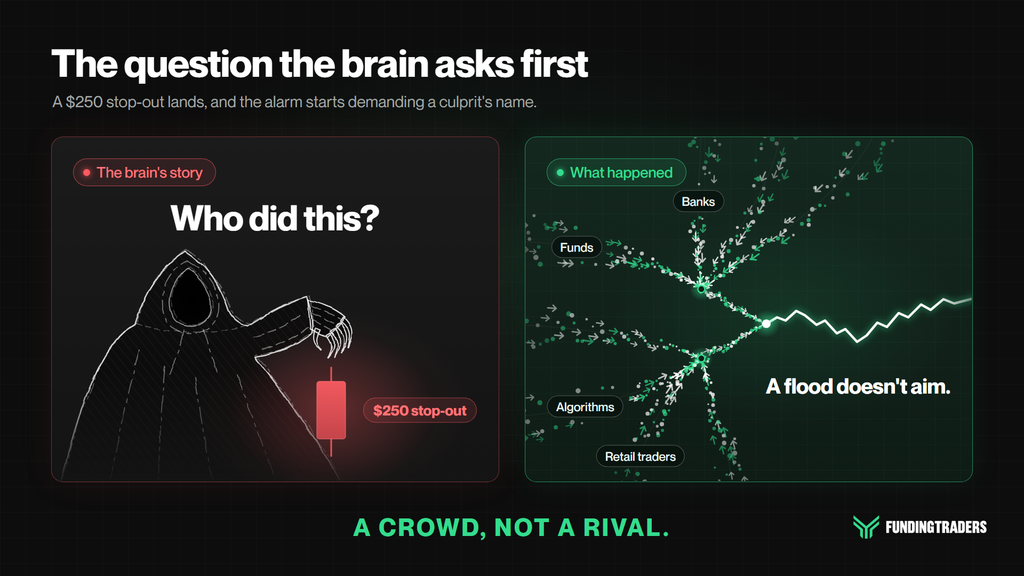
Swap the campfire for a trading platform and the old wiring often can’t tell the difference. A $250 stop-out lands, and the alarm starts demanding a culprit’s name.
There is no culprit to name. The price on your screen comes out of a flood of orders from banks, funds, algorithms and retail traders around the world, and a flood doesn’t aim. Price went one way, your trade sat on the other side, and the stop did its job.
“Nobody” is an answer the brain struggles to use. It tends to sort events into allies and enemies, with no easy slot for variance doing its arithmetic, so the loss gets filed with the enemies. Enemies come with a standing order, old and simple: go after them. That standing order is where revenge trading begins.
The Words You Use After a Loss Give It Away
Hardly anyone announces that price has declared war on them. Personification, crediting something mindless with motives, lives in the half-sentences that slip out after a stop-out, each one casting price as a mind aimed at you.
Familiar lines from the minute after a red trade:
- “It went straight for my stop.”
- “It turned the second I clicked buy.”
- “It dangled a winner, then pulled the rug.”
- “It wants to see me crack.”
- “It slams the door whenever I’m close.”
- “It saves its worst moves for me.”
They all make one claim: the move had a plan. Behind the stop complaint sits an imagined someone with your order ticket in view. The crack line turns the chart into an examiner, grading your nerve before it allows a win. The pulled-rug line pictures a cat letting a mouse scamper a few steps before pouncing again.
A fair caveat: stops do bunch up at obvious levels, and fast moves often trade straight through those pools. That is aggregate order flow reacting to a price level, not anyone singling out your position; our guide to placing a hard stop beyond structure shows how to give your stop that extra room.
Strip the story away and what remains is arithmetic: millions of orders net out every second, and now and then the net lands on the wrong side of your trade.
Here is why the wording matters. Nobody chases a statistic, but almost everyone chases a thief. Once a loss has a culprit attached, a counterpunch or a quick recovery trade starts to look like the reasonable next step, and revenge trading needs nothing more than that. Those little phrases do real work: they set up the next revenge trade.
A Survival Shortcut That Misfires at the Screen
So where does the villain story get its grip in the minute after a stop-out? The usual explanation reaches a long way back.
The brain seems built to assume a someone first and check the evidence later, because the two possible mistakes carried very different prices. Flinch at a stick that looks like a snake and you lose a second. Step on a snake that looks like a stick and you lose a lot more. The jumpy guessers likely left more descendants, and we inherited the jumpiness.
Psychologists call this hyperactive agency detection. It helps explain some everyday spookiness: an old house settling at night can pass for footsteps, and a close cousin of the reflex makes a car’s front grille seem to glare. A related pattern-hunting error, the gambler’s fallacy, persuades people that a coin is owed a tails after five heads in a row, exactly the habit the psychology that separates profitable traders from gamblers works to break.
For a trader, “it came for my stop” sounds like an explanation. “Price tagged the stops under the low by 3 pips, then turned” sounds like an excuse, even though it is the accurate account.
Feeling singled out is a symptom, not a clue.
The sensation is real; a hunter with your name on the list isn’t. Your pattern detector seems to have no setting for “no reason.” Hand it a random outcome and it tends to supply a culprit, usually one with a face.
The Bill Revenge Trading Runs Up
Sitting through variance without letting it bend your size or your plan is a full-time job on its own. Cast price as an opponent, and that job turns into a boxing match with the weather: you swing, and it doesn’t even notice.
With price in the villain’s role, the whole routine gets rewritten:
- Losses register as injuries that demand a response.
- Wins turn into points on a scoreboard against an opponent, and whether you followed the plan stops mattering.
- Revenge trading starts to look like standing up for yourself, which is exactly why it slips past your guard.
- Logging off would protect the account, but mid-fight it looks like throwing in the towel.
- Size keeps doubling, each jump justified as reaching for a bigger stick.
Somewhere in there, the scorecard changes: trades get graded on who won the exchange, and plan and risk drop out of the review. Price keeps printing ticks for millions of people who have no idea you hold a grudge, and the only casualty is your account. Every revenge trade born of that grudge also feeds the overtrading trap.
A Three-Trade Spiral, Step by Step
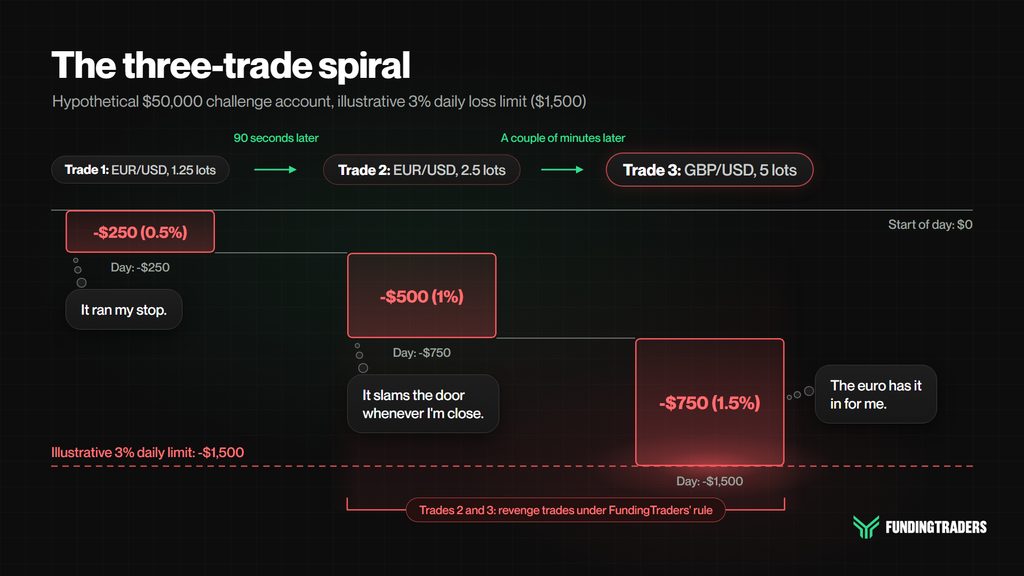
Here is revenge trading in numbers, using a hypothetical example (not a real trade). You are trading a $50,000 challenge account with a 3% daily loss limit, or $1,500 (illustrative; limits vary by product, so check your own account’s rules). On EUR/USD and GBP/USD, one standard lot (1.00 lot) is worth $10 per pip.
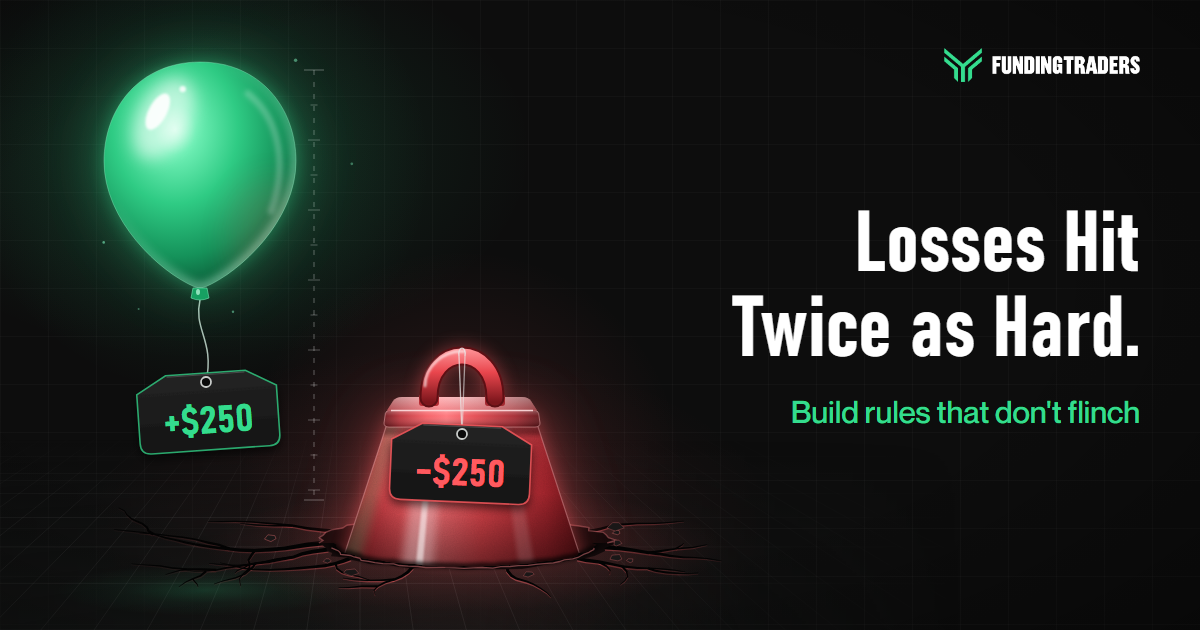
- Trade 1. You buy EUR/USD with 1.25 lots and a 20-pip stop: $250 at risk, 0.5% of the account. Price dips 3 pips through your stop, fills it, then turns back up. Loss: $250. The thought: “It ran my stop.”
- Trade 2, about 90 seconds later. You buy EUR/USD again at double the size, 2.5 lots, with a 20-pip stop: $500 at risk, or 1%. Stopped out. Loss: $500, and you are down $750 on the day. The thought: “It slams the door whenever I’m close.”
- Trade 3, a couple of minutes after that. The thought: “The euro has it in for me.” So you switch to GBP/USD with 5 lots and a 15-pip stop: $750 at risk, or 1.5%. Stopped out. Loss: $750, and you are down $1,500 on the day: 3% of the account, the entire illustrative daily limit.
Look at the sizes: 1.25 lots, then 2.5, then 5, with risk climbing from 0.5% to 1% to 1.5%. That is the bigger-stick logic written in lots. FundingTraders’ rule of thumb is to keep risk per trade idea around 1% of account balance; trade 3 was one and a half times that, a single $750 bet to fill a $750 hole. Fix the size before the session and trade 3 can’t reach 5 lots; our guide to position sizing for prop accounts walks through the math.
Three trades, one grudge, and the full $1,500 of daily room is gone, the same room that passing a prop firm challenge depends on.
FundingTraders has a name for trades 2 and 3. Under the Revenge rule in Toxic Trading Practices, opening a new position within 5 minutes, on any symbol, after a losing trade of 0.5% or more of account size is a revenge trade. The $250 loss is exactly 0.5% of $50,000 and the $500 loss is 1%, so both follow-up entries qualify, the switch to GBP/USD included.
The help center describes re-entering to recover a loss as “a decision made under pressure,” not one made from a plan, and the rule exists to break that loop. On a funded account, trades like these are flagged, but a flag is not a strike on its own: strikes are applied on review, and several flags in one review usually count as one step on FundingTraders’ strike ladder.
On that ladder, the first strike brings a warning and protective controls, the second and third reduce the profit split and deduct part or all of the profit on violating trades at payout, and a fourth discontinues the account. On a challenge account, your evaluation history is reviewed when you reach the profit target; if behavioral violations show up, the funded account can start on a tier of that ladder, with protective controls from day one.

How to Stop Revenge Trading: 4 Habits That Retire the Villain
These four do most of the lifting. None works overnight; the reflex they target has had a lifetime of rehearsal.
Step 1: Log Every Time the Market Gets a Personality
Keep a note open beside your platform for the next five sessions. Whenever “it” is the subject of a sentence about price, said aloud or only thought, copy it in verbatim. Don’t fix anything yet. Just collect.
The tally after session five is your villain count. Each line on it marks a moment when a revenge trade was one click away.
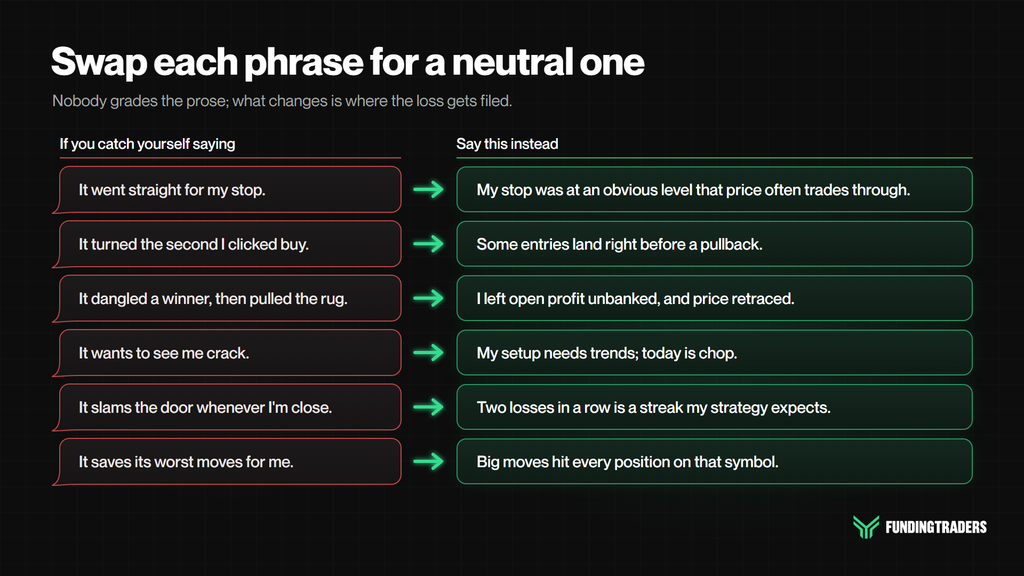
Step 2: Swap Each Phrase for a Neutral One
Then translate the worst offenders in advance:
| If you catch yourself saying | Say this instead |
|---|---|
| “It went straight for my stop.” | “My stop was at an obvious level that price often trades through.” |
| “It turned the second I clicked buy.” | “Some entries land right before a pullback.” |
| “It dangled a winner, then pulled the rug.” | “I left open profit unbanked, and price retraced.” |
| “It wants to see me crack.” | “My setup needs trends; today is chop.” |
| “It slams the door whenever I’m close.” | “Two losses in a row is a streak my strategy expects.” |
| “It saves its worst moves for me.” | “Big moves hit every position on that symbol.” |
For the first week or two, the swaps will sound like someone reading a script. Nobody grades the prose; what changes is where the loss gets filed.
Step 3: Put a Visible Reminder on Your Screen
Write one line on a card and tape it to your monitor: A CROWD, NOT A RIVAL.
Yes, it’s a wellness-poster gimmick. Put it up regardless. Its job is to sit in your line of sight while your pulse is up and a robbery story is forming, exactly when a thought alone tends to lose. It will fail more often than it works, but stop your hand once in ten tries and that one skipped revenge trade can separate a red day from a blown one.
Pair the card with a hard pause that mirrors the Revenge rule above: after any losing trade of 0.5% or more of account size, set a 5-minute timer and open nothing, on any symbol, until it rings. The pause protects your head and the account at once. Decide it before the session, the way set and forget trading locks decisions in while you are calm and then leaves them alone.

Step 4: Rewrite Losing Trades in Plain Words
In each losing journal entry, swap any line that hands the market a motive, like “got hunted again,” for what a camera would have recorded: “EUR/USD dipped 3 pips below my stop, filled the order, then turned higher.” Same trade, no opponent, and the plain version gets more automatic each time.
Funded traders also get a record no mood can rewrite: the Revenge tile in the Clarity Desk reads Clean or shows a count of flagged trades. Check it when you review the week’s journal. A flagged tile does not automatically mean a strike, but it shows which trades came too soon after a loss.
The Myth of Winning It Back
Of all revenge trades, the winning one tells the most convincing story: you marched back in and reclaimed what was taken. Check the fill, not the feeling. That profit came from a second bet with its own stop and its own odds, and it would have paid exactly the same with no earlier loss on the books; nothing was handed back. A theft story feels unfinished without a recovery scene, so your memory stitches the two trades into one tale.
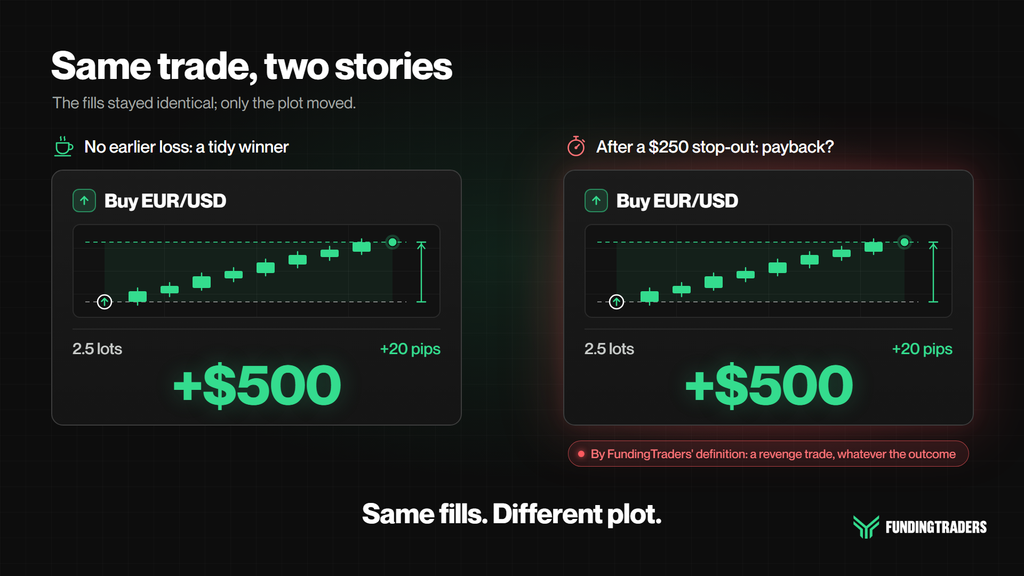
Rewind the spiral and let trade 2 win: EUR/USD runs 20 pips your way on 2.5 lots, a $500 gain, so after trade 1’s $250 loss the day sits at +$250. It feels like payback. In fact it is a new trade at double the size, risking 1% of the account, opened 90 seconds after a 0.5% loss: by FundingTraders’ definition, a revenge trade whatever the outcome.
Run the counterfactual. Delete trade 1 from that morning, and the entry is a tidy 20-pip winner that nobody remembers by lunch. Put the $250 stop-out back in front of it, and the same 20 pips get retold as settling the score. The fills stayed identical; only the plot moved, and nothing on the chart backs that plot up.
The market keeps no ledger with your name on it.
Nobody confiscated anything, so there is nothing to collect. Your loss and your win came from the same spread of outcomes; asking which you deserved is asking dice for an opinion. The real damage from a winning revenge trade is the lesson it teaches: that the next one will work too.
On a funded account, that winner can be flagged too. Under Risk Management at FundingTraders, strikes come on review, and from a second strike part or all of the profit on violating trades is deducted at payout. So the pause comes first; our guide to managing risk on a funded account covers the rest of the routine.
Frequently Asked Questions
What is revenge trading?
Revenge trading is opening a new position soon after a loss, sometimes at a bigger size, to win back what was lost rather than because your plan calls for it. It often grows out of treating the market as an opponent, so the next entry feels like hitting back.
Why does the market feel personal after a loss?
One common explanation is hyperactive agency detection, the brain’s habit of assuming a mind sits behind events. The market is the combined activity of countless participants and orders, and no one in that crowd is singling out your position.
Does FundingTraders have a rule on revenge trading?
Yes. After a losing trade of 0.5% or more of account size, opening a new position within 5 minutes on any symbol counts as a revenge trade. On a challenge account, evaluation history is reviewed at the profit target, and violations can mean the funded account starts on a tier of the strike ladder with protective controls. On funded accounts, a flag is not a strike on its own, and from a second strike part or all of the profit on violating trades is deducted at payout. More in our overview of prop firm trading rules.
How long should you wait after a loss before trading again?
At minimum, wait out FundingTraders’ 5-minute window after any losing trade of 0.5% or more of account size, and take longer if your pulse is still up. Re-enter only when the next setup matches your written plan, at normal size, so it is a planned trade rather than a revenge trade.
Is stop hunting real?
Stop orders do cluster at obvious levels, such as round numbers and recent highs and lows, and price often trades through those pools in fast moves. That is aggregate order flow, not someone singling out your position. A stop beyond structure, with a buffer, is harder for routine wicks to reach.
No Villain, No Vendetta
Every loss arrives with a choice of story. In one, a villain saw your stop, pocketed your $250 and owes you. In the other, price moved, the stop did its job and your plan is still intact. Only the second story leaves no reason for a revenge trade.
Refile each loss as a routine cost of the strategy, not a personal injury, and revenge trading has nothing left to hold. Four habits get you there: catch the “it” in your sentences, swap in neutral words, keep the card and the 5-minute pause in front of you, and rewrite your journal in plain terms. Retire the villain and let your checklist pick the next entry.

Disclaimer: Trading involves significant risk and is not suitable for every investor. Past performance is not indicative of future results. The information provided in this article is for educational and informational purposes only and should not be considered financial, investment, or trading advice. All account rules, payout structures, profit splits, and promotional offers described in this article are subject to change at the discretion of FundingTraders. Promo codes may expire or be modified without prior notice. Always trade responsibly and only risk what you can afford to lose.